A Garden for the Fallen, A Bridge to the Past: Yerevan’s 2026 Memorial and the Duality of Armenian Memory
| Photo by: IRCNA | Taken in Victory Park on May 6th |
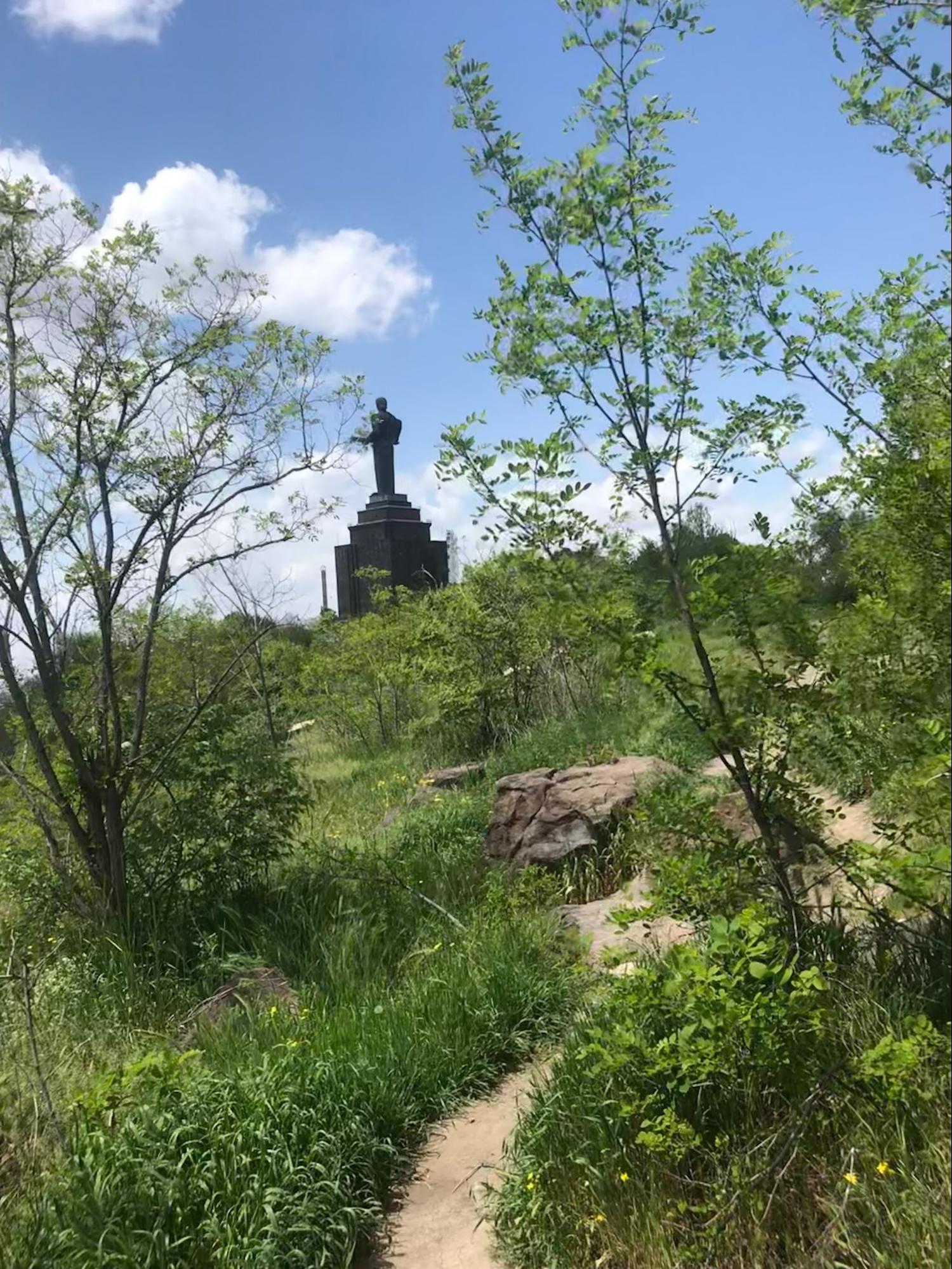
YEREVAN — The wind that sweeps across Victory Park (Haghtanak) on a spring afternoon carries the scent of damp earth and fresh leaves. On May 6, 2026, just two days after Armenian Prime Minister Nikol Pashinyan had concluded the 8th European Political Community (EPC) Summit—a gathering of nearly fifty European leaders that signaled Armenia’s most decisive pivot toward the West since independence—a different kind of diplomatic ritual unfolded in the same city.
Just weeks after the EU pledged a €2.5 billion “connectivity partnership” for projects bypassing Russia, a small, poignant ceremony was underway in the shadow of the Mother Armenia monument, a towering copper statue that has stood watch over the capital’s war dead for generations.
The Russian ambassador to Armenia, Sergey Kopyrkin, was not in Brussels or Strasbourg. He was in Victory Park, sleeves rolled up, planting a sapling. He was there for the international “Garden of Memory” (Сад памяти) campaign, a living monument to the 27 million Soviet citizens who perished in the Great Patriotic War (1941–1945). The event is in its sixth year, a quiet but potent counterbalance to the high-level summits and geopolitical realignments that have recently defined Armenian diplomacy. It is a testament to the fact that while a country’s political alliances may shift, the memory of a shared, world-altering sacrifice often proves immovable.
The 2026 Ceremony: Saplings and Statesmen
| Photo by: IRCNA | Taken on Alley of Border Glory on May 6th |
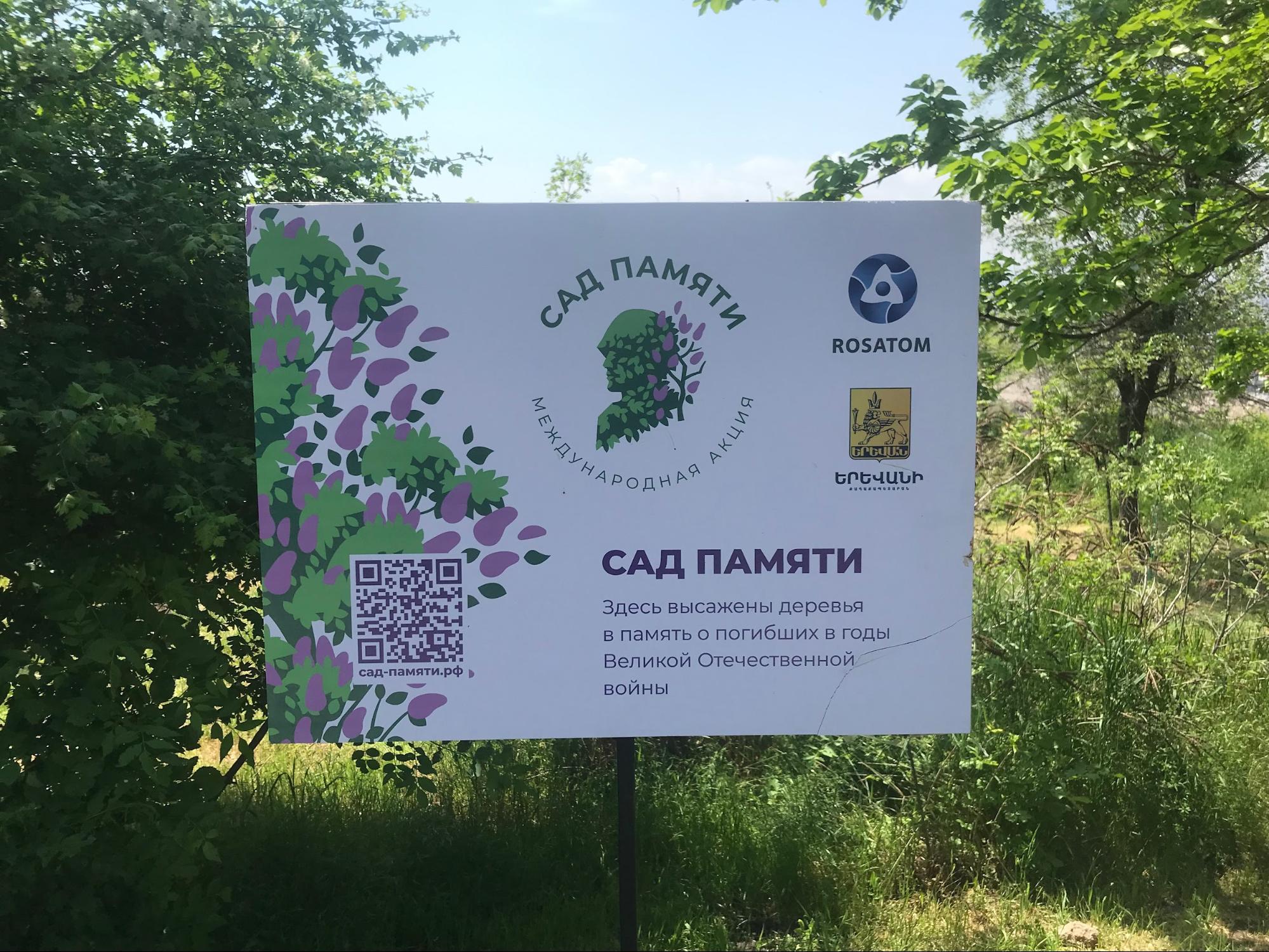
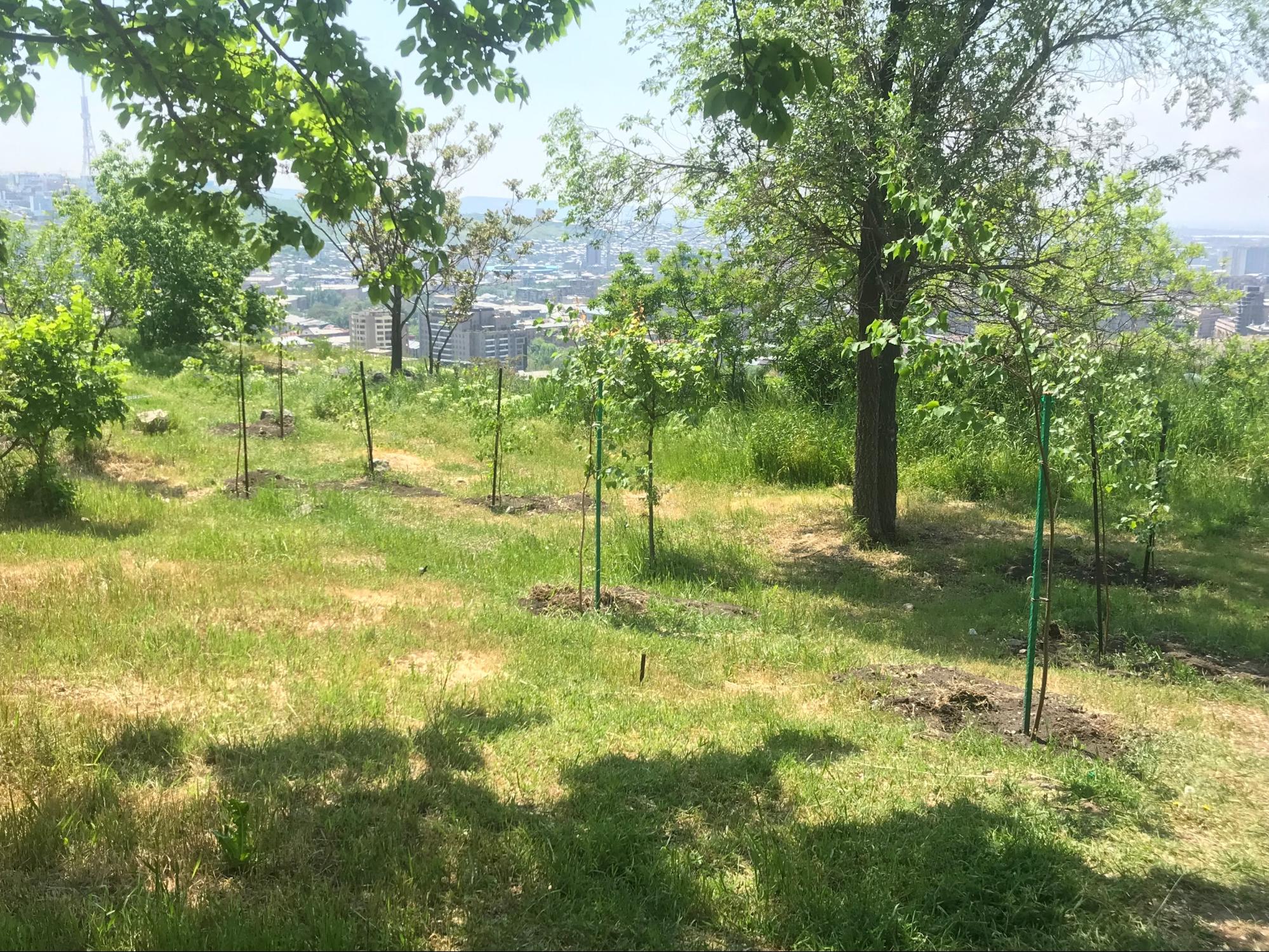
The 2026 “Garden of Memory” planting took place on the Alley of Border Glory within Victory Park. Ambassador Kopyrkin, joined by representatives from the Yerevan City Hall, the Embassy of Belarus, veterans of the Great Patriotic War, and youth activists, participated in the planting of new trees. The event was supported by the Foundation for the Development and Support of Russian-Armenian Humanitarian Initiatives “Heritage and Progress.”
In his opening remarks, Kopyrkin framed the act not as political but as profoundly human. “The trees planted as part of this initiative symbolize the Soviet people who lost their lives during the Great Patriotic War,” he told the assembled crowd. “It is crucial to preserve this memory and pass it down to the younger generation”.
For some, these words might seem at odds with the backdrop of Armenia’s rapidly warming relations with the European Union. Just days earlier, EU Commission President Ursula von der Leyen had, during a bilateral summit, declared that the bloc’s partnership with Armenia had been “elevated to a new level”. French President Emmanuel Macron had called Europe “the most natural partner for Armenia at this moment in time”.
Yet, the presence of Kopyrkin and the Belarusian ambassador at a memorial event just hours after the heads of 47 European nations had left Yerevan speaks to a persistent and essential truth of the South Caucasus: geopolitical realignment does not erase shared history.
The Ground Beneath the Politics: Why Victory Park?
| Photo by: IRCNA | Taken near The Eternal Flame on May 9th |
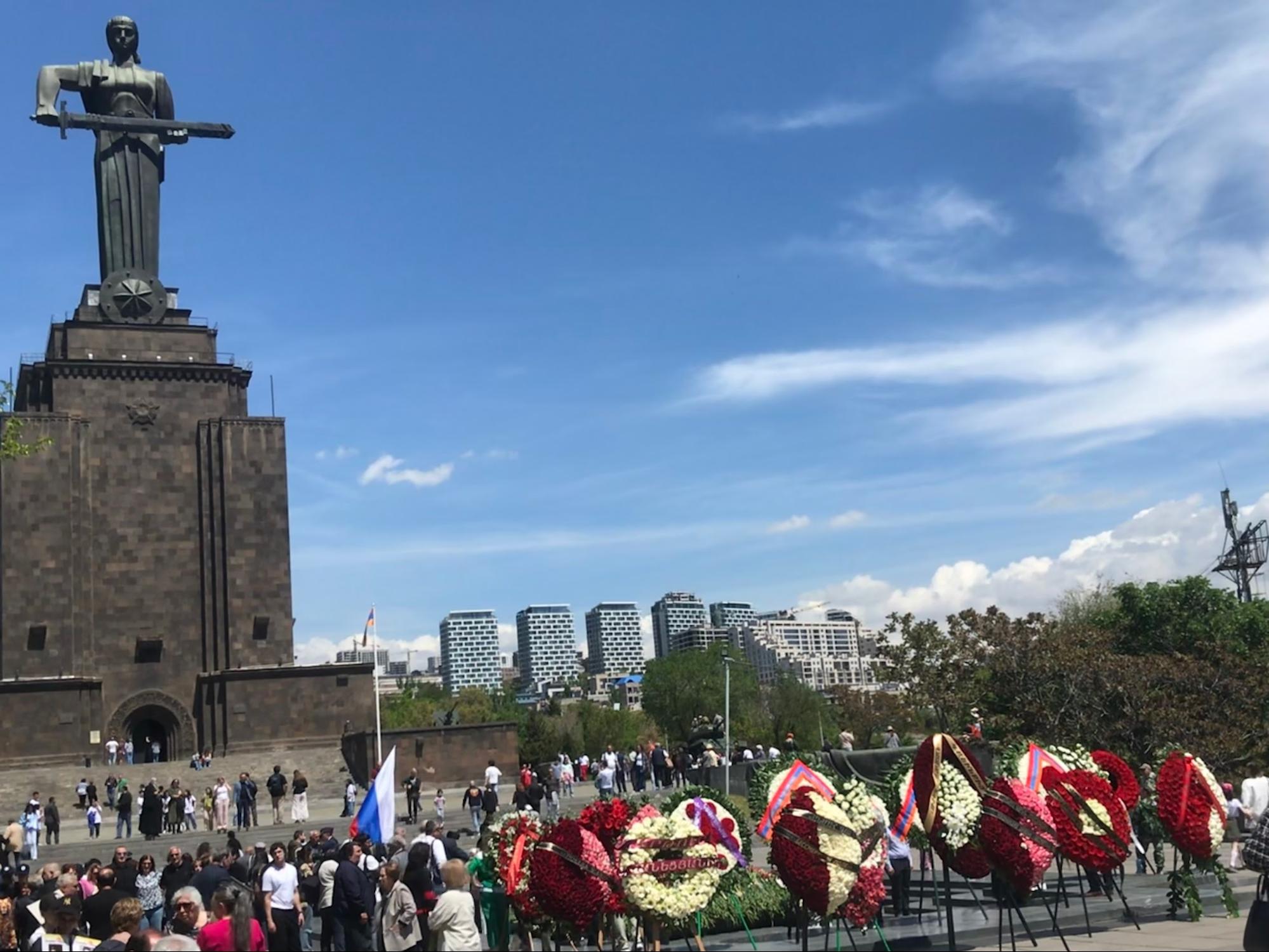
The choice of location is the story’s silent, powerful narrator. Victory Park was renamed in the aftermath of the Great Patriotic War to commemorate the Soviet victory over Nazi Germany. It is no generic green space; it is Armenia’s primary secular shrine to those who fell in that conflict. The park is crowned by the statue of Mother Armenia, a 54-meter tall monument that contains a museum dedicated to the heroism of Armenian soldiers in the war. At its base, the eternal flame burns by the Tomb of the Unknown Soldier.
For decades, Armenians have marked May 9th, Victory Day, at this site, not as a foreign ritual but as a distinctly Armenian one. Over 500,000 Armenians served in the Soviet armed forces during the war, and nearly half of them perished. In Armenian families, the memory is not abstract; it is genealogical. The “Garden of Memory” campaign, therefore, is not an import. It is an extension of a local, sacred tradition of honoring the fallen, woven into the very geography of the capital.
Voices from the Soil: Locals on Memory and Meaning
| Photo by: IRCNA | Tree saplings planted in Border Glory Alley on May 6th |
To understand the ceremony beyond the diplomatic soundbites, one must walk through the park and listen. The campaign’s resonance is felt most acutely by those whose family histories are buried in the soil of Eastern Europe.
Speaking at a similar ceremony in 2023, 99-year-old veteran Rozalia Abgaryan, who had volunteered for the front at the age of 18 and was wounded in action, looked at the young saplings with a mix of exhaustion and hope. “We will make Yerevan more beautiful,” she said as she planted a tree. “These trees give off so much oxygen. So we will use that oxygen and build a new, worthy life.” Her words, recorded at the time, reflect a view common among her generation: the act of planting is a final gift to a future they helped secure.
Armenian academic and head of the “Heritage and Progress” Foundation, Armais Kamalov, who was instrumental in organizing the Yerevan plantings, described the act of remembrance as a form of genetic inheritance. “This mission is the genetic code of memory, which passes from generation to generation,” Kamalov said during a prior year’s ceremony. “After all, in every family there were those who did not return from the war”. For Kamalov, the act is not for a “checkmark” but one that “comes from the heart,” a moral imperative rather than a political one.
Such sentiments are not confined to the older generation. Youth volunteers, including students from Yerevan’s universities and members of the “Victory Volunteers” movement, have been a mainstay of the annual plantings. For them, the act is one of conscious, tangible connection to a past they only know through stories. As one student activist, whose grandfather fought at Stalingrad, put it in a 2024 interview with a local news outlet, “We study European integration in our political science classes, but we plant trees for our ancestors who died so we could have a country to integrate with anyone.”
These voices reveal that for many Yerevan residents, the “Garden of Memory” occupies a separate, non-conflictual space from the EPC summit and the EU association agreements. One can advocate for visa liberalization with Brussels in the morning and honor the Red Army’s role in defeating fascism in the afternoon. The two identities, for many, are not opposed; they are simply layers of a complex national story.
The Weight of History: A Shared Soviet Sacrifice
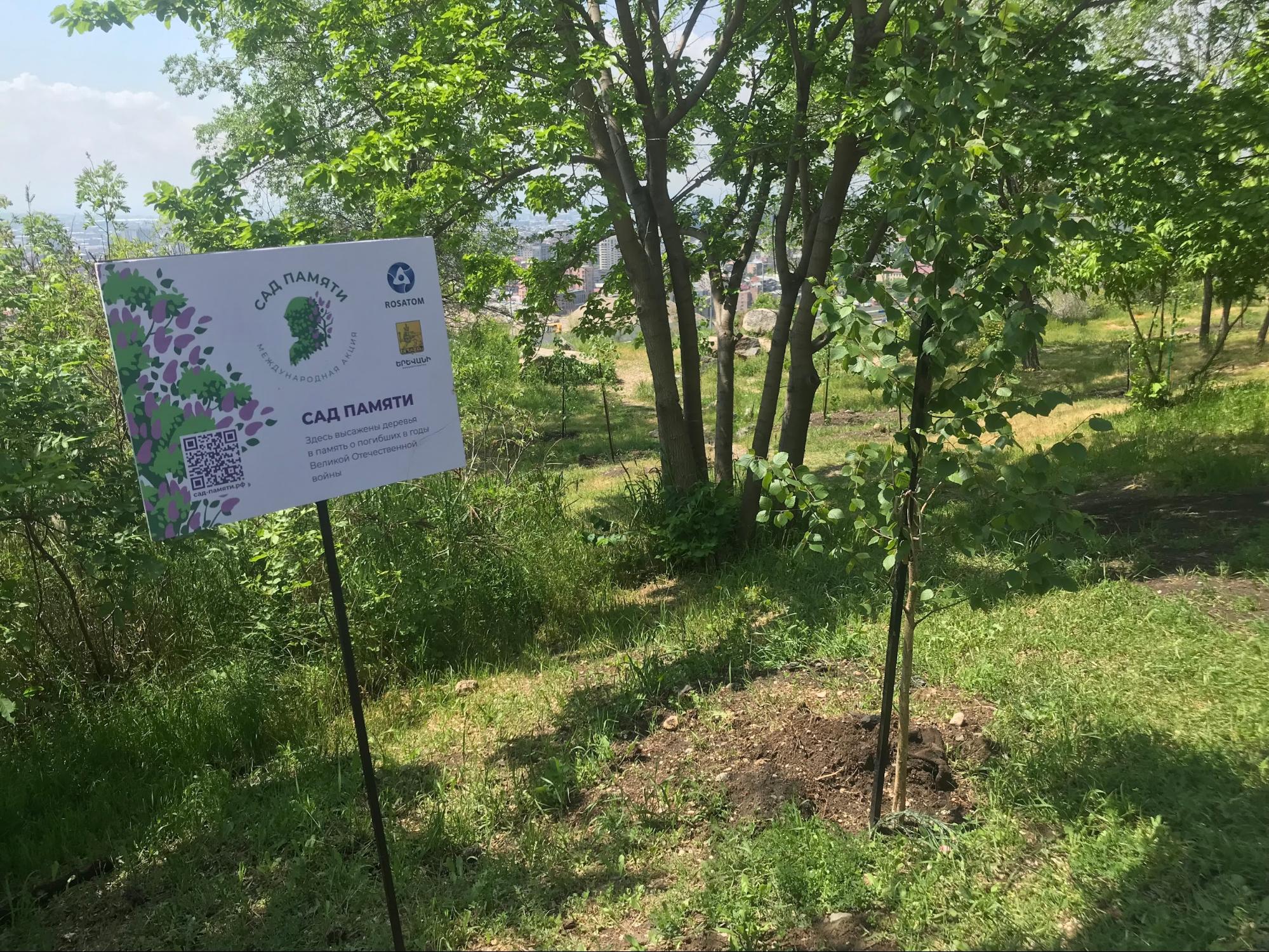
| Photo by: IRCNA | Taken in Victory Park on May 6th |
The “Garden of Memory” campaign is the brainchild of the all-Russian public movement “Victory Volunteers” and the Victory Commanders Memorial Foundation, launched in 2020 under the direct support of Russian President Vladimir Putin. Its goal is staggering in scale: to plant 27 million trees across Russia and the world, one for every documented life lost in the war.
For Armenia, the “Garden” is a particularly resonant symbol. The country’s contribution to the Soviet war effort was immense. General Hayk Bzhishkyan commanded the Red Army in the Russian Civil War; Marshal Ivan Bagramyan was one of the most brilliant Soviet commanders of WWII; and the 89th Tamanyan Division, formed in Armenia, was among the first to enter Berlin. The shared sacrifice created a bond that transcended ideology. It was a bond of blood, not of political systems.
This is the heart of the matter that is often lost in news reports about “Russian influence” or “Westward pivots.” The memory of the war is not a tool of Russian foreign policy for many Armenians; it is a family heirloom. When Ambassador Kopyrkin speaks of the “younger generation” inheriting this memory, he is tapping into a well of feeling that is authentically Armenian.
From the EPC Summit to the Garden: Armenia’s Two Faces
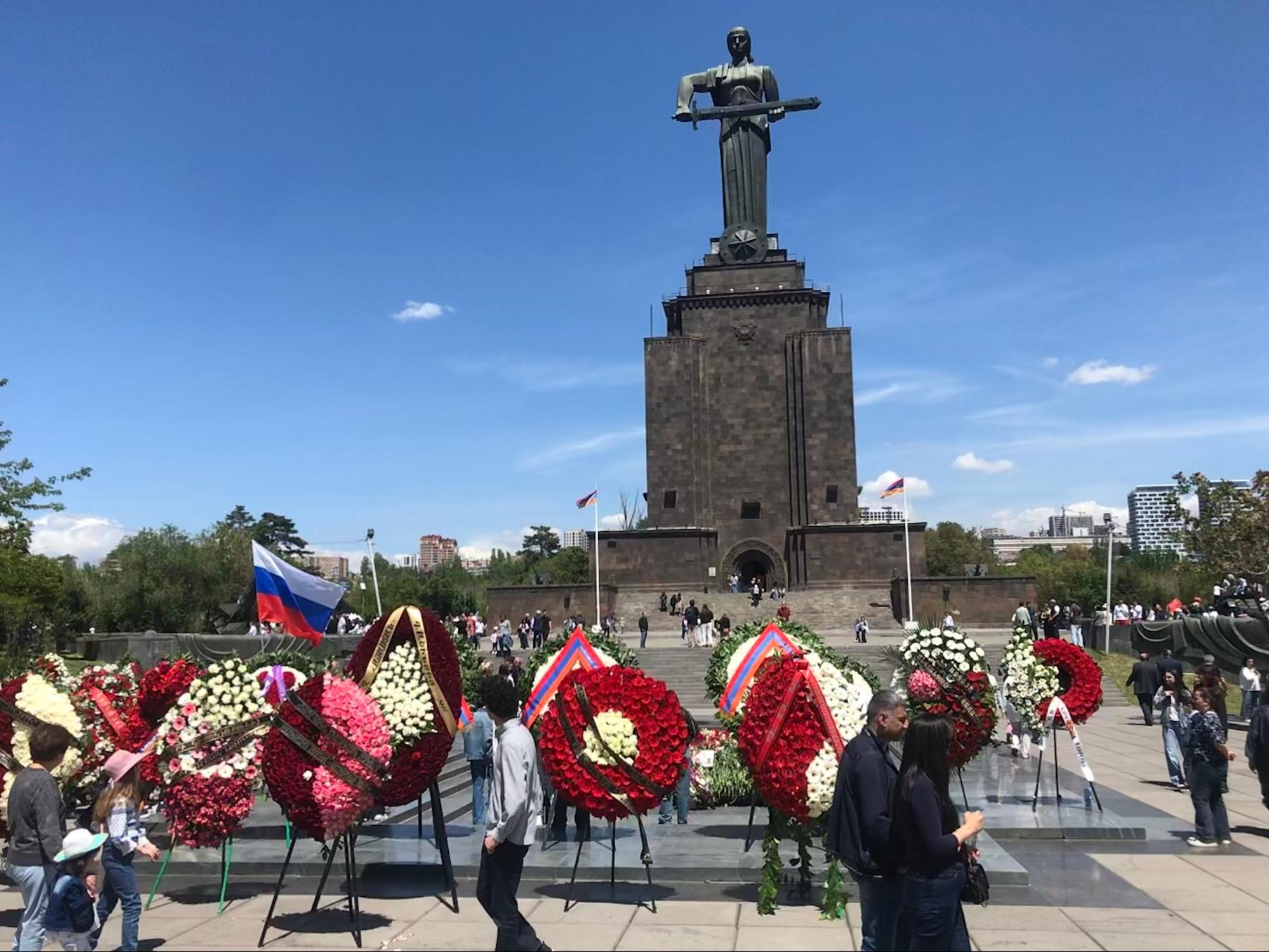
| Photo by: IRCNA | Taken at the Tomb of the Unknown Soldier on May 9th |
The juxtaposition of the May 4th EPC Summit and the May 6th “Garden of Memory” is a perfect, unscripted encapsulation of modern Armenia’s geopolitical balancing act.
The EPC Summit was a landmark event. Prime Minister Pashinyan called it “historic for Armenia” and successfully used the platform to discuss a peace agenda with Azerbaijan and Turkey. The outcome was a significant strengthening of ties with Europe, including a new connectivity partnership and momentum toward visa liberalization. It was a clear signal that Armenia is seeking to diversify its security and economic architecture away from an exclusive reliance on Russia.
However, to see the pivot as a complete rejection of the past is to misread the depth of cultural memory. The “Garden of Memory” event two days later was a reminder that while governments can change treaties and trade routes, they cannot rewrite the personal histories of millions of citizens. For the veterans present, some nearly a century old, the Russian ambassador is not merely the representative of a geopolitical rival; he is the representative of a nation whose soldiers stood with their grandfathers in the mud of Kursk and the rubble of Berlin.
Roots for the Future
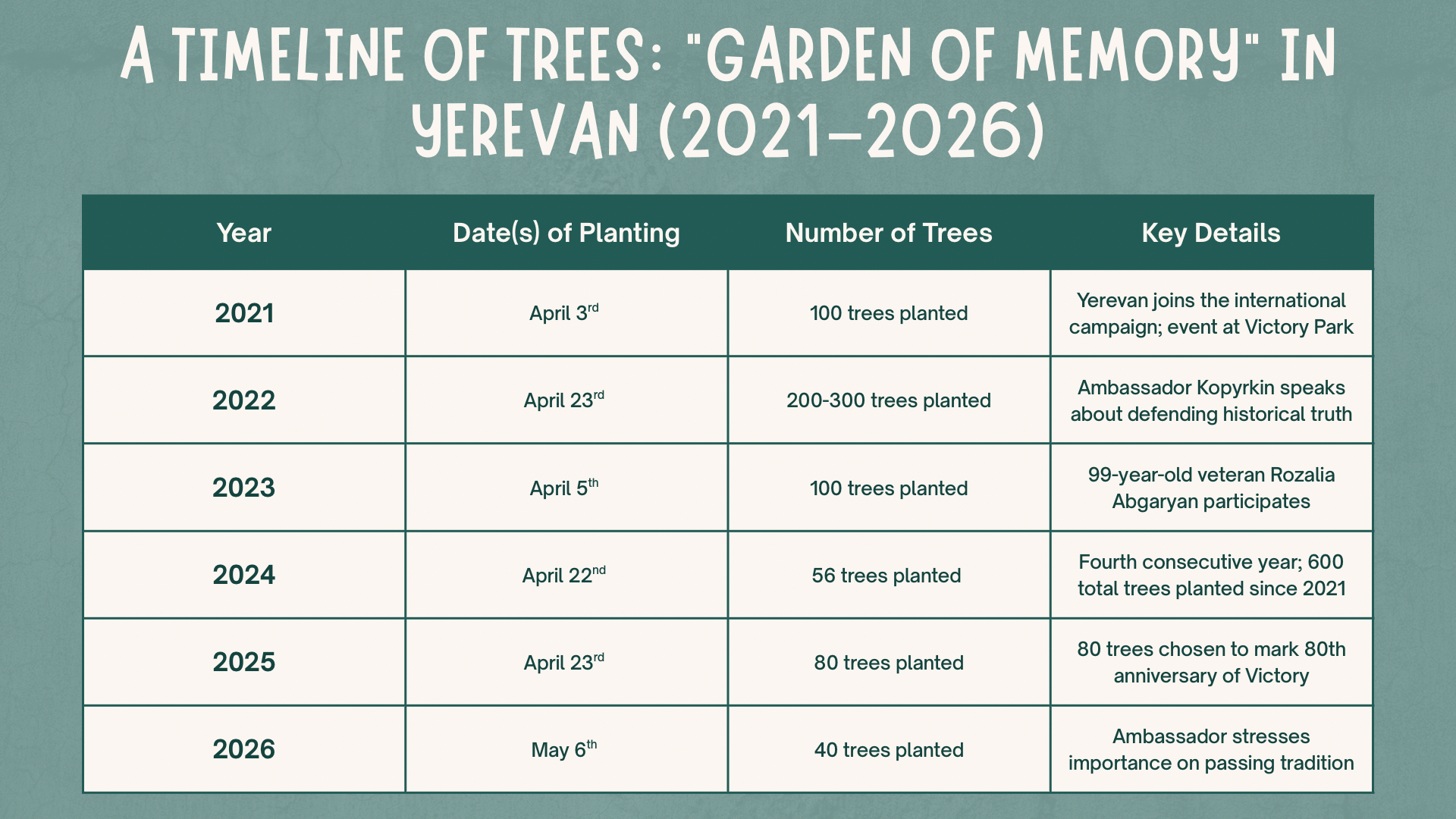
Timeline Chart provided by IRCNA
As the volunteers in Yerevan’s Victory Park finished their work on May 6, they stood back to admire a row of young chestnut and birch trees. The new plants joined hundreds of others planted since the first Armenian “Garden of Memory” in 2021. They are small now, unassuming. But they are a living, growing monument. Unlike the statues and plaques that surround them, these trees will not remain unchanged.
The “Garden of Memory” is, at its core, an act of stubborn hope. It is a belief that the dead deserve not just a marble slab, but a future—a growing, oxygen-giving, life-affirming future.
For IRCNA’s readers, the lesson of Yerevan’s 2026 plantings is this: Geopolitics is a story of the present and the future, but memory is a claim on the past. And as long as trees are planted in the shadow of Mother Armenia for the fallen of the Great Patriotic War, that past will be a living presence, no matter which flags fly over government buildings.
Sources and Attribution
This article was built from public reports, official statements, and original analysis based on the principles of transparent journalism. All direct quotations are attributed. The primary sources for the 2026 event information are:
- ArmInfo: For details on the May 6, 2026 “Garden of Memory” event, including the direct quotes from Ambassador Sergey Kopyrkin.
- NovostiNK: For additional context on the “Garden of Memory” campaign in Yerevan, including the remarks of Ambassador Kopyrkin and Armais Kamalov.
- Public Radio of Armenia / Euractiv: For analysis and direct quotes concerning the 8th European Political Community Summit and the EU-Armenia bilateral summit.
- Wikipedia / HyurService: For historical and descriptive context regarding Victory Park and the Mother Armenia monument.
- RIA Novosti and Sputnik Armenia: For contextual analysis regarding Russian-Armenian historical ties and contemporary relations.
This article is an original piece of journalism, Written By: Mikael Yamiosei - specifically for IRCNA. The analysis, framing, and any reported opinions from unnamed sources are the original work of the author and were not derived from any other published article.
Comments