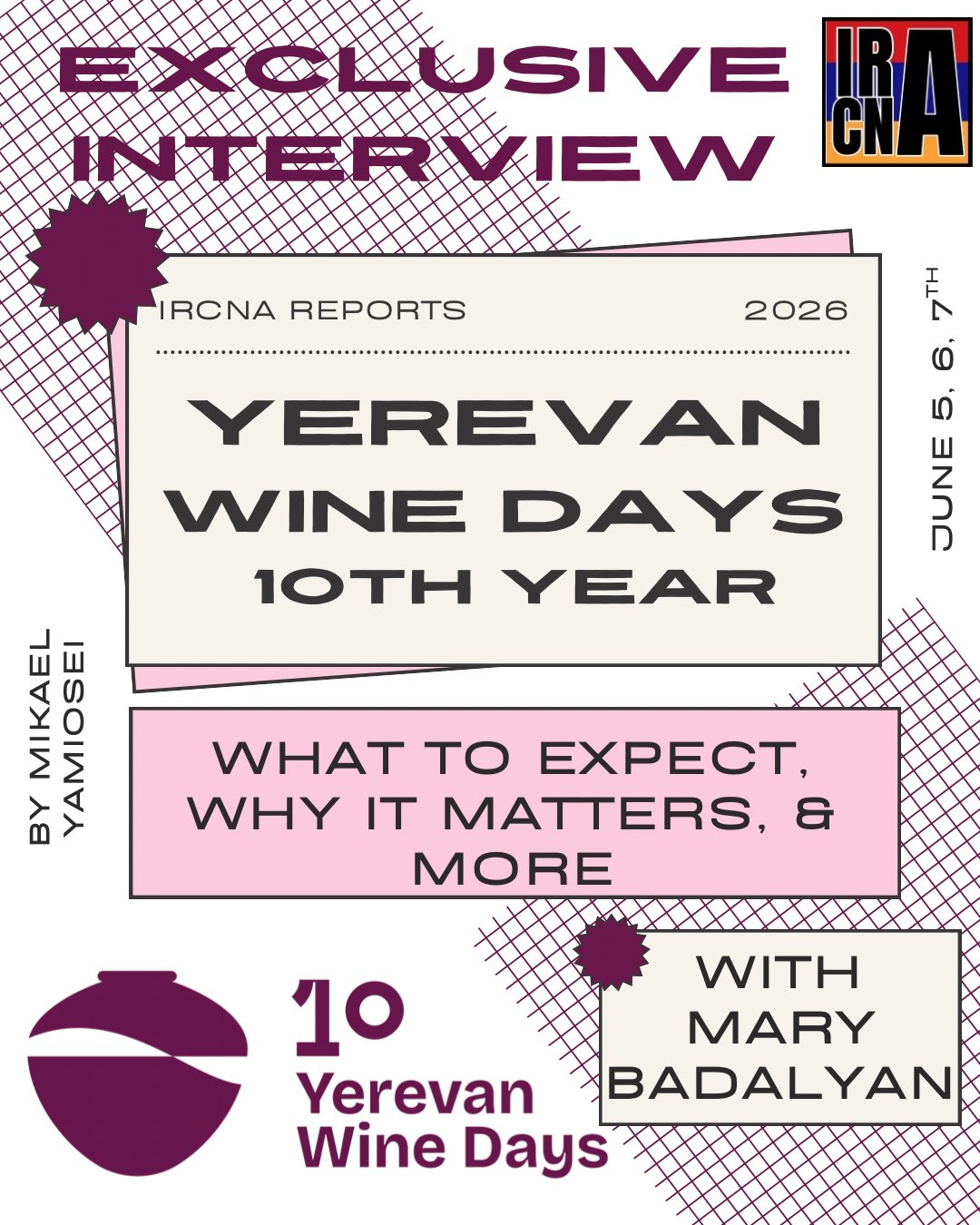
YEREVAN — Every June, the city of Yerevan undergoes a quiet transformation. The usual rhythms of Saryan, Moskovyan, and Tumanyan streets give way to the clinking of glasses, the murmur of Armenian and a dozen other languages, and the unmistakable warmth of a city that has opened its doors to the world. This is Yerevan Wine Days (YWD) — a festival that began in 2017 with 25 winemakers on a single street and has since grown into one of the most distinctive urban wine and tourism experiences in the region.
In 2026, from June 5 to 7, the festival celebrates its 10th anniversary. To understand what makes this edition historic—and why it matters for Armenia culturally, economically, and socially—we spoke exclusively with Mary Badalyan, co‑founder and CEO of EventToura, the agency behind Yerevan Wine Days. Below, we combine that interview with open‑source research to present a complete picture: what to expect, where it happens, why the 6,100‑year‑old Areni‑1 winery shaped this year’s messaging, and why international tourists should book their flights now.
Part I: What to Expect at Yerevan Wine Days 2026
For first‑time visitors and returning fans alike, the 10th edition is not merely a larger version of previous years. It is a deliberate, emotional statement about community, continuity, and the maturation of Armenia’s wine ecosystem.
A Festival Built on a Decade of Trust
“Yerevan Wine Days 2026 is a very special edition for us, as it marks the festival’s 10th anniversary,” Badalyan told EVENTS. “This anniversary edition is dedicated to the people of Yerevan Wine Days — the winemakers, visitors, restaurants, partners, volunteers, artists, and communities who have turned it into one of the region’s most distinctive urban wine and tourism experiences.”
The festival remains free to enter. Tastings are accessed via the Wine Enjoyment Package (14,000 AMD / ≈$36), which includes a commemorative 10th‑anniversary branded glass, 12 tasting coupons, a raffle ticket, and a festival map. The package price increased slightly from 12,000 AMD in 2025, reflecting the expanded programming.
New for 2026: The Winemakers’ Parade
The single most significant addition is a ceremonial parade on June 5 at 6:30 p.m. along Tumanyan Street. For the first time, participating winemakers will be presented not as individual labels but as communities — representatives of wine‑producing territories, family traditions, and the human geography of Armenian viticulture.
“This is not simply a festive performance,” Badalyan explained. “It is a symbolic and visual statement. We are making Armenian wine communities visible in the heart of Yerevan.”
The Wines: Over 1,000 Varieties from 100+ Producers
Visitors can expect nearly the full spectrum of modern Armenian winemaking in one walkable urban space. Approximately 100 Armenian wineries will pour 1,000+ wine varieties, including:
- Indigenous grapes: Areni (the flagship red), Voskehat (“golden grape”), Kangun, Haghtanak, Khndoghni/Sireni.
- Styles: Crisp whites, expressive rosés, elegant reds, sparkling wines, blends, experimental wines, and wines made in traditional karases (large clay amphorae buried for fermentation).
- Regions represented: Vayots Dzor, Aragatsotn, Armavir, Ararat Valley, Tavush, and other emerging areas.
Badalyan offered specific advice for international guests:
“My advice is not to taste only the already familiar names. One of the most valuable things they can do is scan the festival map — which is available on the wine price lists at each winemaker’s stand — and look for the smaller or lesser‑known wineries. Very often, the most memorable discoveries happen there, when you meet a family producer, hear their story, and understand how much personal care, memory, and love stand behind the wine.”
Beyond Wine: Gastronomy, Masterclasses, Culture
While 2026 will not feature the full Yerevan Gastronomic Days format (due to physical space limitations at the current festival area), a Wine and Gastronomic Business Talks zone will operate each day, hosting 4‑5 local and international speakers discussing wine culture, gastronomy, tourism, and food systems. From 2027 onward, as the festival aims to move its main platform to Republic Square, the gastronomic component will return and expand.
Other activities include:
- Masterclasses and pairing sessions led by winemakers and sommeliers.
- Live music across multiple genres.
- Art installations, live painting, and graffiti workshops.
- National costume (taraz) experiences and craft workshops.
“Yerevan Wine Days is not only about wine,” Badalyan said. “Wine is the anchor, but the larger value is the experience it creates around Armenia. When visitors discover an indigenous grape variety, meet a small family producer, hear the story behind the wine, and experience it in the middle of Yerevan, they are not only tasting a product — they are entering the country through its culture, people, and place.”
Practical Details at a Glance
| Detail | Information |
|---|---|
| Dates | June 5–7, 2026 |
| Hours | 4:00 p.m. – 10:30 p.m. daily |
| Location | Saryan, Moskovyan, and Tumanyan streets, central Yerevan |
| Entry | Free |
| Tasting package | Wine Enjoyment Package: 14,000 AMD (glass + 12 tasting coupons + raffle ticket + map) |
| Nearest airport | Zvartnots International Airport (EVN) |
| Official website | yerewinedays.am |
Note: Armenia will hold parliamentary elections on June 7. Organizers have announced that the festival may conclude a few hours earlier on that day.
Part II: What Is Yerevan Wine Days? (And Why It Matters)
To call Yerevan Wine Days a “wine festival” is accurate but insufficient. Badalyan describes it as a strategic city platform that connects wine, gastronomy, tourism, culture, business, and national identity.
From a Local Initiative to National Infrastructure
The festival began in 2017 with 20‑40 wine participants and a few thousand visitors. By 2025, it attracted 180,000‑200,000 visitors over three days, with a substantial share coming from outside Armenia. The growth is not accidental.
Key statistics (2024–2026):
| Year | Visitors | International share | Wineries | Direct sales (3 days) |
|---|---|---|---|---|
| 2024 | 120,000 | 30% (≈36,000) | 87 | $2.5 million |
| 2025 | 180,000+ | 40% (≈72,000) | ≈100 | Not yet disclosed |
| 2026 | \~200,000 expected | Not specified | 100 | Not yet disclosed |
Sources: 2024 data from WineBusiness.com, Armenpress, Wikipedia, and Armenian Weekly. 2025 data from Liz‑Palmer.com and Armenian Discovery.
In 2024, the festival generated $2.5 million in direct sales for 250 participating businesses (wineries, restaurants, food producers, tour operators). This figure does not include the multiplier effect: hotel stays, transport, post‑festival winery visits, restaurant bookings, and long‑term export visibility.
“Yerevan Wine Days shows that festivals can become economic infrastructure,” Badalyan said. “They can create demand, formalize business activity, bring visitors into the city, generate tax‑paying sales, and connect several sectors — wine, gastronomy, tourism, hospitality, transport, media, and small business — into one economic rhythm.”
Cultural Representation: Heritage as Living Experience
Armenia is home to the world’s oldest known winery — the 6,100‑year‑old Areni‑1 cave complex — but Badalyan is careful not to let that fact stand alone.
“Armenia has one of the oldest wine cultures in the world, but heritage alone does not create movement. People do not travel simply because a country has a beautiful past. They travel when that past is translated into a present‑day experience they can taste, feel, share, and remember. This is what Yerevan Wine Days has done: it has taken Armenia’s wine heritage out of museums, books, and professional circles and placed it in the middle of the city, where people can experience it directly.”
Socially, the festival has changed how locals and visitors experience Yerevan. It creates a shared public space where winemakers, chefs, artists, tourists, and Yerevantsi meet as equals. People come for the wine, but they return for the atmosphere — the feeling that the city is open, alive, and international.
The Areni‑1 Winery: A 6,100‑Year‑Old Strategic Asset
The Areni‑1 winery (discovered in 2007, announced in 2011) is the oldest known wine production facility in the world. It includes a grape press, fermentation vats, storage jars, and drinking vessels — proof that winemaking in Armenia predates the Bronze Age.
Badalyan acknowledges its importance but frames it as the beginning, not the end, of Armenia’s wine story.
“Our goal has been different: to show that Armenian winemaking is not only ancient, but continuous. We see Areni‑1 as the beginning of the conversation, not the whole story. The international audience is increasingly looking for authenticity, and Armenia has something stronger than a single symbolic fact: it has a long and layered wine history that can be traced through material culture, indigenous varieties, living production, and contemporary winemaking.”
This philosophy directly influenced the festival’s branding in 2024 and 2025. Working with archaeologists, EventToura created accurate visual reconstructions of historically significant karases from different periods of Armenian wine history — including a 10th‑century BCE karas from Dvin that became part of the festival’s logo. A special booklet documenting these karases (discovery locations, historical context, centuries) was also issued.
“We wanted to move the conversation beyond the idea that wine happened here once in deep antiquity and then somehow ‘reappeared’ in modern times. Through this work, we aimed to show a much more powerful truth: that Armenia’s wine culture has depth, continuity, and civilizational presence across centuries.”
Part III: Where It Is — and How to Experience It Fully
Yerevan Wine Days 2026 takes place in the Kentron (central) district of Yerevan, Armenia’s capital. The festival footprint covers:
- Saryan Street (the historic heart of the festival)
- Moskovyan Street
- Tumanyan Street
All three are pedestrian‑friendly, tree‑lined streets within walking distance of Republic Square, the Cascade, and most major hotels.
For International Tourists: Why It’s Worth the Trip
Armenia’s total wine production fell 23.3% in 2025 to 7.7 million liters, but festival attendance and economic impact have continued to grow. For international wine travelers, YWD offers several unique advantages:
- Concentrated discovery. Nearly the entire Armenian wine industry — from boutique family estates to export‑oriented wineries — is present in one walkable area. No car, no long drives.
- Indigenous grapes. Varieties like Areni, Voskehat, and Khndoghni are almost unknown outside Armenia. They offer genuine novelty for even the most seasoned tasters.
- Strategic timing. The festival is preceded by the Concours Mondial de Bruxelles (May 21–23, 2026), one of the world’s most prestigious wine competitions, which will be held in Yerevan for the first time. This creates a two‑week “wine window” in the country.
- Direct access to producers. At YWD, you can ask the winemaker about soil, elevation, and blending decisions. That connection is rare at larger European festivals.
- Affordability. Armenia remains one of the most cost‑effective wine travel destinations in Europe/Asia, with reasonable flights, accommodations, and dining.
“Yerevan Wine Days is one of the few places where visitors can experience almost the full picture of modern Armenian winemaking in one walkable urban space,” Badalyan said. “A guest may taste a wine during the festival and later visit the winery, recommend it abroad, order it in a restaurant, or help create new visibility for Armenian wine. That is how a wine festival becomes more than tasting; it becomes part of the country’s tourism and business ecosystem.”
Part IV: The Future — Gastronomy, Exports, and International Platforms
The 10th anniversary is not an endpoint but a launchpad. Badalyan outlined several strategic directions for the next five years:
- Expansion to Republic Square (2027 or 2028) to accommodate growing demand and restore the full Yerevan Gastronomic Days format, which in previous years involved Michelin‑starred and Bocuse d’Or‑level chefs from 16 countries.
- B2B and expo formats to facilitate wine exports, distributor meetings, and tour operator partnerships.
- International festival exchange: Hosting representatives of other wine festivals in Yerevan while ensuring Armenian wine is represented abroad.
- Multilingual accessibility: The festival’s on‑site and social media communication has been multilingual since 2017, a conscious decision to welcome international visitors.
“From next year, we plan to host representatives of other international wine festivals in a special zone, creating opportunities for exchange, visibility, and cooperation. The idea is not only to invite international festivals to Armenia, but also to ensure that Yerevan Wine Days and Armenian wine are represented at their respective festivals abroad. Armenian wine tourism should not remain only a local success; it should enter international circulation.”
Sources
This article is based on an exclusive interview with Mary Badalyan (co‑founder and CEO, EventToura) conducted on May 27, 2026, combined with open‑source research from the following verified sources:
- Official Yerevan Wine Days website: yerewinedays.am (accessed May 2026)
- Armenpress news agency: articles dated May 25, 2026 and May 29, 2025
- WineBusiness.com: press releases for 2024, 2025, 2026 editions
- Arminfo news agency: report dated April 10, 2026
- Liz‑Palmer.com: “Yerevan Wine Days at 10” (April 28, 2026)
- Armenian Discovery: “Yerevan Wine Month 2026 – The Ultimate Guide”
- Wikipedia: “Винные дни Еревана” (Russian), “Yerevan Wine Days” (English), “Areni‑1 winery”
- Armenian Weekly: “Eight years of Yerevan Wine Days” (June 25, 2024)
- EnjoyArmenia.am: “Yerevan Wine Days 2026: Guide”
- Courrier.am (French): report dated April 15, 2026
Final Word: A Living Armenian Experience
Yerevan Wine Days 2026 is not a museum piece. It is not a nostalgic exercise. It is a festival that has, over ten years, proven that a small country with an ancient wine culture can build a contemporary, export‑oriented, and deeply welcoming tourism experience around what grows in its soil and what is poured from its bottles.
As Mary Badalyan put it in her closing thought:
“Yerevan Wine Days is not only about wine. Wine is the anchor, but the larger value is the experience it creates around Armenia. When visitors discover an indigenous grape variety, meet a small family producer, hear the story behind the wine, and experience it in the middle of Yerevan, they are not only tasting a product — they are entering the country through its culture, people, and place. That is when wine becomes part of tourism demand.”
For travelers, oenophiles, and curious minds alike, June 5–7, 2026 is the time to be in Yerevan. Bring a glass, an open palate, and a willingness to discover a wine culture that has been waiting 6,100 years to welcome you properly.
EVENTS is a publication of IRCNA. For more information, visit malhelel.github.io.
Comments