Revision Notice – June 15, 2026: This Article has been corrected following feedback from Alexandrea Winery. The 2025 Reserve blend is mostly Khndoghni (not Cabernet Sauvignon); the future winery will simulate gravity‑flow techniques; a transcribed word “curve” has been corrected to “cuvée”; and Jeff Ritchey’s experience is clarified as a 31‑year veteran winemaker from California. IRCNA thanks Jeff Ritchey and the Alexandrea team for holding us accountable.
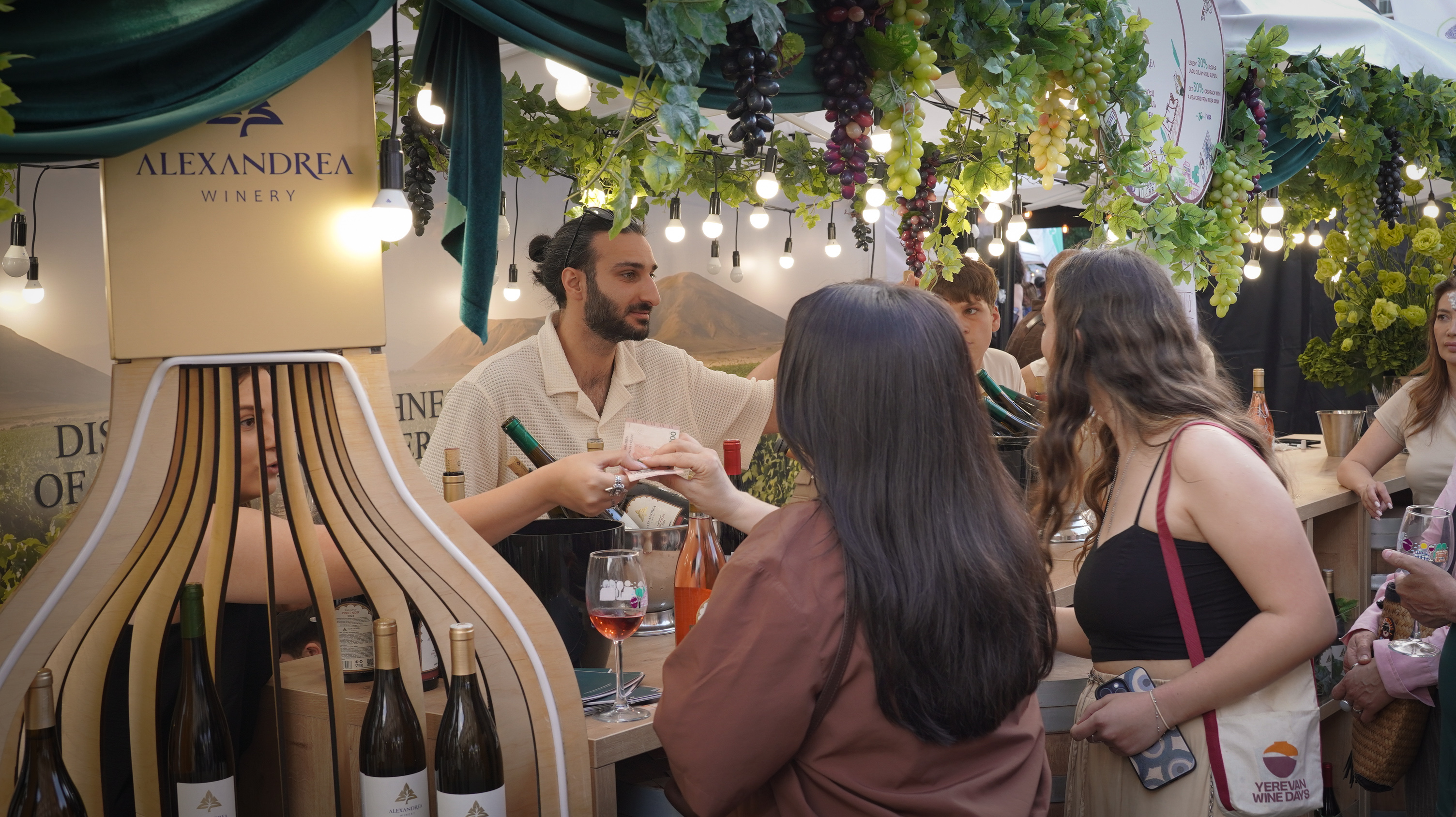
The Marriage between Wine and Gastronomy | Modern Traditional Balance
Alexandrea Winery
A ground-level investigation into high-altitude viticulture, plot-specific blending, and the private investment reshaping Armenian wine — reported from the Wine and Gastronomic Business Talks, Yerevan Wine Days 2026 (June 5–7, Saryan Street).
By Mikael Yamiosei | IRCNA
YEREVAN — The soil in Proshyan does not give way easily. It extends more than seventy centimeters deep — a dense, unbroken layer of volcanic stone and sharp gravel that resisted every tool brought against it. When Alexandrea Winery acquired the land in 2017, the question was not whether grapes would grow. The question was whether the earth could be broken at all.
The answer required Japanese rock-cutting machinery, manual labor, and a five-year experiment in high-altitude viticulture that would eventually produce Armenia's first commercial Pinot Noir and a Riesling sharp enough to stand beside its German inspirations.
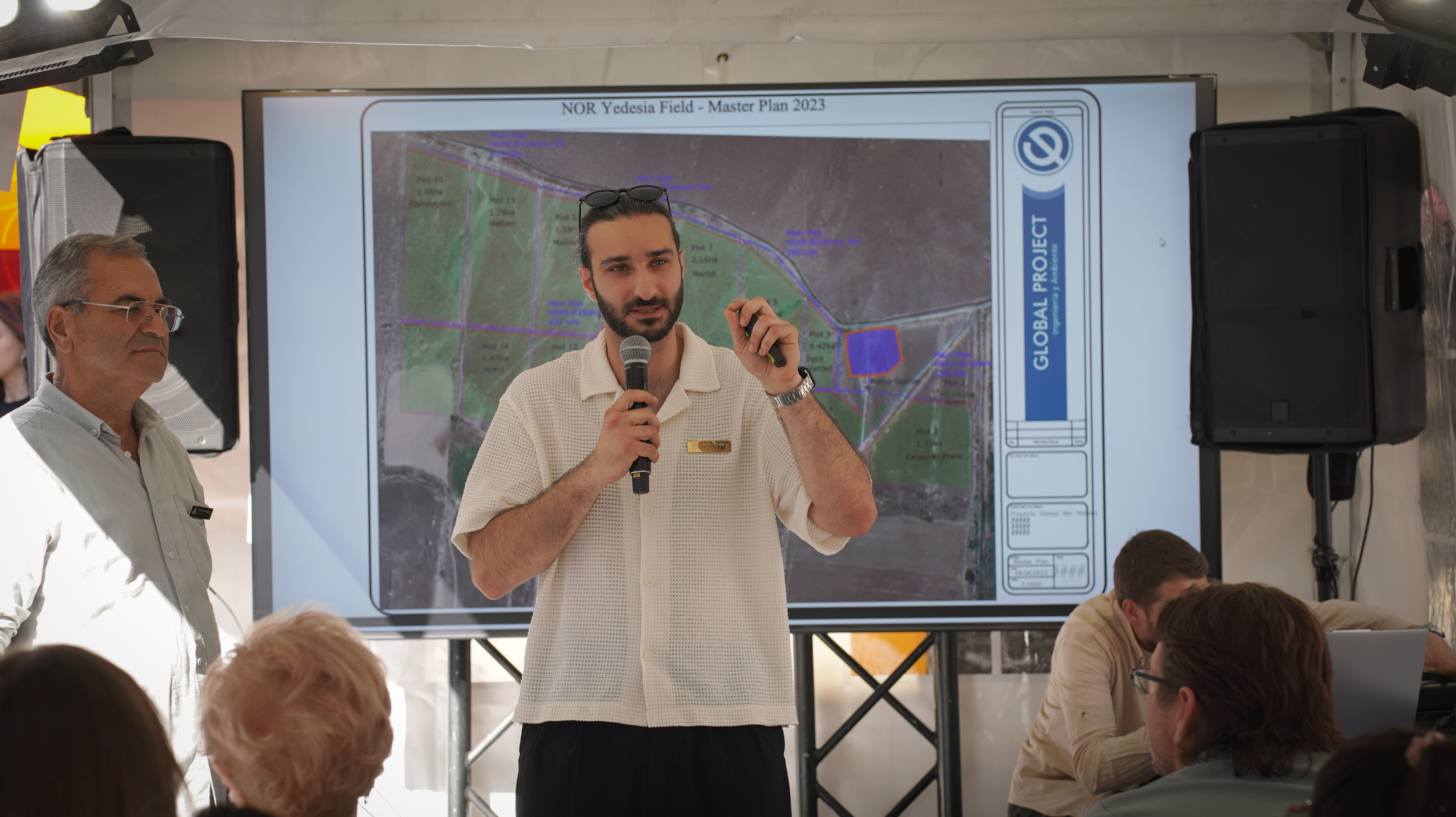
On June 5, 2026, the 10th anniversary of Yerevan Wine Days, Alexandrea Winery presented its full portfolio to an audience gathered on Saryan Street. The presentation was delivered by Karen Gabrielyan (winery representative) and Jeff Ritchey (Chief Winemaker), with Alex providing English translation for Karen. What followed was the most technically detailed winemaker's briefing of the entire festival — a rare public disclosure of soil composition, plot-specific blending, and the logistical realities of building a wine economy from volcanic rubble.
This is the story of that briefing, told through floor transcripts, correspondence, and firsthand tasting notes. It is the first of three pillars examining how private investment, not state funding, is stabilizing Armenia's emergence as a wine and gastronomic hub.
I. The Winemaker's Journey: From California to the Caucasus
Jeff Ritchey has been making wine professionally for 31 years, most of that time in California's long, mild valleys. On June 5, 2026 — the opening day of the festival — he marked his ninth year to the day since his first visit to Armenia.
The path to Alexandrea Winery was indirect. Ritchey met founder Adam Kablanian (an Armenian-American entrepreneur) through a family connection. Kablanian tasted Ritchey's wines and said, "Someday I'm going to make you my winemaker." Ritchey's internal response, he told the audience: Whatever.
Then Ritchey emailed Kablanian a National Geographic article about the Areni-1 cave, where archaeologists had discovered the oldest evidence of winemaking. "No wonder you like wine so much," Ritchey wrote. "It's in your blood."
Kablanian replied that he was planning to hike past the cave that summer. Ritchey asked to come along. That trip was nine years ago.
In 2021, in the middle of the COVID pandemic, Kablanian called. "I have grapes coming in. I need you to make wine." Ritchey agreed. The first vintage was harvested that year.
"I get to do the fun stuff," Ritchey told the Saryan Street audience. "I get to taste wine with you."
But his actual job, he explained, is more patient: walking the vineyards, sampling the soil, tasting grapes directly from the vine. "You can't just have a Cabernet Sauvignon and say, 'Make this a Bordeaux.' You have to listen to what the grapes say."
II. Three Terroirs, Two Altitudes, One Philosophy
Alexandrea Winery manages approximately 70 hectares across three distinct vineyard sites. According to correspondence from Nvard, the winery's communications representative, the locations were chosen for their specific microclimates and soil compositions.
| Vineyard | Region | Altitude | Primary Varieties | Soil Character |
|---|---|---|---|---|
| Proshyan | Kotayk | 1,315m | Chardonnay, Riesling, Pinot Noir, Muscat, Areni, Voskehat | Volcanic, stony gravel extending 70+ cm deep |
| Nor Yedesia | Aragatsotn | 1,125m | Syrah, Sireni, Areni, Cabernet Sauvignon, Cabernet Franc, Malbec, Petit Verdot, Merlot | Volcanic, closer to Aragats and Ararat mountains |
| Vayots Dzor | Vayots Dzor | 1,250m | Areni, Voskehat | Rocky, historic wine-growing soils |
During the presentation, Karen Gabrielyan emphasized the importance of altitude selection. "You cannot plant in 2,000 or 2,500 meters of altitude — it will not grow," he said. Proshyan's elevation, slightly above 1,300 meters, provides "the best bioclimatic conditions to grow and to gain the best quality possible."
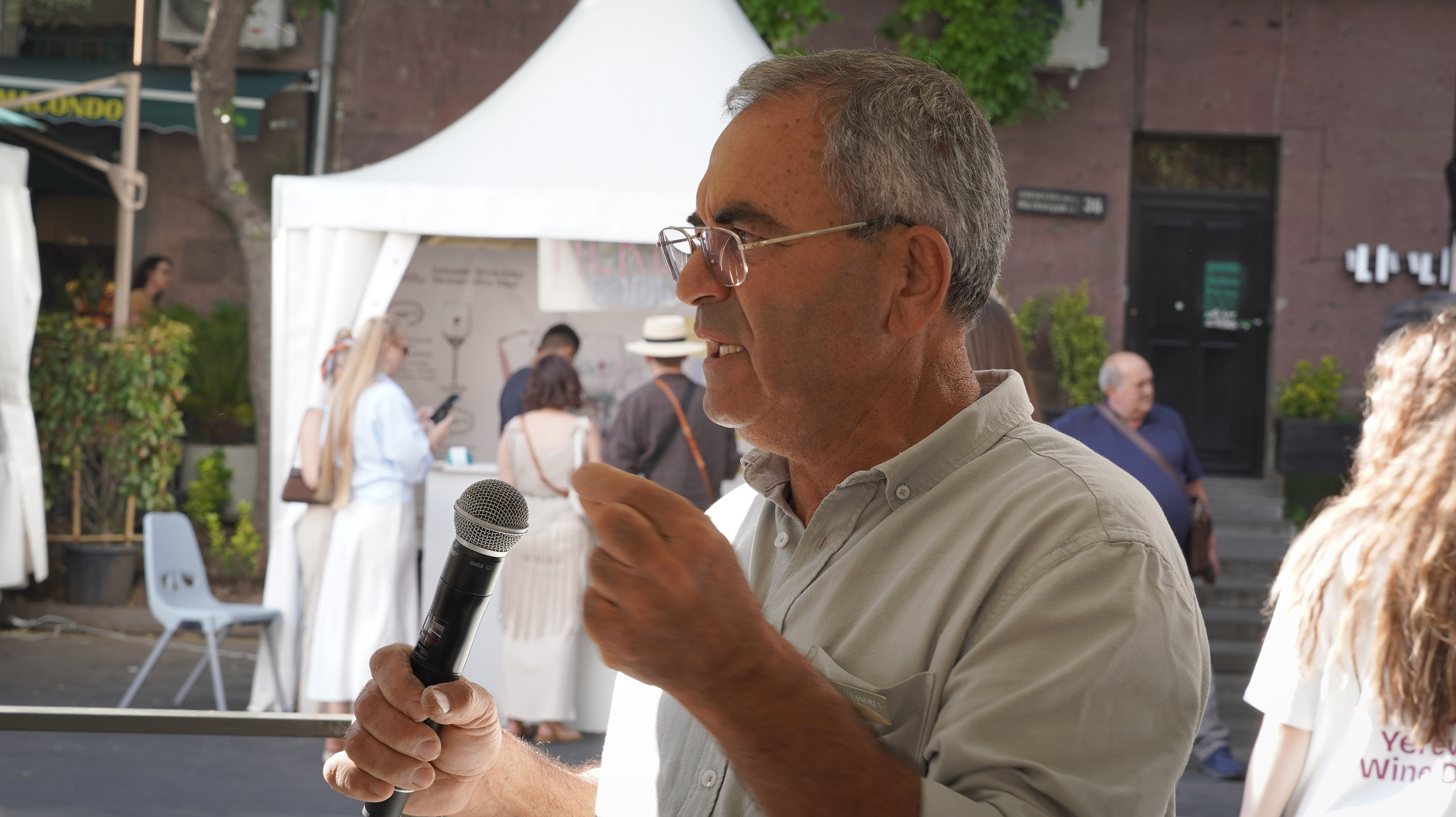
The sun exposure across both Proshyan and Nor Yedesia is southwest — a critical factor. "It gives one of the best sunny days" during the vegetative year, Karen explained, creating perfect conditions for Pinot Noir. Alexandrea is the first winery in Armenia to produce wine from Pinot Noir.
Jeff Ritchey elaborated on the temperature differential between the two main vineyards. "Proshyan's at about 1,300 meters. Nor Yedesia is 1,100 meters," he said. "There'll be up to five degrees Celsius difference in temperature between the two in the middle of the day. It's much cooler in Proshyan, and that's why Riesling, Chardonnay — all the cooler weather Burgundian varietals — work better there. In Nor Yedesia, it's warmer, not as windy, so the red varietals, the Bordeaux varietals, work better there."
The core philosophy uniting these distinct terroirs, Karen stated, is "balancing innovation and traditions."
III. Breaking the Rock: The Manual Genesis of Proshyan
The Proshyan vineyard was Alexandrea's first. In 2019, the winery planted its initial small trial of Chardonnay. The soil was so dense with stone and gravel that conventional methods failed.
"Literally impossible to cut without a Japanese very cool technique which is like cutting the rock," Karen told the audience. The method required specialized machinery to fracture the volcanic stone, followed by individual hand-planting of each vine.
The soil profile at Proshyan extends more than 70 centimeters deep — a solid matrix of gravel and rock with little organic matter. In 2020, the winery installed automated drip-irrigation systems and anti-hail netting, essential protections for delicate continental varieties in a region prone to unpredictable Caucasian weather.
"From the beginning, he was skeptical about accepting working in Alexandrea Winery or not," Karen said, referring to an unnamed colleague. "But since the day when he saw what kind of job has been done over there — what kind of job Alexandrea Winery is doing for their wines — he fell in love. We all fell in love with Alexandrea because the job and the experience that we are having here is enormous."
The vineyards, Karen concluded, were created "from nothing to an integrated style of viticulture. Everything is planned, everything is planted."
IV. The Goldilocks Chardonnay: Five Years of Elevation Study
One of Alexandrea's most methodical experiments involved the Chardonnay blocks planted across the sloping terrain of Proshyan. Over five years, Ritchey and his team fermented grapes from different elevations separately, tracking the results.
"What we started doing is fermenting the different elevations of Chardonnay so that we can see what the differences are," Ritchey said. "After five years, we figured out where the best grapes come from. It turns out they're the one that's right in the middle."
He drew a parallel to Burgundy's Côte d'Or. "The highest stuff isn't the best, the lowest stuff isn't the best — the stuff in the middle is."
This discovery shaped Alexandrea's Chardonnay program. The winery now produces two expressions: a tank-fermented Chardonnay designed to emphasize fruit and terroir, and a barrel-fermented Reserve with greater stylistic intensity.
"When I stopped by Burgundy last year," Ritchey said, "in southern Burgundy they do tank ferments — it's all about the terroir, all about the fruit. So when we blended the 2024 Chardonnay, we have the Reserve, which is the stylistic one, but we also have the regular Chardonnay that was mostly tank fermented. It really emphasizes the terroir and the fruit and shows the potential that Armenia has to grow grapes and make wine."
V. The Pinot Noir Triad: Skeleton, Flesh, and Humidness
The most technically sophisticated disclosure of the presentation concerned Alexandrea's Pinot Noir — the first commercial Pinot Noir produced in Armenia. The wine is sourced from three distinct blocks within the Proshyan vineyard, designated Plots 11, 12, and 13. Each block produces grapes with radically different characteristics.
Plot 13 (northwest, isolated from the other blocks) yields dense, dark fruit with thick skins. Ritchey described it as "the skeleton of the wine" — the structural framework that provides tannic architecture and aging potential.
Plot 12 (corner of the field, steeper slope with maximum sun exposure) produces grapes with higher sugar ripeness and pronounced berry flavors. This is "the flesh" — the fruit-forward volume that gives the wine its mid-palate richness.
Plot 11 (right flank, shaded under-slope) contributes earthiness — the organic, forest-floor character that Ritchey called "the humidness."
The 2024 vintage was the first harvest from these plots. "I didn't know what we were going to get," Ritchey admitted. "It turns out that Plot 13 has all the structure. Plot 12 — more exposed to the sun, steeper hill — you get a lot more ripeness, the fruit and the berries. Plot 11 provides the earthiness, the humidness, the forest floor. It all just came together very beautifully."
The Pinot Noir was aged for ten months in barrel, with 25% new French oak. "You get some of the vanilla, some of the spice, all that pure fruit, some of the earthiness they call forest floor or sous-bois," Ritchey said. "For the first vintage off a vineyard, it's pretty remarkable. You've probably heard that when vineyards are planted, it takes seven or eight years before they start to normalize. The first, second, third crops aren't necessarily the greatest. But this is the first crop off the volumes, and it's remarkable. We're really excited about the potential for Pinot Noir."
During the presentation, I tasted the 2024 Pinot Noir. Swirling the glass released a sweet aroma of grapes and floral tones. The acidity was subtle and pleasant — on a subjective scale of 1 to 5 (with 5 being bitterly acidic), it measured a 2. Floral and grape tones lingered on the tongue, finishing with an earthy, forest-floor aftertaste.
VI. The Riesling: Germany in Armenian Soil
The Riesling program at Alexandrea has a personal origin. Adam Kablanian worked as a CEO of a company in Germany for five years and fell in love with German Riesling. When he saw the Proshyan property, he believed the site could support the variety. Ritchey was skeptical.
"I'll have to admit, I was a little skeptical," Ritchey said. "But you're tasting it, and I think it's pretty darn good."
Ritchey described the wine's profile: "You get a lot of stone fruit, citrus, lime, even a little tropical, hints of the petroleum that you can get with Riesling from Germany. There's good acidity, good structure. It pairs very well with food."
My tasting notes, recorded on-site: the Riesling was quite balanced — sharp with a sudden acidic but floral taste to begin with. As it lingered on the palate, subtle hints of citric and floral flavors coated the tongue, leaving a pleasant aftertaste. Swirling the glass released sour and floral scents, alongside the classic nascent petroleum signature of aged German Rieslings.
"I'm still learning that vineyard," Ritchey said. "It's been five years, and I'm still learning every year. One of the things with winemaking that's challenging is you get one chance a year. When you decide to pick, that's it. You can't take the cluster back to the vine and ask for more time."
VII. The Balance Philosophy: Listening to the Wine
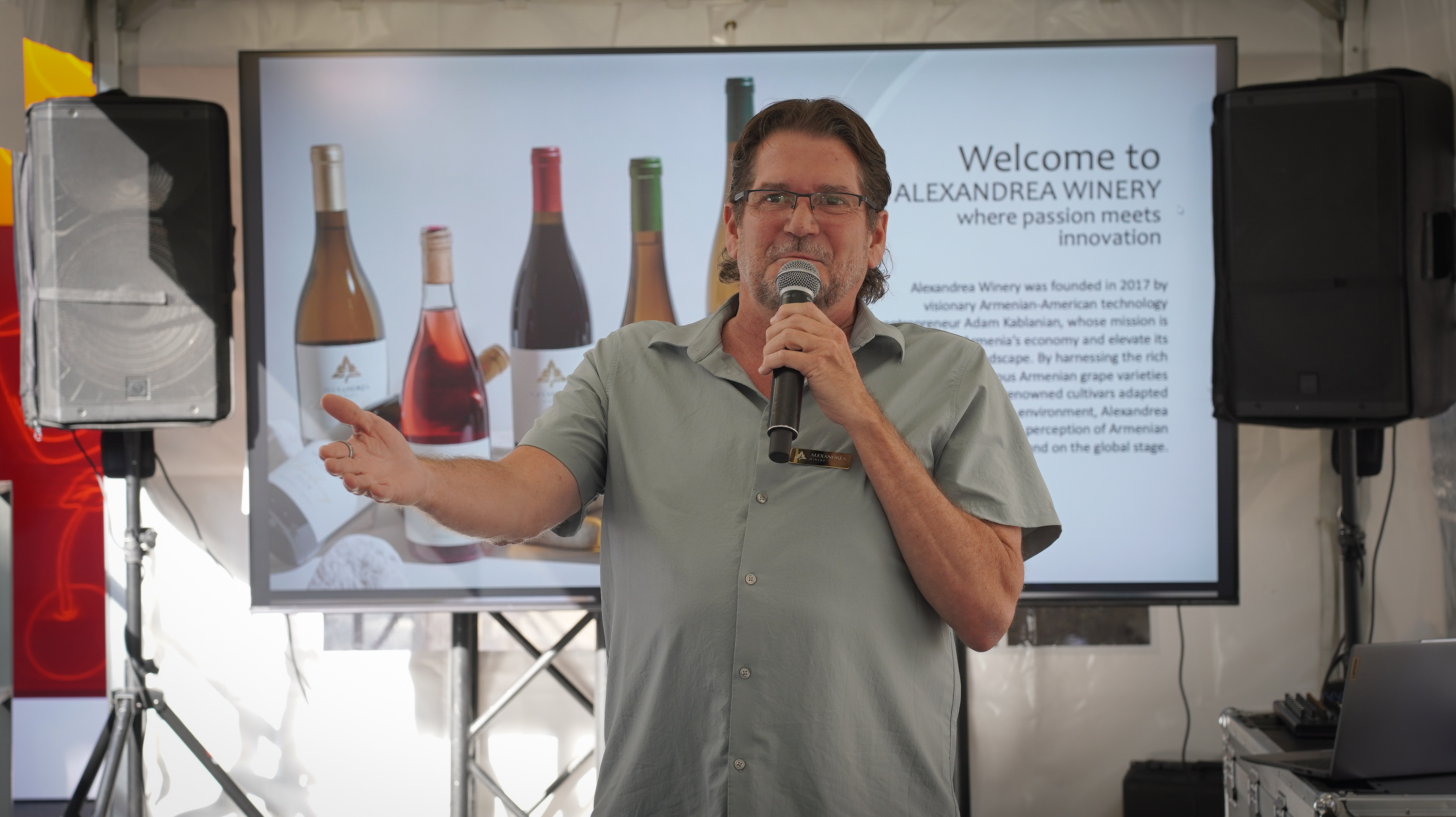
Throughout the presentation, Ritchey returned to a single concept: balance. When an audience member asked whether each wine has a different set of balance criteria, he offered his most extended meditation on the subject.
"Wine can be a little bit esoteric, right? What is balance?" he said. "To me, balance is when all the components of the wine come together and don't fight with each other. I'm sure you've tasted a really ripe Zinfandel or Cabernet where it's just jammy and too much, and it overwhelms you. You have to find the balance for each wine. Part of that is understanding what the intensity of the wine is."
He contrasted California and Armenia directly. "In California, the growing season is much longer, much milder. You get a lot of concentration, so you can put a lot of oak or a lot of alcohol. In Armenia, because there's much more heat and it's a shorter growing season, you have to pay attention to the intensity of the wine. If there's not a lot of intensity, you can't put a lot of oak or a lot of acid or a lot of alcohol."
The result, when balance is achieved, is almost subliminal. "When the tannins, the fruit, the alcohol, the sugars, the flavors are all balanced, you actually feel the wine. You taste it and go, 'This is really good,' but you don't really know why because everything's balanced and you kind of just feel it. Then when you smell it a little more, taste it a little more, you realize there's so much complexity in it."
He offered a concrete example: Alexandrea's upcoming reserve blend (mostly Khndoghni with Malbec and Petit Verdot). "It has so much intensity, it's amazing. So I can put new oak on it — even though it has 50% new oak on it right now, it doesn't taste like it because the concentration just lifts it up. It's in balance."
VIII. The Challenges of a Frontier Wine Economy
When asked directly about his biggest challenge as a winemaker in Armenia, Ritchey did not hesitate.
"The wine industry here is developing right now, and they're doing a wonderful job. If you taste the wines all over here, up and down, they're making great wines. The challenge is, the nearest big wine producer is Italy. In California, there's 5,000 wineries. If I need a tank, I can call somebody and it'll be there the next day. If we need a tank here, I have to find a producer. It has to be manufactured. It has to be shipped. It has to go through customs."
He added labor logistics to the list. "In California, we have lots of picking crews. Here, trying to arrange picking can be a challenge. There's a lot of logistics that I have to deal with. But we're figuring it out."
An audience member — Tamar Burjanadze — asked about the weather: "Okay. Uh in Caucasian region; it.. the weather can be a big challenge. Uh so uh how many sunny days that the grapes need for it to be ripened and it's good for the wine making?"
Ritchey acknowledged the complexity of the question. "It depends on the region. Right here in Proshyan and Nor Yedesia, we still get a lot of sunny days, and the days are long, but they're very hot, and the sun's very hot. We do get sugar, we do get ripeness. The challenge is getting the flavor intensity. The longer the grapes can be on the vine, the more flavor you get."
The calendar is the enemy. "Once we reach October here, you never know what the weather's going to do. In California, I've picked the week before Thanksgiving. Here, we're usually starting at the end of August and hoping to be done by mid-October. You never know what mother nature's going to throw at you. It could be hot in October. It could be snowing in October. You have to pay attention — especially during harvest, because if you see a rainstorm coming in, you might have to pick your grapes early. You don't want them to rot on the vine."
IX. The Future: Estate Winery, 2028 Icon, and the Reserve Blend
Despite the headwinds, Alexandrea is expanding. Ritchey disclosed that the winery is in the design phase of a new estate winery on the Proshyan hill, overlooking the Pinot Noir vineyards with a direct sightline to Mount Ararat. While the facility will not be gravity-fed, it will use equipment designed to simulate gravity-flow techniques, ensuring the gentlest possible handling of the grapes.
"We're right in the middle of designing the winery," he said. "It's going to go right here, up on a hill. It overlooks the Pinot Noir vineyard right to Mount Ararat. It's stunning. It's going to be amazing."
He acknowledged the uncertainty of Armenian construction timelines with a wry laugh. "I've helped design and build three wineries in California, so I know the process. But I don't know the exact process for construction in Armenia." The audience laughed with him. The winery will include an event center, wedding facilities, and a restaurant.
On the wine front, Alexandrea has eight current labels and four additional blends coming from the Nor Yedesia vineyard: a Malbec (on its own), a Sireni, a Bordeaux blend, and a reserve blend (mostly Khndoghni with Malbec and Petit Verdot). "We were tasting it last night," Ritchey said. "It's going to be amazing. But one of the challenges of being a winemaker is you have to wait. It's going to be in barrel for one more year, then we put it in bottle, then we have to let it age for another six months. In a year and a half, look for our cuvée."
A flagship icon wine is slated for release in 2028.
X. Two Spotlights: Owines and Sargsyan
Alexandrea was not the only winery presenting at the Wine and Gastronomic Business Talks, but it was the most technically forthcoming. Two others provided on-the-record information.
Owines, represented by Ara SH, focuses exclusively on Red Areni from the southern Vayots Dzor region (Aghvanadzor). Ara SH, an IT worker by trade, described winemaking as his "getaway" — an escape into nature. The winery practices sustainable agriculture with minimal, "only as needed" chemicals, resulting in a deliberate medium yield. Preservation of the environment, he said, is paramount.
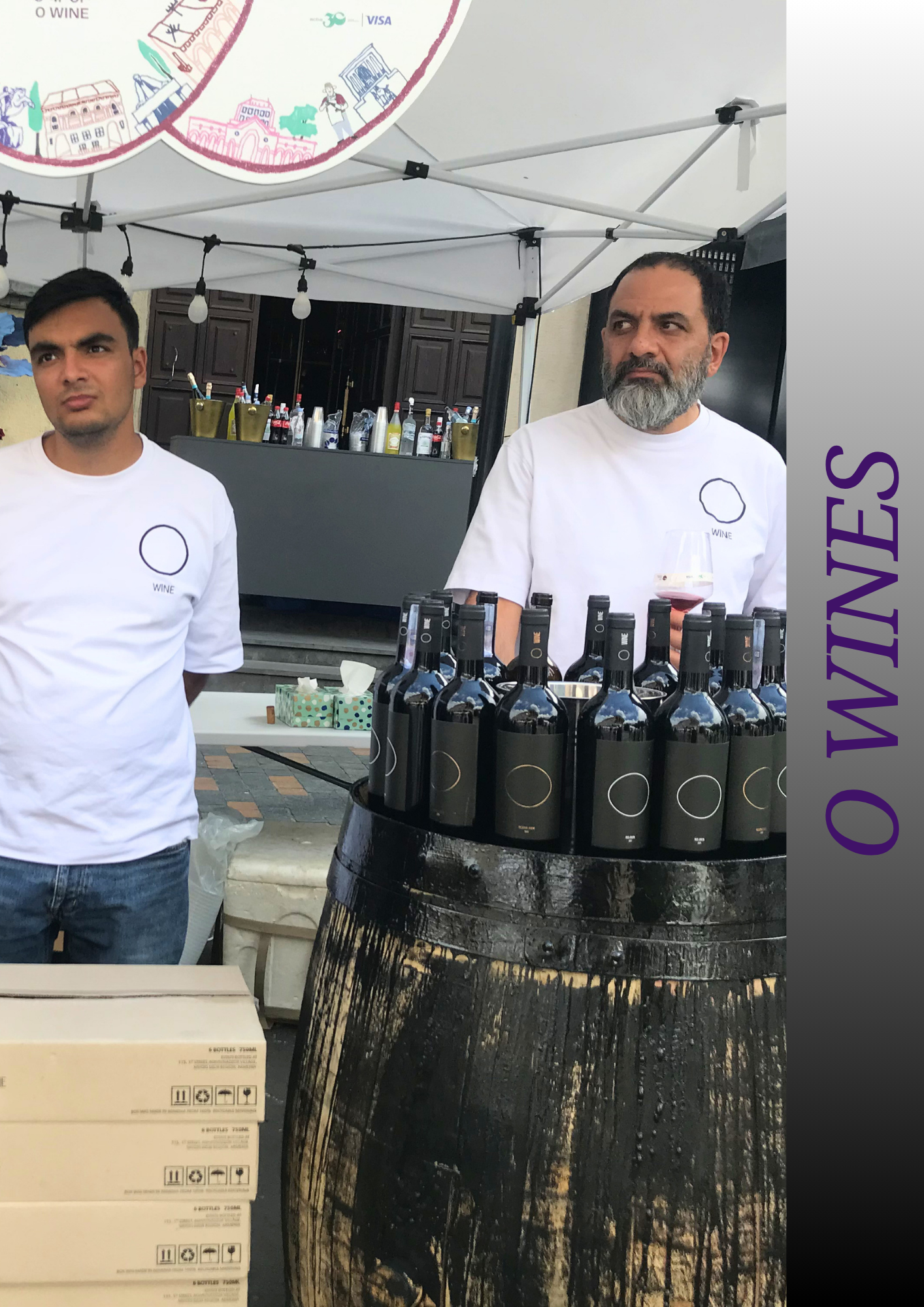
Owines produces two wines from the same grape: O Wine (young, bold, 14% ABV) and O Reserve (aged, sweeter, oakier). Both are aged for 12 months in oak barrels. A visual signature: when you swirl O Wine, an "O"-shaped ring forms along the interior walls of the glass. "Everything about O Wine starts with O," Ara SH said. "It's a full circle from our traditions to modern life."
Editorial note: As of June 13, 2026, Owines had not responded to IRCNA's requests for technical clarifications. This article will be updated if a response is received.
Sargsyan Wines by Ararat Wine Factory operates at a different scale entirely. Founded in 1906, it is the largest cognac, wine, and vodka factory in Armenia, with more than 120 years of uninterrupted operation. In 2025, the company rebranded from Ararat Wine Factory to Sargsyan Wines, describing the change as "a return to origins, a family-driven vision shaped by dedication, continuity, and respect for heritage."
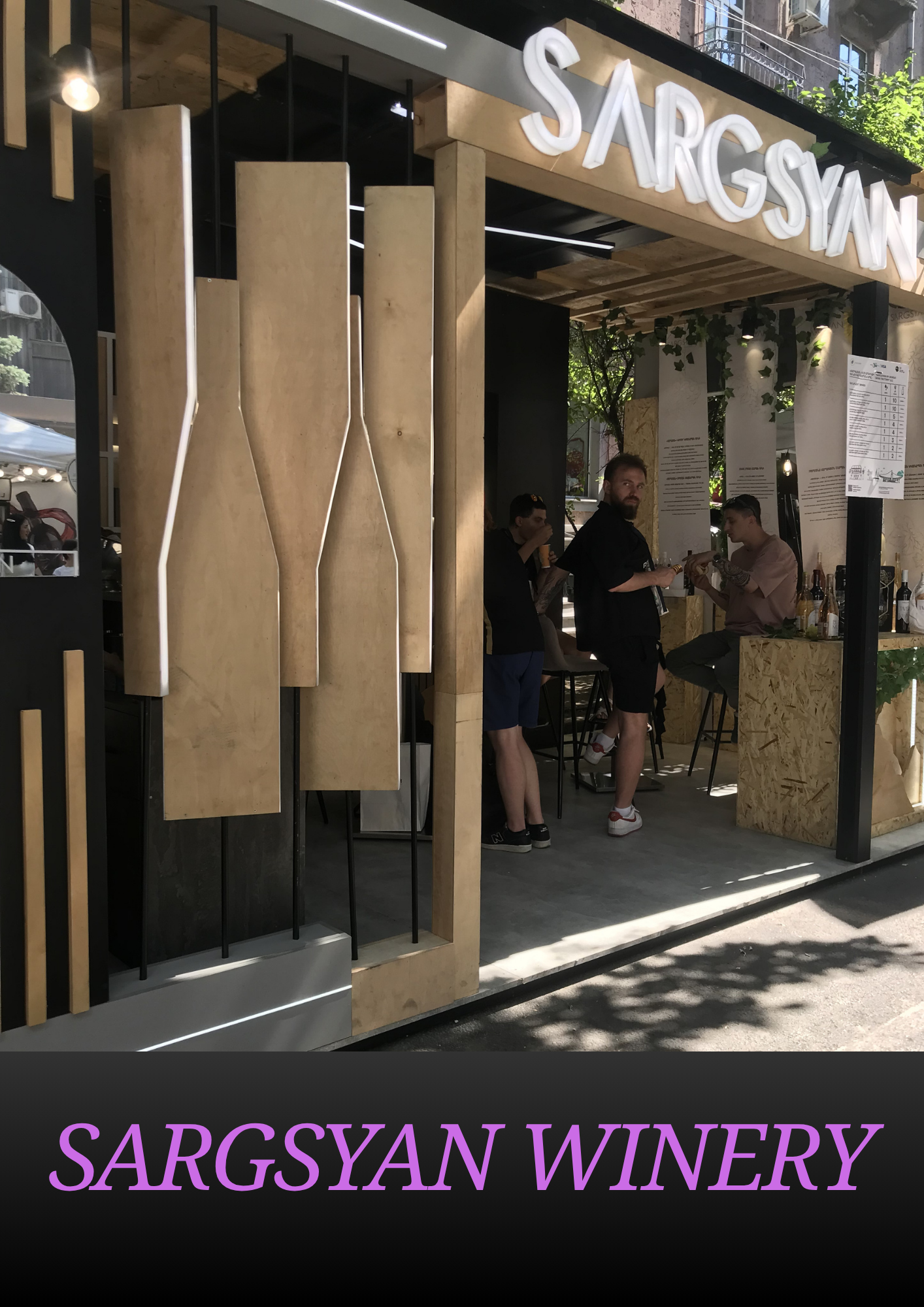
Unlike Alexandrea's detailed disclosures, Sargsyan provided no technical data on vineyards, altitudes, or aging protocols. Their participation appeared focused on brand continuity rather than operational transparency.
XI. The Response Problem
IRCNA contacted 17 additional wineries for interviews or written comments following Yerevan Wine Days 2026. As of June 13, 2026, only two responded: Owines (partial, with pending clarifications) and Sargsyan (corporate overview, no technical data). No other wineries replied.
This silence — whether due to capacity constraints, disinterest, or the post-festival lull — means the wine sector profile presented here is necessarily limited to those producers willing to speak on the record. The full story of Armenian viticulture at Yerevan Wine Days 2026 remains, in significant part, untold.
XII. Conclusion: The Liquid Evidence of Private Investment
The wine poured on Saryan Street during the 10th anniversary of Yerevan Wine Days is not simply the product of volcanic soil and California expertise. It is the liquid evidence of a private sector learning to build, scale, and survive without state funding.
Alexandrea Winery broke 70 centimeters of volcanic stone by hand, imported Japanese machinery, installed anti-hail nets, and spent five years fermenting Chardonnay at different elevations to find the middle slope. They produced Armenia's first commercial Pinot Noir, structured across three plots as skeleton, flesh, and humidness. They brought a 31-year veteran winemaker from California to the Caucasus and trusted him to listen to what the vines said.
The challenges remain — supply chains that run through Italian customs, October snowfalls that can destroy a harvest, a construction timeline no one can predict. But the wine in the glass, at least from Alexandrea, suggests the gamble is paying off.
Jeff Ritchey was asked, near the end of the presentation, what his favorite Alexandrea wine is. He admitted he initially scoffed when Adam Kablanian planted Muscat. "I was like, 'Oh god, why did you plant Muscat?'" Now, he said, "It's my favorite wine. It's delicious. It's delicate. It's complex. It's beautiful."
That is the arc of Alexandrea Winery — and, in microcosm, of the wine sector at Yerevan Wine Days 2026. Skepticism, patience, and the willingness to break rock eventually yield something worth raising a glass to.
Sources for Pillar One:
- Live presentation by Karen Gabrielyan and Jeff Ritchey (Alexandrea Winery), with English translation by Alex, Wine and Gastronomic Business Talks, Saryan Street, Yerevan Wine Days 2026 (June 5). Transcript provided by IRCNA.
- Email correspondence from Nvard (Alexandrea Winery Communications Representative), received June 13, 2026.
- Floor interview with Ara SH (Owines), Saryan Street, June 6, 2026.
- Audience question from Tamar Burjanadze, documented on-site, June 5, 2026.
- Written correspondence from Sargsyan Wines by Ararat Wine Factory, received June 2026.
- Firsthand tasting notes, on-site, June 5–6, 2026.
Correction note: The presentation transcript which can be found on our Youtube Channel originally rendered "humidness" as "humanness." The correct term, as confirmed by source materials, is "humidness" — referring to forest-floor earthiness.

Comments