From the winemakers’ parade to the late‑night DJs — a complete chronicle of Armenia’s landmark festival, June 5–7
By Mikael Yamiosei | IRCNA
</a>
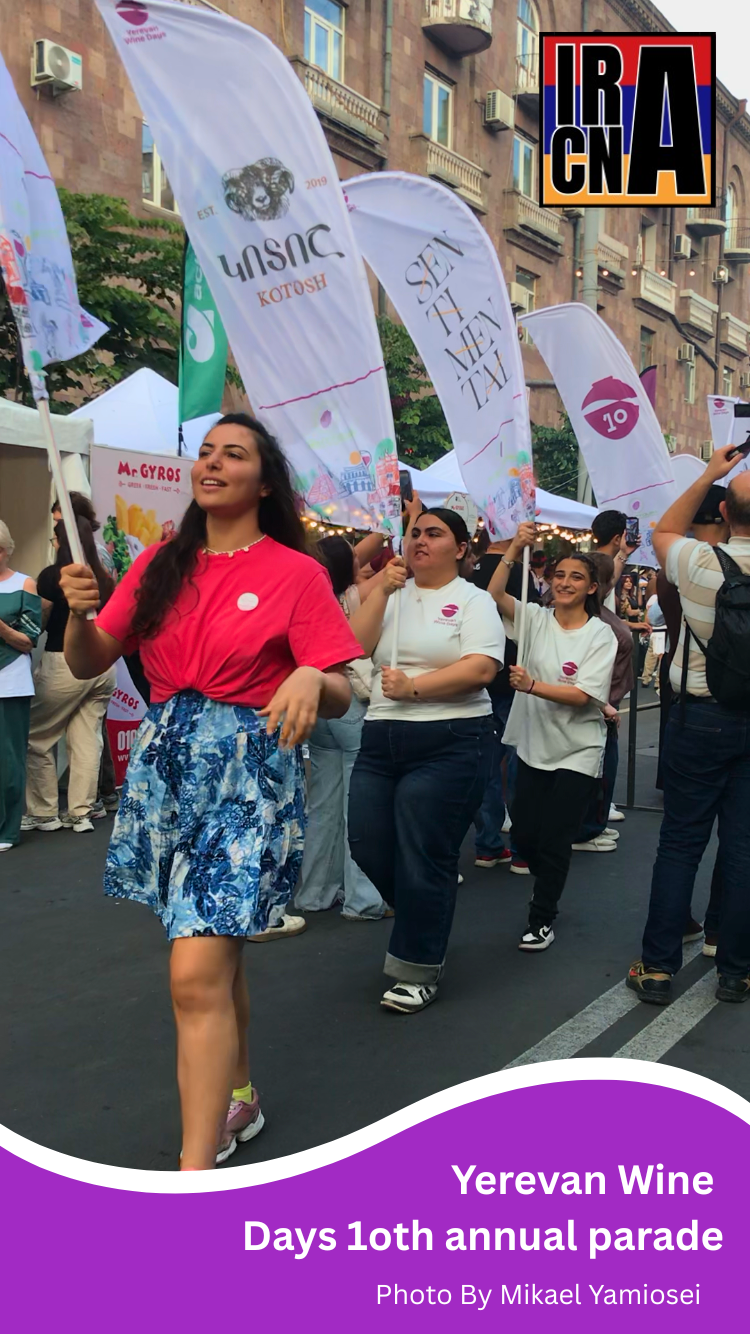
YEREVAN — At 6:30 p.m. on June 5, the first of three evenings of open‑air celebration began not with a toast but with a procession. Approximately one hundred winemakers, some in traditional dress, others in simple shirts, walked down Tumanyan Street into the heart of the festival zone. It was the first ceremonial winemakers’ parade in the event’s decade‑long history — a deliberate signal that the 10th anniversary of Yerevan Wine Days would be different.
The parade was the opening move in a three‑day takeover of central Yerevan’s Saryan, Tumanyan and Moskovyan streets, which had been announced days earlier by the Yerevan City Hall. From Friday evening through Sunday night, those roads became a pedestrian‑only republic of wine, food, music and business. Entry was free. By the time the last DJ packed up on the night of June 7, the festival had drawn approximately 180,000 visitors and generated an estimated $2.5 million in direct sales from about 250 participating businesses, according to figures EventToura shared with reporters.
From a single street to a national stage
What began in 2017 with 25 winemakers on a section of Saryan Street has grown into one of the region’s largest public‑facing wine events. Over the decade, the geography of participants has expanded significantly, with visitors coming from Scandinavia, England, and Australia. The festival’s milestone year brought more than 100 Armenian wineries and over 1,000 wine varieties to the capital, making it a concentrated platform for brand visibility, consumer engagement, and destination‑driven demand.
Day One — Friday, June 5: The Parade and the First Pour
The festival’s official opening was the winemakers’ parade. EventToura co‑founder Mary Badalyan had announced it weeks earlier as a moment of pride. “On June 5 at 6:30 p.m., I invite everyone to Tumanyan Street in Yerevan, where 100 winemakers will enter the festival area in a grand parade,” she said at a press conference. The winemakers walked in rows, carrying not only their individual brands but the villages and regions they came from — a visual statement that Armenian winemaking is not a collection of isolated labels but a national landscape of wine‑producing territories.
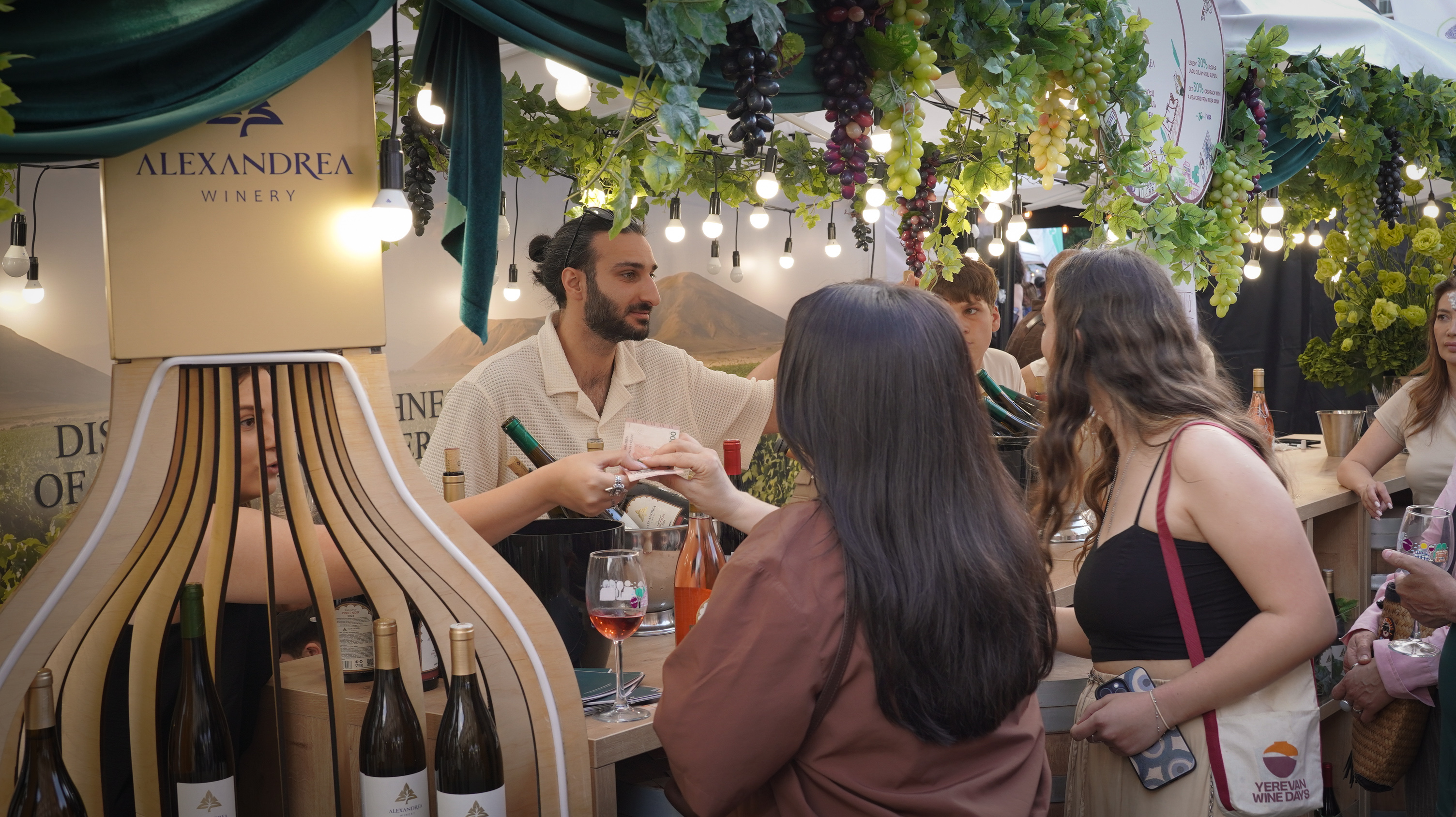
</a> Photo By Alexandria Winery
After the parade, the streets filled quickly. By 7:30 p.m., Saryan Street was a slow river of people holding glasses. The “Wine Enjoyment Package” (AMD 14,000) — a 10th‑anniversary branded glass, 12 tasting coupons, a neck pouch, a raffle ticket, an information booklet, and a cloth sleeve — sold steadily. The first evening’s musical programme included live bands on two stages, with genres ranging from Armenian folk‑rock to pop. DJs began playing later, as the light faded, and the atmosphere remained warm and welcoming.
Day Two — Saturday, June 6: The Peak and the Downpour
Saturday was the festival’s busiest day. The crowd thickened by midday and remained heavy through the late afternoon. Wineries ran low on some vintages by early evening. The Rieslings and Pinot Noirs from various producers drew consistent lines, while gastronomic zones saw long queues. The festival had noticeably expanded its culinary lineup compared to previous years, with about 50 restaurant and food points integrated into the footprint.
The second day of the Wine and Gastronomic Business Talks featured a series of masterclasses and public panels. One presentation, by photo artist and essayist Nata Brettell, left a lasting impression on those who attended. Speaking on food journalism, she proposed looking at food and wine not merely as commodities but as vehicles for human storytelling. “The word ‘delicious’ alone doesn’t make a story interesting,” Brettell noted. In her view, readers and travelers are drawn less to dishes and drinks themselves, and more to the people, memories, and heritages behind them — a theme that echoed across the festival’s deeper programming.
Then the rain came. A heavy downpour began in the middle of the afternoon and continued for about two hours. The festival’s open‑air areas emptied quickly; visitors huddled under awnings, shop overhangs, and the tent where the Wine Talks were taking place. Inside the tent, the audience realized they were not going anywhere. The speaker, seeing the soaked crowd, ended her presentation with a practical joke: “Now that we’ve all gathered and you cannot leave…” The audience laughed. The rain eventually stopped, but the memory of that captive, communal moment became one of the festival’s unexpected highlights. Outside, the music had paused during the worst of the storm but resumed once the skies cleared.
Day Three — Sunday, June 7: The Finale and the Elections
The final day of the festival coincided with Armenia’s national elections. This juxtaposition — a celebration centered on alcohol running alongside a democratic vote — could have been tense. Instead, the streets remained peaceful. The crowd’s mood was cooperative. “Всем весело и совсем немного ‘пьяно’,” one Russian‑language outlet observed: everyone is having fun, but only slightly drunk.
Sunday’s programme included the last full round of tastings, a reduced music schedule, and the final sessions of the Wine and Gastronomic Business Talks. These included discussions on wine culture, gastronomy, tourism, food systems, and the role of culinary identity in destination development. The panels drew attendees who valued depth over volume — a quieter but more engaged audience than the crowds on the main streets.
That evening, the festival wound down. DJs played until late. The last glasses were poured. The clean‑up crews began moving in as the crowd dispersed.
The Business of the Feast
Behind the festive atmosphere, the festival performed serious economic work. According to figures EventToura shared with media outlets, the 10th anniversary edition generated approximately $2.5 million in direct sales from about 250 participating partners — winemakers, restaurants, food producers, and service providers. The broader economic multiplier — hotel stays, restaurant bookings, transport, and post‑festival winery visits — pushed the total impact higher. In recent editions, Yerevan Wine Days has also set sales records, with winemakers selling around 42,000 bottles during the event.
Gosh Sargsyan, head of the Yerevan City Hall Department of Culture and Tourism, confirmed the municipality’s support. “The Yerevan Municipality provides financial support to the festival, and I am very pleased that over the years it has become such an important event and tourism product that we proudly present to our international partners,” he said.
The festival is the work of EventToura, a private event tourism agency founded by Mary Badalyan and Nune Manukyan. It receives no state funding for its core operations; the municipal support is promotional and logistical, not structural. This private‑sector backbone has allowed the festival to outlast funding shifts and remain agile — a point of pride for the organisers.
What Made 2026 Different
Three elements distinguished this anniversary from previous editions.
First, the winemakers’ parade. It was not merely a festive performance. It was a visual statement that Armenian winemaking is not a collection of isolated brands but a national landscape of wine‑producing territories. For the first time, the public could see the industry as a community.
Second, the Wine and Gastronomic Business Talks. These free, hour‑long sessions gave the festival an intellectual anchor that the crowded streets could not provide. They allowed winemakers to discuss soil composition, chefs to share pairing frameworks, and infrastructure builders to present urban recovery projects. Unlike the main festival, which prioritised volume and atmosphere, the Talks prioritised depth and exchange.
Third, the juxtaposition with the elections. That the festival ran peacefully alongside a democratic vote was noted by several international observers as a sign of Yerevan’s civic maturity.
However, the milestone year also raised familiar questions. The physical footprint — Saryan, Tumanyan and Moskovyan streets — has not changed since the early years. Some areas became so congested that movement was difficult. “Is it time for a conceptual overhaul? Should the festival expand its geographical footprint?” one post‑festival analysis asked. Organisers acknowledged the limitation and announced plans to ask the municipality to consider moving the festival to Republic Square in 2027, allowing for an EXPO zone and expanded B2B formats.
The Numbers and the Legacy
By the end of June 7, approximately 180,000 people had passed through the festival zone. More than 1,000 wine varieties had been poured. About 50 restaurants had fed the crowd. Three days of live music had played. And one tent had proven that a street festival can also be a classroom — especially when the rain leaves you nowhere else to go.
Nune Manukyan, co‑founder of EventToura, reflected on the decade. “Our goal was to make Armenia recognised as a cradle of wine, and ten years later we can confidently say that we have achieved that,” she said.
Mary Badalyan, reflecting further, offered a closing statement: “Yerevan Wine Days is not only about wine. Wine is the anchor, but the larger value is the experience it creates around Armenia. When visitors discover an indigenous grape variety, meet a small family producer, hear the story behind the wine, and experience it in the middle of Yerevan, they are not only tasting a product, they are entering the country through its culture, people, and place. That is when wine becomes part of tourism demand.”
The 10th anniversary is over. The streets are back to traffic. But the parade, the late‑night DJ sets, the thousand wines, and the rain that locked a hundred people in a room with a woman describing a dream for Gyumri — all of it has left a mark. Yerevan Wine Days is no longer a local curiosity. It is a fixture, waterlogged and all.
Sources
- Armenia Press — “Yerevan Wine Days 2026 to feature three‑day celebrations and expanded cultural program” (May 25, 2026)
- Wine Business — “One of the World’s Premier Wine Destinations Opens Its Doors for the 10th Anniversary of Yerevan Wine Days” (June 8, 2026)
- Style.news.am — “Yerevan Wine Days 2026: A Toast to Ten Years and a Look into the Future” (June 8, 2026)
- Sovetreklama — “Фестиваль Yerevan Wine Days как визитная карточка страны” (June 9, 2026)
- Sputnik Armenia — “Фестиваль ‘Винные дни’ в Ереване: всем весело и совсем немного ‘пьяно’” (June 5, 2026)
- News Armenia — “В Ереване 4-8 июня перекроют ряд улиц из‑за винного фестиваля” (June 4, 2026)
- Yerevan Wine Days press materials (March 17, 2026) — participant numbers, package pricing, sustainability practices
- Yerevan Wine Days 2026 Festival — EventBrite listing (accessed June 2026)
- Wikipedia — Yerevan Wine Days (accessed June 2026) — historical attendance and economic impact data
*IRCNA is an independent, non‑profit news platform based in Yerevan. All reporting, opinions and articles are solely the work of Mikael Yamiosei and IRCNA. No part of this coverage was sponsored or approved by EventToura or any festival partner.*
Comments