The Anatomy of a Festival
Private Resilience, High‑Altitude Terroir, and the Platform That Connected Them
Ten years of Yerevan Wine Days, three deep‑dive pillars, and the Wine & Gastronomic Business Talks that proved wine and gastronomy go hand in hand
By Mikael Yamiosei | IRCNA
Revision Notice – June 15, 2026: This article has been updated to correct several factual inaccuracies following feedback from Alexandrea Winery. Specifically: (1) the 2025 Reserve blend is mostly Khndoghni, not Cabernet Sauvignon; (2) the future winery will not be gravity‑fed but will use equipment designed to simulate gravity‑flow techniques; (3) a transcribed word “curve” has been corrected to “cuvée”; (4) the description of Jeff Ritchey’s experience has been clarified to avoid ambiguity. IRCNA thanks Jeff Ritchey and the Alexandrea team for holding us accountable.
YEREVAN — For three days in early June, Saryan Street became a river of people. Corks popped. Music thrummed. Nearly two hundred thousand visitors moved from stall to stall, tasting wines from more than one hundred Armenian producers. The 10th anniversary of Yerevan Wine Days was, by any measure, a celebration.
But the most important part of the festival was not on the crowded asphalt. It was in a tent, under a shade, with folding chairs and a small stage.
That tent held the Wine and Gastronomic Business Talks – a series of free, hour‑long presentations where winemakers disclosed soil pH, chefs explained wine pairings, and infrastructure builders described a €2.5 million project to rebuild a market in Gyumri. I found the Talks because Jeff Ritchey, a 31‑year veteran winemaker from California, invited me to his presentation twenty minutes after I met him at his stall. He said it was the best way to answer my questions. He was right.
What I discovered over the next three days became the spine of this feature. Yerevan Wine Days is not just a street party. It is a case study in private resilience. EventToura, the private organisation behind the festival, receives no state funding. After USAID closed its support in 2025, the gastronomic component of the festival was cut to the bone. Marianna Vardanyan, the project manager, planned the 2026 Talks in one month, with limited financial aid, because she believed that wine and gastronomy belong together.
The four articles that follow – each collapsible for easy reading – tell that story through three pillars: high‑altitude viticulture (Alexandrea Winery), authentic hospitality integration (Olé Yerevan), and tech‑driven infrastructure (TUMO Gyumri). A fourth piece explains why the Talks mattered, how they were built, and why they transformed the festival for me.
This is the anatomy of a feast.
Pillar One: Alexandrea Winery – Breaking Volcanic Stone at 1,315 Metres
TLDR
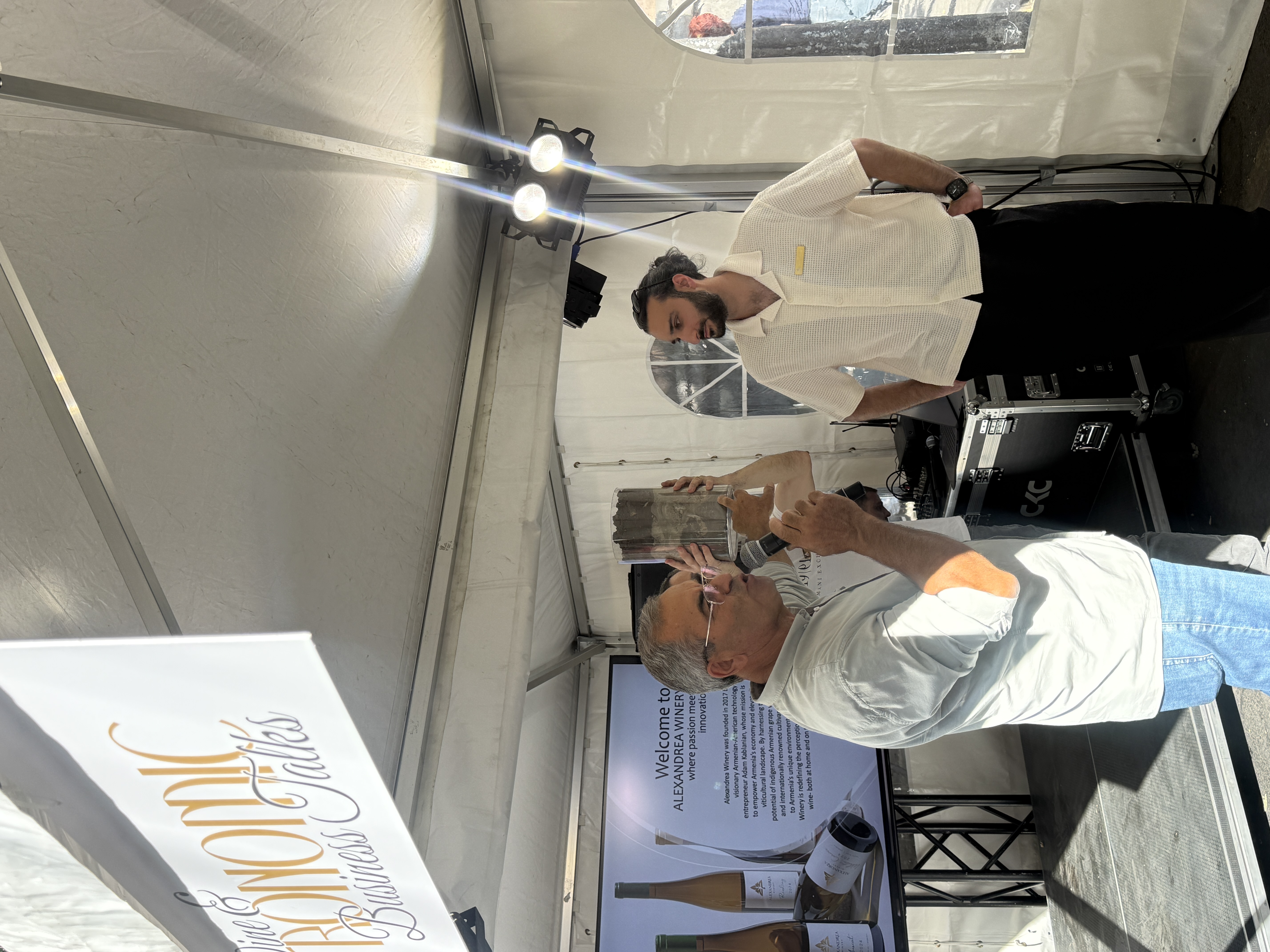
The Proshyan vineyard sits at 1,315 metres above sea level. Its soil is volcanic gravel extending more than 70 centimetres deep – so dense that workers needed Japanese rock‑cutting machinery to plant vines by hand. Alexandrea Winery, founded in 2017 by Armenian‑American entrepreneur Adam Kablanian, brought in Jeff Ritchey, a 31‑year veteran winemaker from California, to turn that brutal terrain into wine.
Over five years, Ritchey and his team conducted elevation studies on Chardonnay, discovering that the mid‑slope blocks produced the best balance – a Goldilocks zone they now use as their benchmark. They also planted three blocks of Pinot Noir. Plots 11, 12, and 13 – each with radically different sun exposure and soil composition – became the skeleton, flesh, and humidness of Armenia’s first commercial Pinot Noir.
During the Wine and Gastronomic Business Talks, Ritchey disclosed the winery’s technical data: the temperature differential between Proshyan and their warmer Nor Yedesia vineyard (up to 5°C), the 25% new French oak ageing for Pinot Noir, and the logistical nightmare of sourcing winemaking equipment in a country without a local supply chain. He also answered a question from audience member Tamar Burjanadze about the unpredictable Caucasian weather – a reminder that every harvest is a gamble against October snow.
Alexandrea’s story is not just about wine. It is about private capital, patient experimentation, and the courage to plant in volcanic stone. No state funding. No shortcuts. Just soil, sweat, and a winemaker who listens to what the vines say.
Between the rows
The Alexandrea presentation anchored the technical credibility of the Wine and Gastronomic Business Talks. While the main festival offered tasting, the Talks offered understanding. Audience members left knowing the difference between plot 12 and plot 13 – not just which wine they preferred, but why.
In the broader arc of this feature, Alexandrea supplies the first leg of the thesis: high‑altitude viticulture as a private, self‑sustaining engine. The winery’s openness about its soil composition, elevation trials, and plot‑specific blending set a standard for transparency that carried through the other pillars.
(Full article follows – collapsible)
Full Article: The Marriage between Wine and Gastronomy | Modern Traditional Balance – Alexandrea Winery
The Marriage between Wine and Gastronomy | Modern Traditional Balance
Alexandrea Winery
A ground-level investigation into high-altitude viticulture, plot-specific blending, and the private investment reshaping Armenian wine — reported from the Wine and Gastronomic Business Talks, Yerevan Wine Days 2026 (June 5–7, Saryan Street).
By Mikael Yamiosei | IRCNA
YEREVAN — The soil in Proshyan does not give way easily. It extends more than seventy centimeters deep — a dense, unbroken layer of volcanic stone and sharp gravel that resisted every tool brought against it. When Alexandrea Winery acquired the land in 2017, the question was not whether grapes would grow. The question was whether the earth could be broken at all.
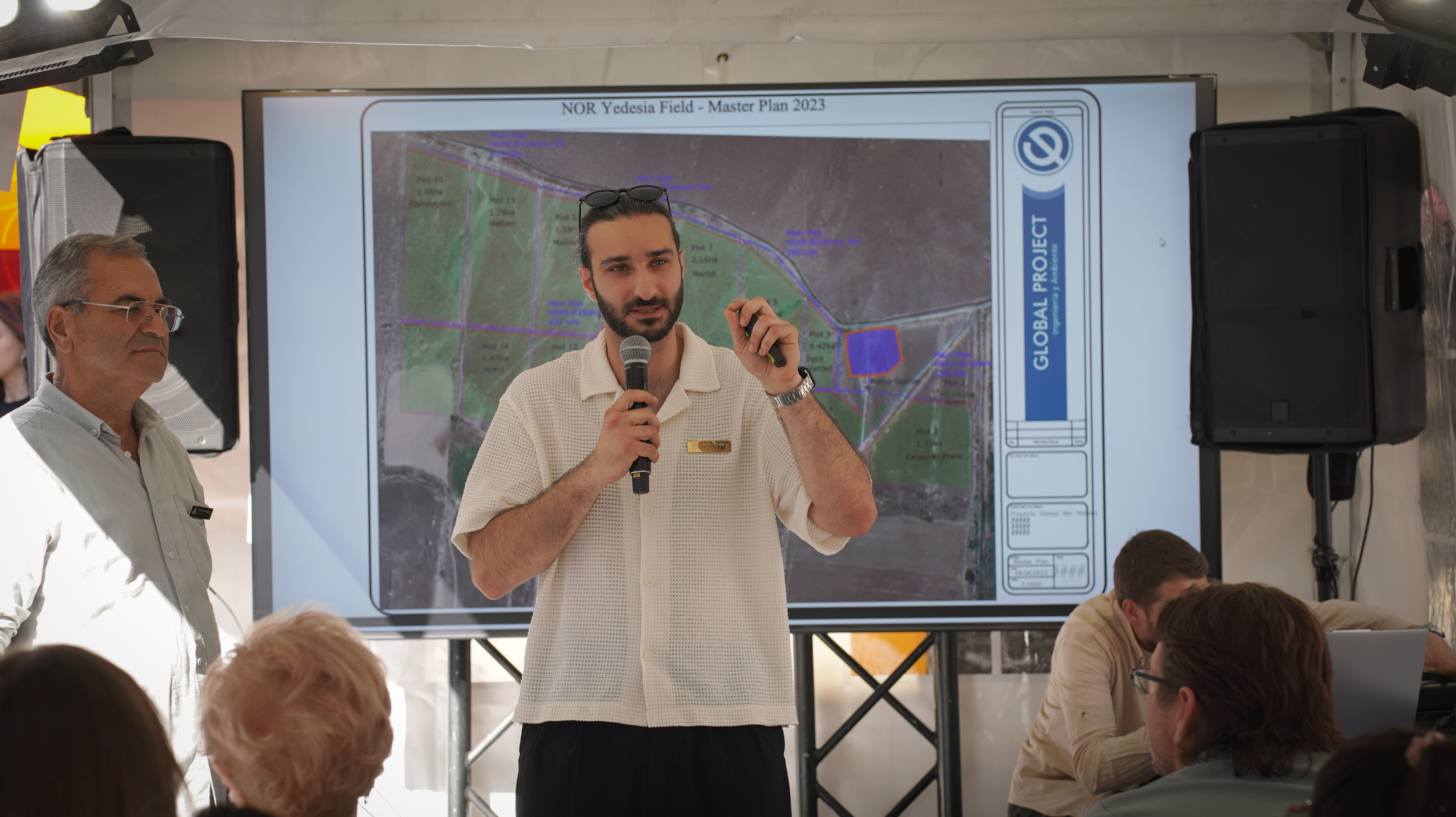
The answer required Japanese rock-cutting machinery, manual labor, and a five-year experiment in high-altitude viticulture that would eventually produce Armenia's first commercial Pinot Noir and a Riesling sharp enough to stand beside its German inspirations.
On June 5, 2026, the 10th anniversary of Yerevan Wine Days, Alexandrea Winery presented its full portfolio to an audience gathered on Saryan Street. The presentation was delivered by Karen Gabrielyan (winery representative) and Jeff Ritchey (Chief Winemaker), with Alex providing English translation for Karen. What followed was the most technically detailed winemaker's briefing of the entire festival — a rare public disclosure of soil composition, plot-specific blending, and the logistical realities of building a wine economy from volcanic rubble.
This is the story of that briefing, told through floor transcripts, correspondence, and firsthand tasting notes. It is the first of three pillars examining how private investment, not state funding, is stabilizing Armenia's emergence as a wine and gastronomic hub.
I. The Winemaker's Journey: From California to the Caucasus
Jeff Ritchey has been making wine professionally for 31 years, most of that time in California's long, mild valleys. On June 5, 2026 — the opening day of the festival — he marked his ninth year to the day since his first visit to Armenia.
The path to Alexandrea Winery was indirect. Ritchey met founder Adam Kablanian (an Armenian-American entrepreneur) through a family connection. Kablanian tasted Ritchey's wines and said, "Someday I'm going to make you my winemaker." Ritchey's internal response, he told the audience: Whatever.
Then Ritchey emailed Kablanian a National Geographic article about the Areni-1 cave, where archaeologists had discovered the oldest evidence of winemaking. "No wonder you like wine so much," Ritchey wrote. "It's in your blood."
Kablanian replied that he was planning to hike past the cave that summer. Ritchey asked to come along. That trip was nine years ago.
In 2021, in the middle of the COVID pandemic, Kablanian called. "I have grapes coming in. I need you to make wine." Ritchey agreed. The first vintage was harvested that year.
"I get to do the fun stuff," Ritchey told the Saryan Street audience. "I get to taste wine with you."
But his actual job, he explained, is more patient: walking the vineyards, sampling the soil, tasting grapes directly from the vine. "You can't just have a Cabernet Sauvignon and say, 'Make this a Bordeaux.' You have to listen to what the grapes say."
II. Three Terroirs, Two Altitudes, One Philosophy
Alexandrea Winery manages approximately 70 hectares across three distinct vineyard sites. According to correspondence from Nvard, the winery's communications representative, the locations were chosen for their specific microclimates and soil compositions.
| Vineyard | Region | Altitude | Primary Varieties | Soil Character |
|---|---|---|---|---|
| Proshyan | Kotayk | 1,315m | Chardonnay, Riesling, Pinot Noir, Muscat, Areni, Voskehat | Volcanic, stony gravel extending 70+ cm deep |
| Nor Yedesia | Aragatsotn | 1,125m | Syrah, Sireni, Areni, Cabernet Sauvignon, Cabernet Franc, Malbec, Petit Verdot, Merlot | Volcanic, closer to Aragats and Ararat mountains |
| Vayots Dzor | Vayots Dzor | 1,250m | Areni, Voskehat | Rocky, historic wine-growing soils |
During the presentation, Karen Gabrielyan emphasized the importance of altitude selection. "You cannot plant in 2,000 or 2,500 meters of altitude — it will not grow," he said. Proshyan's elevation, slightly above 1,300 meters, provides "the best bioclimatic conditions to grow and to gain the best quality possible."
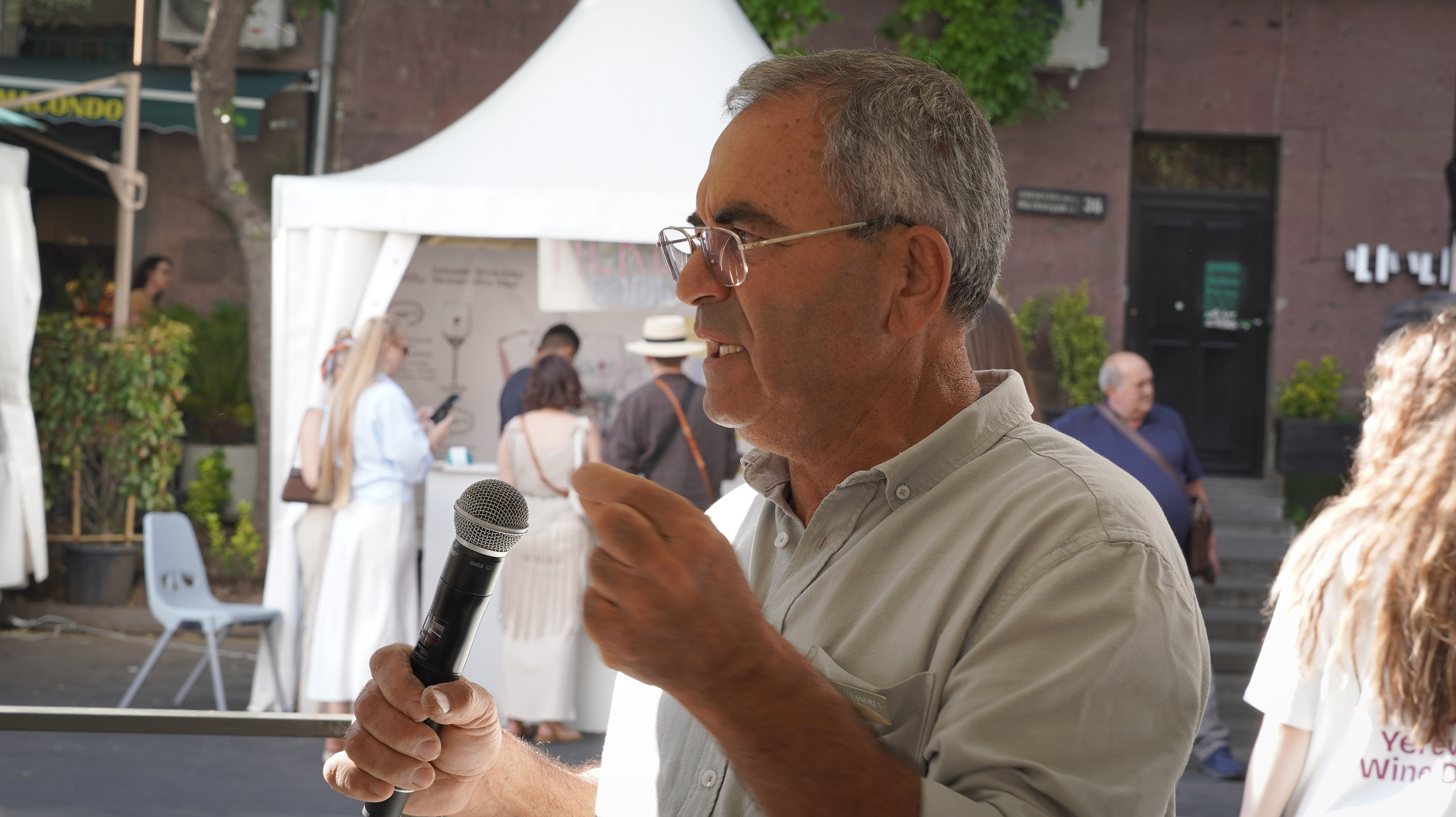
The sun exposure across both Proshyan and Nor Yedesia is southwest — a critical factor. "It gives one of the best sunny days" during the vegetative year, Karen explained, creating perfect conditions for Pinot Noir. Alexandrea is the first winery in Armenia to produce wine from Pinot Noir.
Jeff Ritchey elaborated on the temperature differential between the two main vineyards. "Proshyan's at about 1,300 meters. Nor Yedesia is 1,100 meters," he said. "There'll be up to five degrees Celsius difference in temperature between the two in the middle of the day. It's much cooler in Proshyan, and that's why Riesling, Chardonnay — all the cooler weather Burgundian varietals — work better there. In Nor Yedesia, it's warmer, not as windy, so the red varietals, the Bordeaux varietals, work better there."
The core philosophy uniting these distinct terroirs, Karen stated, is "balancing innovation and traditions."
III. Breaking the Rock: The Manual Genesis of Proshyan
The Proshyan vineyard was Alexandrea's first. In 2019, the winery planted its initial small trial of Chardonnay. The soil was so dense with stone and gravel that conventional methods failed.
"Literally impossible to cut without a Japanese very cool technique which is like cutting the rock," Karen told the audience. The method required specialized machinery to fracture the volcanic stone, followed by individual hand-planting of each vine.
The soil profile at Proshyan extends more than 70 centimeters deep — a solid matrix of gravel and rock with little organic matter. In 2020, the winery installed automated drip-irrigation systems and anti-hail netting, essential protections for delicate continental varieties in a region prone to unpredictable Caucasian weather.
"From the beginning, he was skeptical about accepting working in Alexandrea Winery or not," Karen said, referring to an unnamed colleague. "But since the day when he saw what kind of job has been done over there — what kind of job Alexandrea Winery is doing for their wines — he fell in love. We all fell in love with Alexandrea because the job and the experience that we are having here is enormous."
The vineyards, Karen concluded, were created "from nothing to an integrated style of viticulture. Everything is planned, everything is planted."
IV. The Goldilocks Chardonnay: Five Years of Elevation Study
One of Alexandrea's most methodical experiments involved the Chardonnay blocks planted across the sloping terrain of Proshyan. Over five years, Ritchey and his team fermented grapes from different elevations separately, tracking the results.
"What we started doing is fermenting the different elevations of Chardonnay so that we can see what the differences are," Ritchey said. "After five years, we figured out where the best grapes come from. It turns out they're the one that's right in the middle."
He drew a parallel to Burgundy's Côte d'Or. "The highest stuff isn't the best, the lowest stuff isn't the best — the stuff in the middle is."
This discovery shaped Alexandrea's Chardonnay program. The winery now produces two expressions: a tank-fermented Chardonnay designed to emphasize fruit and terroir, and a barrel-fermented Reserve with greater stylistic intensity.
"When I stopped by Burgundy last year," Ritchey said, "in southern Burgundy they do tank ferments — it's all about the terroir, all about the fruit. So when we blended the 2024 Chardonnay, we have the Reserve, which is the stylistic one, but we also have the regular Chardonnay that was mostly tank fermented. It really emphasizes the terroir and the fruit and shows the potential that Armenia has to grow grapes and make wine."
V. The Pinot Noir Triad: Skeleton, Flesh, and Humidness
The most technically sophisticated disclosure of the presentation concerned Alexandrea's Pinot Noir — the first commercial Pinot Noir produced in Armenia. The wine is sourced from three distinct blocks within the Proshyan vineyard, designated Plots 11, 12, and 13. Each block produces grapes with radically different characteristics.
Plot 13 (northwest, isolated from the other blocks) yields dense, dark fruit with thick skins. Ritchey described it as "the skeleton of the wine" — the structural framework that provides tannic architecture and aging potential.
Plot 12 (corner of the field, steeper slope with maximum sun exposure) produces grapes with higher sugar ripeness and pronounced berry flavors. This is "the flesh" — the fruit-forward volume that gives the wine its mid-palate richness.
Plot 11 (right flank, shaded under-slope) contributes earthiness — the organic, forest-floor character that Ritchey called "the humidness."
The 2024 vintage was the first harvest from these plots. "I didn't know what we were going to get," Ritchey admitted. "It turns out that Plot 13 has all the structure. Plot 12 — more exposed to the sun, steeper hill — you get a lot more ripeness, the fruit and the berries. Plot 11 provides the earthiness, the humidness, the forest floor. It all just came together very beautifully."
The Pinot Noir was aged for ten months in barrel, with 25% new French oak. "You get some of the vanilla, some of the spice, all that pure fruit, some of the earthiness they call forest floor or sous-bois," Ritchey said. "For the first vintage off a vineyard, it's pretty remarkable. You've probably heard that when vineyards are planted, it takes seven or eight years before they start to normalize. The first, second, third crops aren't necessarily the greatest. But this is the first crop off the volumes, and it's remarkable. We're really excited about the potential for Pinot Noir."
During the presentation, I tasted the 2024 Pinot Noir. Swirling the glass released a sweet aroma of grapes and floral tones. The acidity was subtle and pleasant — on a subjective scale of 1 to 5 (with 5 being bitterly acidic), it measured a 2. Floral and grape tones lingered on the tongue, finishing with an earthy, forest-floor aftertaste.
VI. The Riesling: Germany in Armenian Soil
The Riesling program at Alexandrea has a personal origin. Adam Kablanian worked as a CEO of a company in Germany for five years and fell in love with German Riesling. When he saw the Proshyan property, he believed the site could support the variety. Ritchey was skeptical.
"I'll have to admit, I was a little skeptical," Ritchey said. "But you're tasting it, and I think it's pretty darn good."
Ritchey described the wine's profile: "You get a lot of stone fruit, citrus, lime, even a little tropical, hints of the petroleum that you can get with Riesling from Germany. There's good acidity, good structure. It pairs very well with food."
My tasting notes, recorded on-site: the Riesling was quite balanced — sharp with a sudden acidic but floral taste to begin with. As it lingered on the palate, subtle hints of citric and floral flavors coated the tongue, leaving a pleasant aftertaste. Swirling the glass released sour and floral scents, alongside the classic nascent petroleum signature of aged German Rieslings.
"I'm still learning that vineyard," Ritchey said. "It's been five years, and I'm still learning every year. One of the things with winemaking that's challenging is you get one chance a year. When you decide to pick, that's it. You can't take the cluster back to the vine and ask for more time."
VII. The Balance Philosophy: Listening to the Wine
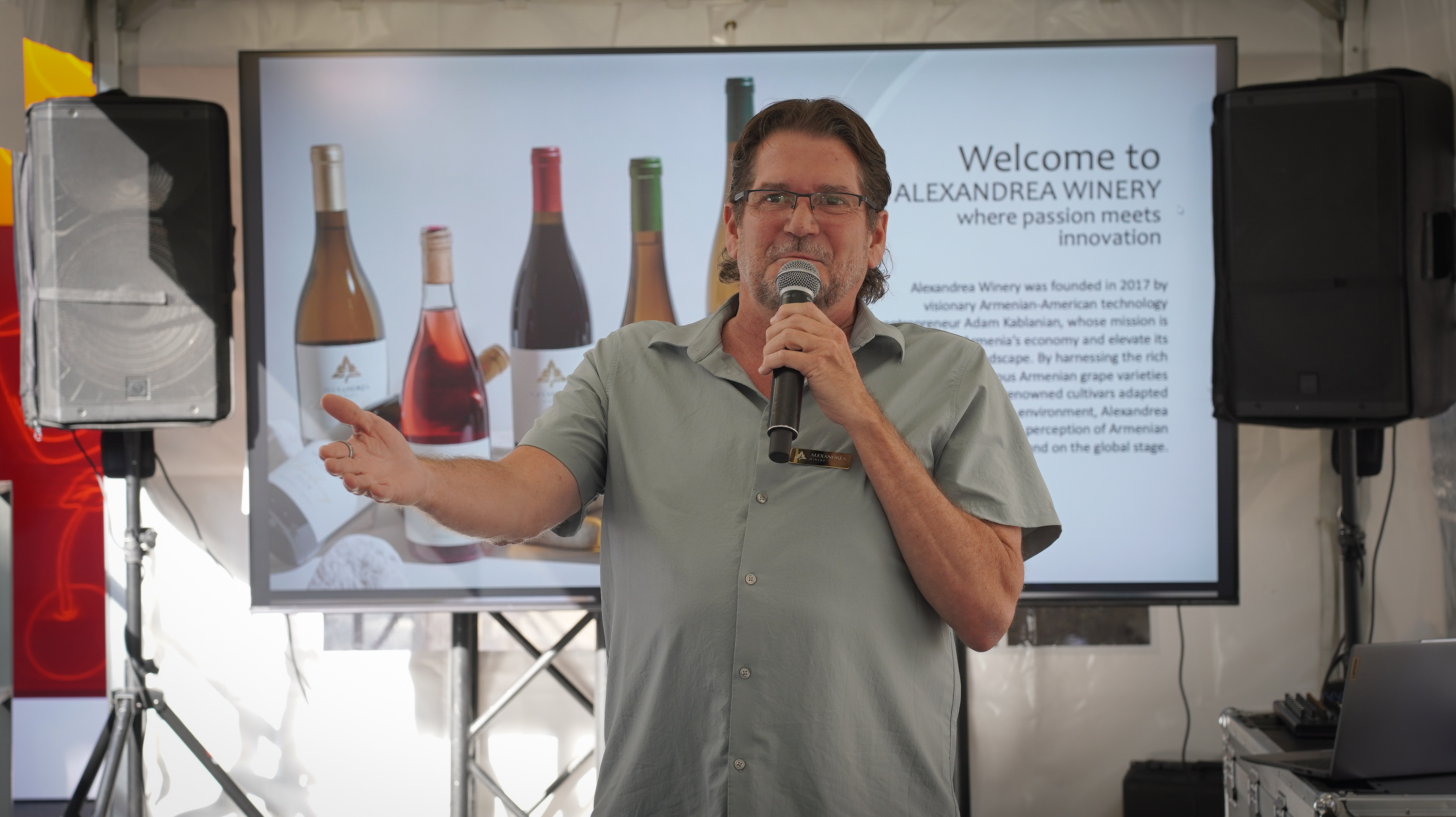
Throughout the presentation, Ritchey returned to a single concept: balance. When an audience member asked whether each wine has a different set of balance criteria, he offered his most extended meditation on the subject.
"Wine can be a little bit esoteric, right? What is balance?" he said. "To me, balance is when all the components of the wine come together and don't fight with each other. I'm sure you've tasted a really ripe Zinfandel or Cabernet where it's just jammy and too much, and it overwhelms you. You have to find the balance for each wine. Part of that is understanding what the intensity of the wine is."
He contrasted California and Armenia directly. "In California, the growing season is much longer, much milder. You get a lot of concentration, so you can put a lot of oak or a lot of alcohol. In Armenia, because there's much more heat and it's a shorter growing season, you have to pay attention to the intensity of the wine. If there's not a lot of intensity, you can't put a lot of oak or a lot of acid or a lot of alcohol."
The result, when balance is achieved, is almost subliminal. "When the tannins, the fruit, the alcohol, the sugars, the flavors are all balanced, you actually feel the wine. You taste it and go, 'This is really good,' but you don't really know why because everything's balanced and you kind of just feel it. Then when you smell it a little more, taste it a little more, you realize there's so much complexity in it."
He offered a concrete example: Alexandrea's upcoming reserve blend (mostly Khndoghni with Malbec and Petit Verdot). "It has so much intensity, it's amazing. So I can put new oak on it — even though it has 50% new oak on it right now, it doesn't taste like it because the concentration just lifts it up. It's in balance."
VIII. The Challenges of a Frontier Wine Economy
When asked directly about his biggest challenge as a winemaker in Armenia, Ritchey did not hesitate.
"The wine industry here is developing right now, and they're doing a wonderful job. If you taste the wines all over here, up and down, they're making great wines. The challenge is, the nearest big wine producer is Italy. In California, there's 5,000 wineries. If I need a tank, I can call somebody and it'll be there the next day. If we need a tank here, I have to find a producer. It has to be manufactured. It has to be shipped. It has to go through customs."
He added labor logistics to the list. "In California, we have lots of picking crews. Here, trying to arrange picking can be a challenge. There's a lot of logistics that I have to deal with. But we're figuring it out."
An audience member — Tamar Burjanadze — asked about the weather: "Okay. Uh in Caucasian region; it.. the weather can be a big challenge. Uh so uh how many sunny days that the grapes need for it to be ripened and it's good for the wine making?"
Ritchey acknowledged the complexity of the question. "It depends on the region. Right here in Proshyan and Nor Yedesia, we still get a lot of sunny days, and the days are long, but they're very hot, and the sun's very hot. We do get sugar, we do get ripeness. The challenge is getting the flavor intensity. The longer the grapes can be on the vine, the more flavor you get."
The calendar is the enemy. "Once we reach October here, you never know what the weather's going to do. In California, I've picked the week before Thanksgiving. Here, we're usually starting at the end of August and hoping to be done by mid-October. You never know what mother nature's going to throw at you. It could be hot in October. It could be snowing in October. You have to pay attention — especially during harvest, because if you see a rainstorm coming in, you might have to pick your grapes early. You don't want them to rot on the vine."
IX. The Future: Estate Winery, 2028 Icon, and the Reserve Blend
Despite the headwinds, Alexandrea is expanding. Ritchey disclosed that the winery is in the design phase of a new estate winery on the Proshyan hill, overlooking the Pinot Noir vineyards with a direct sightline to Mount Ararat. While the facility will not be gravity-fed, it will use equipment designed to simulate gravity-flow techniques, ensuring the gentlest possible handling of the grapes.
"We're right in the middle of designing the winery," he said. "It's going to go right here, up on a hill. It overlooks the Pinot Noir vineyard right to Mount Ararat. It's stunning. It's going to be amazing."
He acknowledged the uncertainty of Armenian construction timelines with a wry laugh. "I've helped design and build three wineries in California, so I know the process. But I don't know the exact process for construction in Armenia." The audience laughed with him. The winery will include an event center, wedding facilities, and a restaurant.
On the wine front, Alexandrea has eight current labels and four additional blends coming from the Nor Yedesia vineyard: a Malbec (on its own), a Sireni, a Bordeaux blend, and a reserve blend (mostly Khndoghni with Malbec and Petit Verdot). "We were tasting it last night," Ritchey said. "It's going to be amazing. But one of the challenges of being a winemaker is you have to wait. It's going to be in barrel for one more year, then we put it in bottle, then we have to let it age for another six months. In a year and a half, look for our cuvée."
A flagship icon wine is slated for release in 2028.
X. Two Spotlights: Owines and Sargsyan
Alexandrea was not the only winery presenting at the Wine and Gastronomic Business Talks, but it was the most technically forthcoming. Two others provided on-the-record information.
Owines, represented by Ara SH, focuses exclusively on Red Areni from the southern Vayots Dzor region (Aghvanadzor). Ara SH, an IT worker by trade, described winemaking as his "getaway" — an escape into nature. The winery practices sustainable agriculture with minimal, "only as needed" chemicals, resulting in a deliberate medium yield. Preservation of the environment, he said, is paramount.
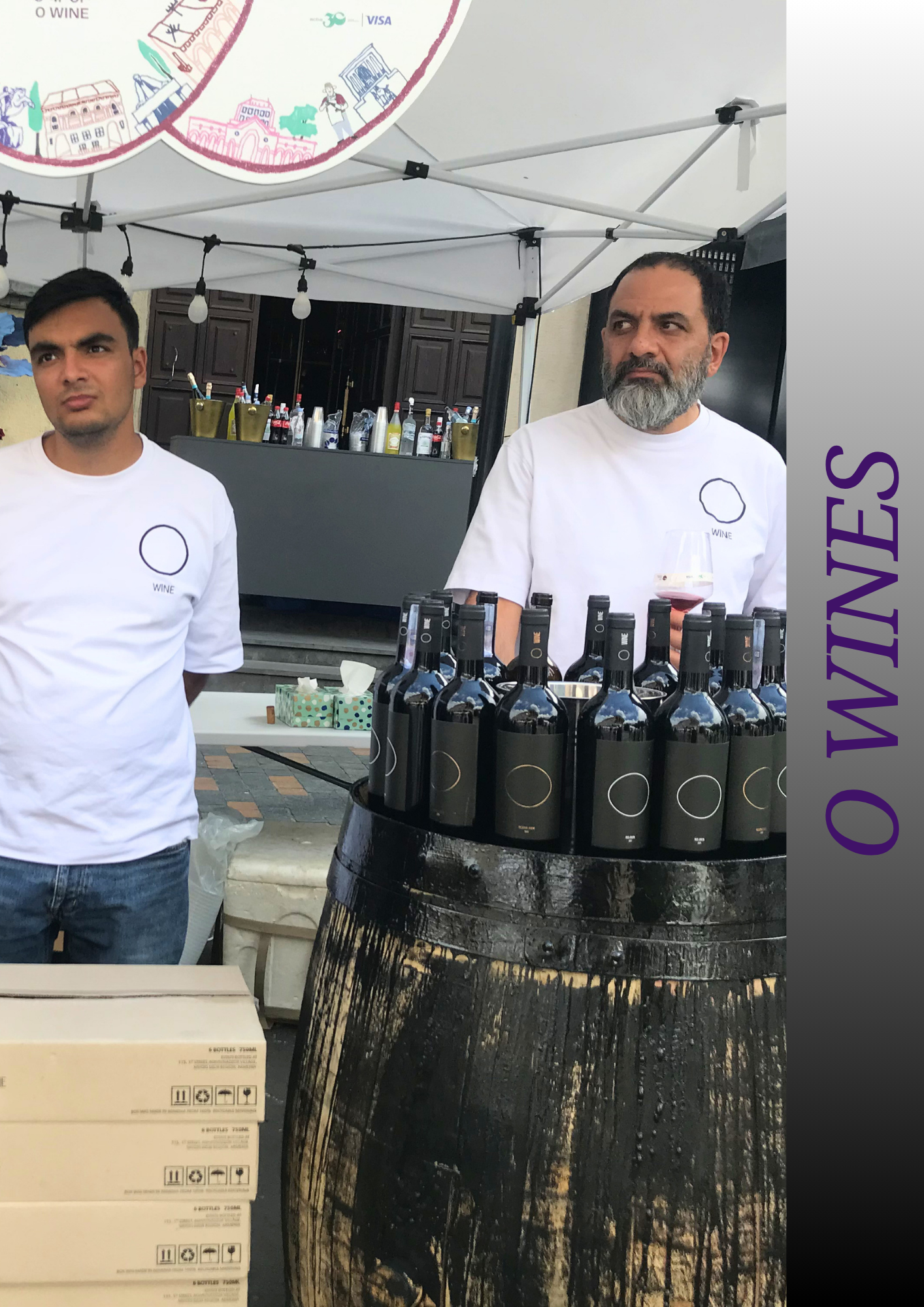
Owines produces two wines from the same grape: O Wine (young, bold, 14% ABV) and O Reserve (aged, sweeter, oakier). Both are aged for 12 months in oak barrels. A visual signature: when you swirl O Wine, an "O"-shaped ring forms along the interior walls of the glass. "Everything about O Wine starts with O," Ara SH said. "It's a full circle from our traditions to modern life."
Editorial note: As of June 13, 2026, Owines had not responded to IRCNA's requests for technical clarifications. This article will be updated if a response is received.
Sargsyan Wines by Ararat Wine Factory operates at a different scale entirely. Founded in 1906, it is the largest cognac, wine, and vodka factory in Armenia, with more than 120 years of uninterrupted operation. In 2025, the company rebranded from Ararat Wine Factory to Sargsyan Wines, describing the change as "a return to origins, a family-driven vision shaped by dedication, continuity, and respect for heritage."
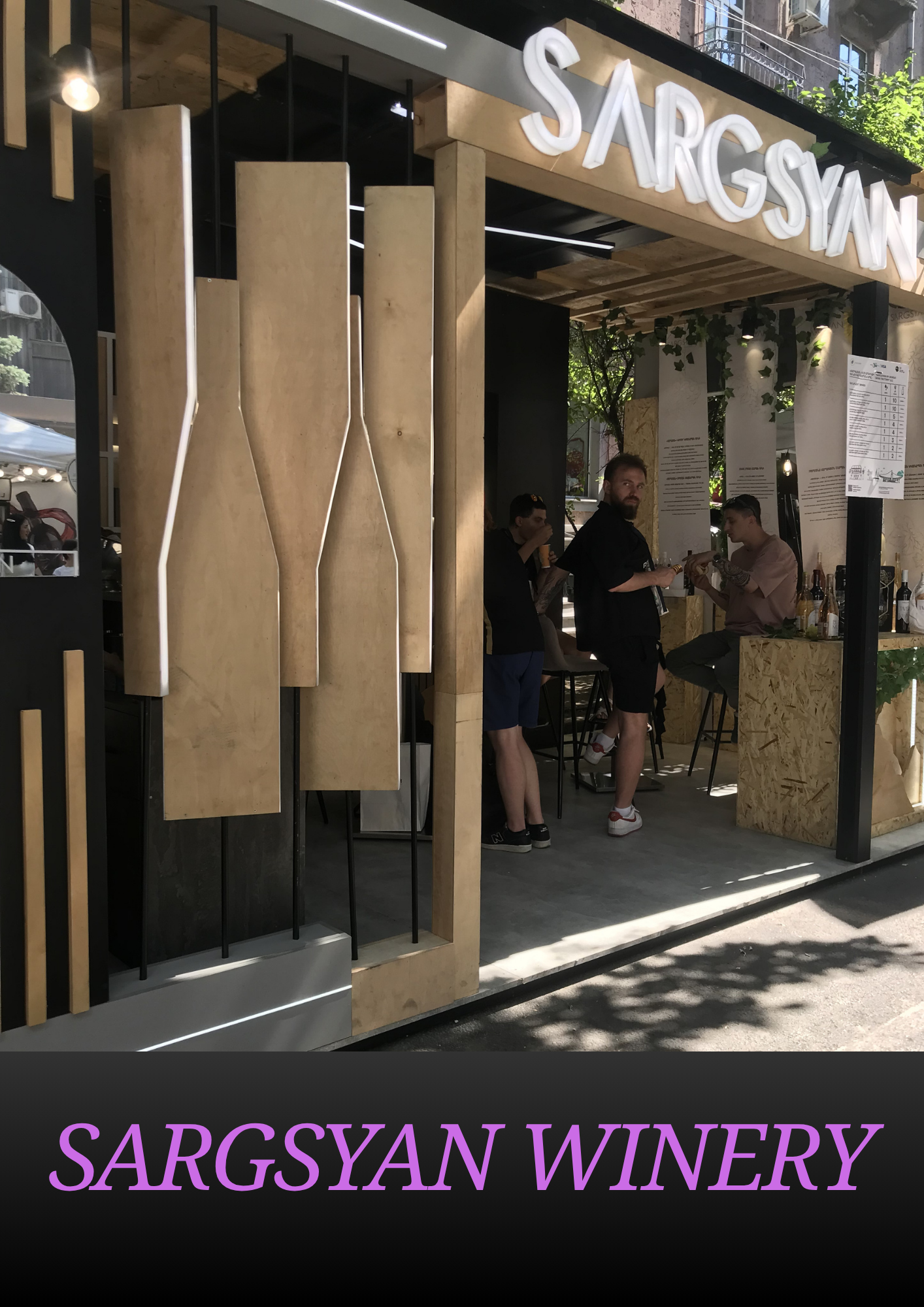
Unlike Alexandrea's detailed disclosures, Sargsyan provided no technical data on vineyards, altitudes, or aging protocols. Their participation appeared focused on brand continuity rather than operational transparency.
XI. The Response Problem
IRCNA contacted 17 additional wineries for interviews or written comments following Yerevan Wine Days 2026. As of June 13, 2026, only two responded: Owines (partial, with pending clarifications) and Sargsyan (corporate overview, no technical data). No other wineries replied.
This silence — whether due to capacity constraints, disinterest, or the post-festival lull — means the wine sector profile presented here is necessarily limited to those producers willing to speak on the record. The full story of Armenian viticulture at Yerevan Wine Days 2026 remains, in significant part, untold.
XII. Conclusion: The Liquid Evidence of Private Investment
The wine poured on Saryan Street during the 10th anniversary of Yerevan Wine Days is not simply the product of volcanic soil and California expertise. It is the liquid evidence of a private sector learning to build, scale, and survive without state funding.
Alexandrea Winery broke 70 centimeters of volcanic stone by hand, imported Japanese machinery, installed anti-hail nets, and spent five years fermenting Chardonnay at different elevations to find the middle slope. They produced Armenia's first commercial Pinot Noir, structured across three plots as skeleton, flesh, and humidness. They brought a 31-year veteran winemaker from California to the Caucasus and trusted him to listen to what the vines said.
The challenges remain — supply chains that run through Italian customs, October snowfalls that can destroy a harvest, a construction timeline no one can predict. But the wine in the glass, at least from Alexandrea, suggests the gamble is paying off.
Jeff Ritchey was asked, near the end of the presentation, what his favorite Alexandrea wine is. He admitted he initially scoffed when Adam Kablanian planted Muscat. "I was like, 'Oh god, why did you plant Muscat?'" Now, he said, "It's my favorite wine. It's delicious. It's delicate. It's complex. It's beautiful."
That is the arc of Alexandrea Winery — and, in microcosm, of the wine sector at Yerevan Wine Days 2026. Skepticism, patience, and the willingness to break rock eventually yield something worth raising a glass to.
Sources for Pillar One:
- Live presentation by Karen Gabrielyan and Jeff Ritchey (Alexandrea Winery), with English translation by Alex, Wine and Gastronomic Business Talks, Saryan Street, Yerevan Wine Days 2026 (June 5). Transcript provided by IRCNA.
- Email correspondence from Nvard (Alexandrea Winery Communications Representative), received June 13, 2026.
- Floor interview with Ara SH (Owines), Saryan Street, June 6, 2026.
- Audience question from Tamar Burjanadze, documented on-site, June 5, 2026.
- Written correspondence from Sargsyan Wines by Ararat Wine Factory, received June 2026.
- Firsthand tasting notes, on-site, June 5–6, 2026.
Correction note: The presentation transcript which can be found on our Youtube Channel originally rendered "humidness" as "humanness." The correct term, as confirmed by source materials, is "humidness" — referring to forest-floor earthiness.
Pillar Two: Olé Yerevan – A Spanish Chef’s Wine Pairings and the Armenian Grape Leaf
TLDR
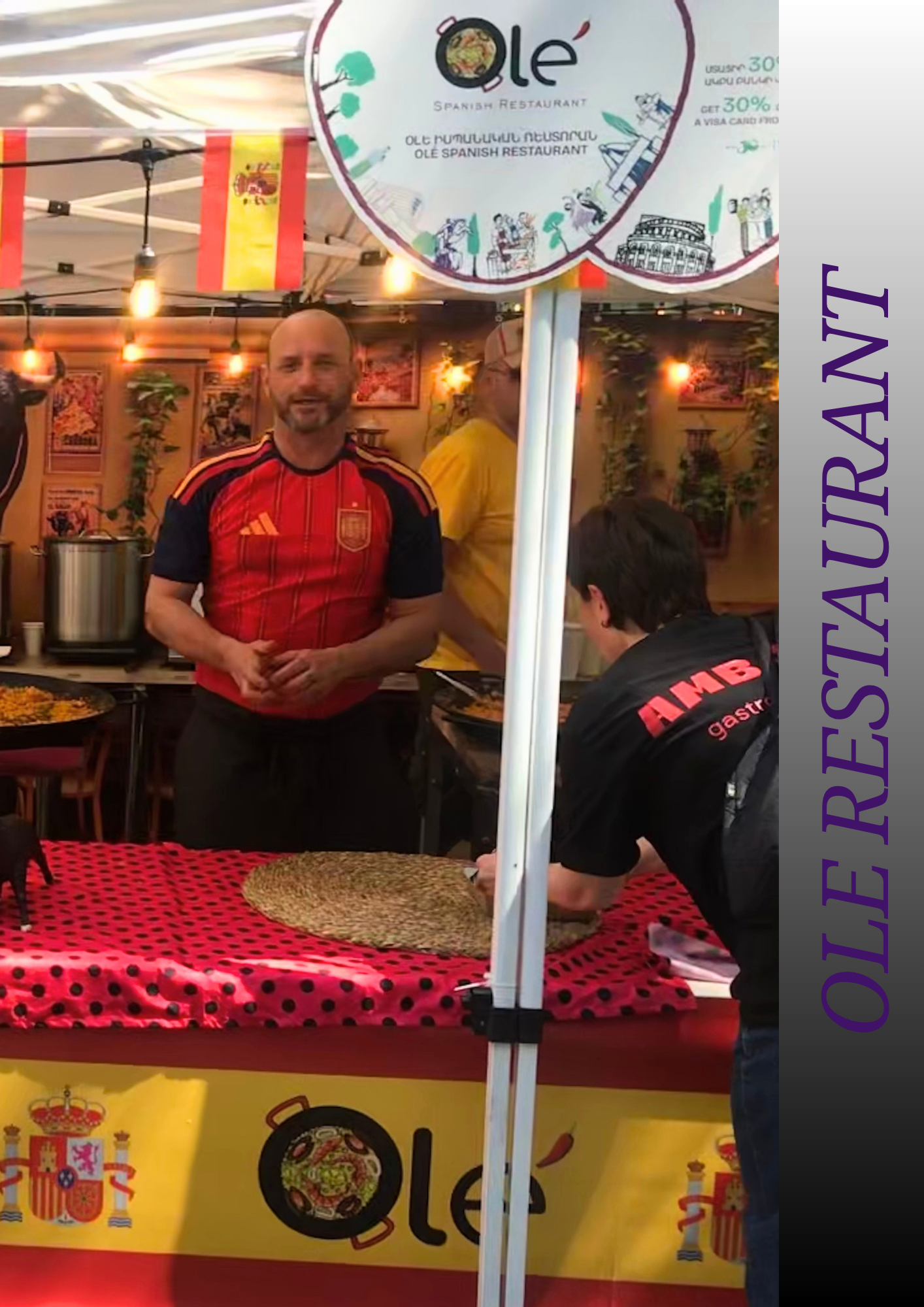
On the afternoon of June 7, Chef Antonio stood in the Talks tent. Elizabeth B. stood immediately to his right, translating his Spanish into English in real time. Antonio had been cooking since age twelve. He is now forty‑three. He has worked across Europe, and he runs Olé Yerevan at 52/2 Mashtots Avenue – a restaurant that sources 50% Iberico Cebo de Campo and Galician octopus into landlocked Armenia.
His presentation covered the history of tapas (King Alfonso X, 11th century), regional naming conventions (Andalucía vs. País Vasco), and the strict timing of tapas (12‑4pm and 8pm‑midnight). He corrected two common misconceptions: paella is a Sunday lunch, never eaten at night; and sangria is largely for tourists – Spaniards drink tinto de verano, calimocho, rebujito, and clara.
His wine pairing framework was classical: white with fish and seafood, red with stewed meat and jamón ibérico, rosé with gazpacho and seafood, sweet wine with desserts and cheeses. He noted that sweet wine exists in both Andalucía and Armenia – a small bridge between cultures.
The most significant moment came when I asked him, in Spanish, about fusing Armenian and Spanish cuisines. He answered without hesitation: la hoja de la parra – the fresh grape leaf. Armenian grape leaves, he explained, are higher in acid than Spanish ones. That acidity can balance the rich fats of Iberian pork and the oiliness of seafood. His proposal: wrap slow‑cooked Iberian meat or fresh white fish in Armenian grape leaves, grill or steam, serve as a tapa.
Olé Yerevan’s presentation proved that gastronomy is not a side attraction to wine – it is an equal partner. Antonio did not just pour samples. He taught history, corrected myths, and proposed a fusion grounded in ingredient science, not novelty.
Between the courses
The Olé presentation demonstrated why the Wine and Gastronomic Business Talks mattered. The main festival had dozens of food stalls, but only the Talks offered a chef explaining why a rosé works with gazpacho or how a grape leaf can solve a structural problem of fat and acid.
In the macro article, Olé represents the second pillar: authentic international hospitality integrating into Yerevan’s culinary landscape. Antonio’s willingness to adapt – using an Armenian ingredient to improve Spanish tradition – shows that gastronomic exchange is not about replacement. It is about listening, then translating.
(Full article follows – collapsible)
Full Article: The Marriage between Wine and Gastronomy | La Hoja de la Parra – Olé Yerevan
The Marriage between Wine and Gastronomy | La Hoja de la Parra
How a Spanish Chef in Yerevan Paired Wine, Corrected Sangria Myths, and Found Armenia's Secret Weapon: The Grape Leaf
By Mikael Yamiosei | IRCNA
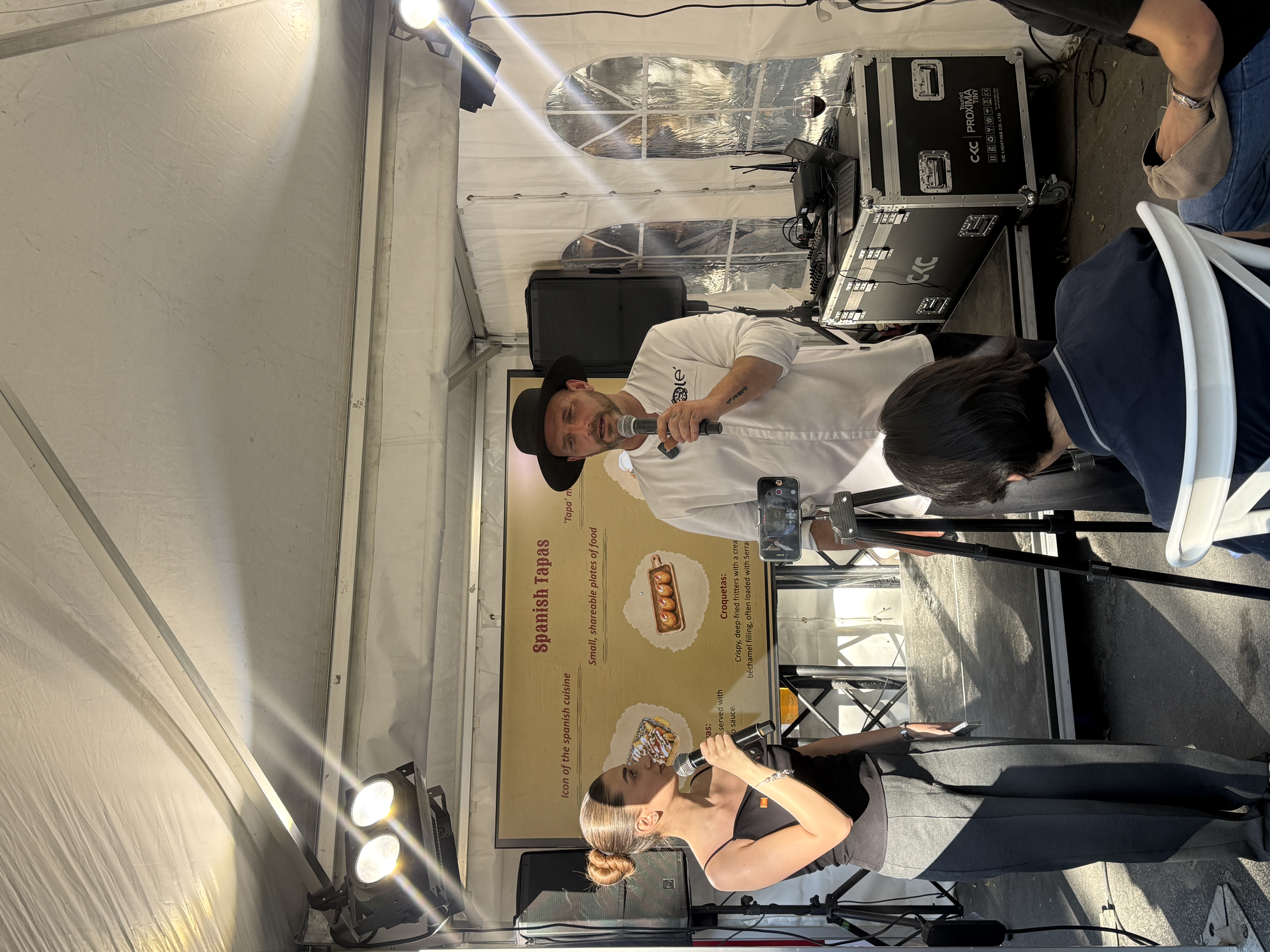
YEREVAN — The voice was Spanish. The translator, Elizabeth B., stood immediately to his right, converting his words into English in real time. The audience sat on folding chairs on Saryan Street, part of the Wine and Gastronomic Business Talks at the 10th anniversary of Yerevan Wine Days.
Chef Antonio, head chef of Olé Yerevan, had been cooking since he was twelve years old. He was now forty‑three. He had worked across Europe representing Spanish cuisine. And on the afternoon of June 7, 2026, he spent about half an hour explaining to an Armenian audience how to pair wine with jamón ibérico, why paella is never dinner, and which Spanish wine cocktail is actually a tourist trap.
But the moment that changed the tenor of the talk came when I asked him, in Spanish, about fusion. His answer was not about blending traditions into a muddy middle. It was about a single ingredient: la hoja de la parra — the grape leaf. He saw in Armenia's high‑acid grape leaves a structural solution to the richness of Iberian pork and the oiliness of Galician seafood.
What followed was not a recipe. It was a philosophy of culinary translation — and a rare public window into how an international chef thinks about adapting to a new food culture without betraying his own.
The Chef and His Restaurant
Antonio did not plan to come to Armenia. "Me ha tocado venir aquí," he said — it fell to me. But once here, he built Olé Yerevan at 52/2 Mashtots Avenue with a clear goal: transport guests to Spain. "Cuando llegas al restaurante, todo el mundo que ha estado en España va a sentir la misma sensación — la comida, el sabor, el diseño, la música." (Translation: "When you arrive, everyone who has been to Spain feels the same sensation — the food, the flavor, the design, the music.") His staff, he said, have absorbed that spirit. "Se sienten un poco como españoles – son muy alegres, muy felices." ("They feel a little like Spaniards — very joyful, very happy.")
He runs the place under serious logistical constraints: landlocked Armenia is not the natural home for Galician octopus or acorn‑fed Iberian ham. Yet he maintains direct sourcing for 50% Iberico Cebo de Campo and European seafood programs. He also spoke with genuine admiration for local Armenian produce — fresh vegetables and fruits that, to him, feel Mediterranean.
The Architecture of Wine and Food
Antonio's wine‑pairing framework was classical, crisp, and entirely portable to an Armenian table.
- White wine – pescado, marisco, fruta (fish, seafood, fruit‑forward dishes).
- Red wine – carne guisada, jamón ibérico (stewed meat, Iberian ham).
- Rosé wine – gazpacho, salmorejo, bebidas refrescantes, también mariscos (gazpacho, salmorejo, refreshing drinks, and also seafood).
- Sweet wine – postres y quesos (desserts and cheeses). He noted that sweet wine exists in both Andalucía and Armenia — a small bridge between the two cultures.
He did not linger on technicalities. The framework was offered as a working tool, not a dogma. But its clarity was useful: a white for light proteins, a red for heavy meats, a rosé for summer soups and seafood, and a sweet for the final course.
Then came the cocktail list. When an audience member asked what Spaniards drink with wine as a base, Antonio ran through the standards:
- Tinto de verano – red wine with lemon soda.
- Calimocho – red wine with Coca‑Cola.
- Rebujito – white wine with Sprite or lemon soda (the drink of Seville's April fair).
- Clara – beer with lemon soda, for midday.
And then he delivered a necessary correction. "Se nota que los españoles no toman sangría para turistas." ("You can tell that Spaniards do not drink sangria — it's for tourists.") He softened it slightly: they do drink it occasionally in summer. But the association with tourism is accurate. For anyone who has ordered sangria in Madrid and received a knowing smile, this was vindication.
The Cultural Corrections: Paella and Timing
Antonio also corrected a misconception that has taken root in Armenia: paella as a dinner dish.
"El arroz no lo comiendo por la noche," he said flatly. ("Rice is not eaten at night.") In Spain, paella is a Sunday family lunch, prepared outdoors, watched as it cooks, accompanied by tapas along the way. "Una reunión familiar, conectar todos juntos, ver cómo se prepara, comerse una tapa mientras que estamos preparando." ("A family reunion, connecting everyone together, watching how it is prepared, eating a tapa while we prepare.")
The Armenian habit of serving paella in the evening, he implied, is a local adaptation — not a crime, but not tradition either.
Tapas themselves follow a strict clock: from 12:00 to 4:00 PM, and again from 8:00 PM to midnight. This was offered in response to an Argentinian audience member who noted that her country eats much later. Antonio did not budge.
The Fusion Question
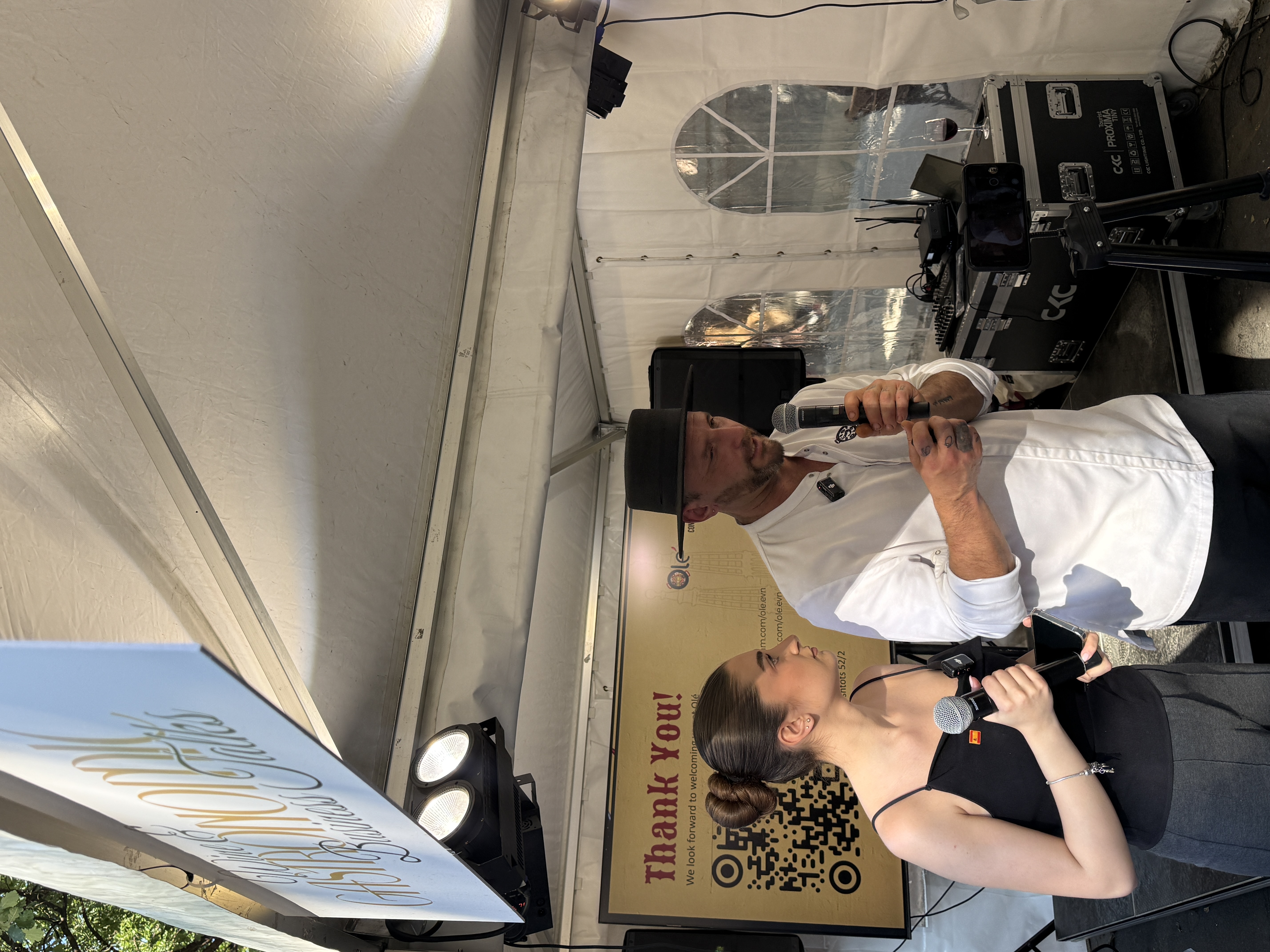
Midway through, I asked him in Spanish: if you could fuse something from Armenian cuisine with Spanish tradition, what would it be?
His answer was immediate and specific.
"La hoja de la parra." The grape leaf.
In southern Spain, he explained, grape leaves are used to wrap slow‑cooked meats, fish, or rice mixtures. The leaf adds a subtle vegetal note and acts as a natural vessel. But Armenian grape leaves, he had discovered, are different: they are fresher and significantly higher in acid than their Spanish counterparts.
That acidity, he argued, is not a problem — it is a solution. It can cut through the rich, heavy fats of Iberian pork (jamón ibérico, chorizo) and balance the oiliness of seafood like Galician octopus or boquerones. His proposal: wrap slow‑cooked Iberian meat or fresh white fish in fresh Armenian grape leaves, then grill or steam, and serve as a tapa.
"Yo siempre tiro por mi zona. Mi zona es del sur," he said. ("I always lean toward my zone. My zone is the south.") But he saw no contradiction. The Armenian leaf, in his view, is an improvement on the ingredient he grew up with.
This was not fusion as novelty. It was fusion as engineering — using a local ingredient to solve a structural problem.
The Sobremesa and the Chef's Philosophy
Asked whether he preferred the main dish or the after‑meal lingering (sobremesa), Antonio chose the latter without hesitation.
"A mí me gusta más la sobremesa... es como picar un poco. Al final la sobremesa es tapear, comer pequeñas porciones de comida. Al final a mí un plato grande no me gusta, me gusta el producto." ("I prefer the after‑meal lingering... it's like snacking a little. In the end, the after‑meal is about tapas, eating small portions of food. In the end, I don't like a large plate — I like the product itself.")
This is the core of his cooking: the tapa is not a menu category but a way of eating — small, focused, ingredient‑driven. It is the opposite of the oversized, sauce‑heavy plate. And it is why his wine pairings are simple: let the product speak, let the wine support, let the conversation continue.
He also gave a short masterclass on jamón ibérico: look at the fat and the condition of the ham. Learn the label colors — black, green, white — which indicate purebred versus crossbreed. "Extremadura y Huelva es donde se crían," he said. ("Extremadura and Huelva are where they are raised.") Olé serves 50% Iberico Cebo de Campo — a solid, honest grade.
The Silence of the Rest
Before, during, and after Yerevan Wine Days, I contacted eight restaurants and gastronomic businesses for interviews or comments. As of June 13, 2026, none responded. Olé Yerevan's presentation was the only restaurant‑sector contribution to the Wine and Gastronomic Business Talks that yielded original, on‑the‑record material.
That silence is worth noting. It does not indicate failure or unwillingness — only that the full story of Yerevan's restaurant scene at the festival remains, for now, partial.
Conclusion: The Leaf as Bridge
Antonio will be a chef until the end, he said. "Voy a más la cocina." ("I am going further in cooking.") That drive is visible in his willingness to adapt — not by abandoning Spanish tradition, but by finding an Armenian ingredient that makes that tradition better.
The grape leaf is small, green, and abundant. It has wrapped dolma in Armenian kitchens for centuries. Antonio looked at it and saw something else: a high‑acid counterweight to the fatty richness of his homeland. That act of seeing — of translating between cuisines without erasing either — is the quiet work of hospitality at its best.
On Saryan Street, on a warm June afternoon, a Spanish chef stood with a translator at his right and told us how to pair wine, when to eat paella, and why sangria is for tourists. Then he told us about a leaf. That leaf is now, for me, the image of this year's Wine and Gastronomic Business Talks: a small bridge between two coasts of the same sea.
Sources
- Live presentation by Chef Antonio (Olé Yerevan), with live English translation by Elizabeth B. (standing immediately to his right), Wine and Gastronomic Business Talks, Saryan Street, Yerevan Wine Days 2026 (June 7). Transcript provided by IRCNA.
- Restaurant address: 52/2 Mashtots Avenue, Yerevan.
- Brief stall visit (June 7) – by mutual agreement, the presentation serves as the informal interview; no follow-up needed.
Eight additional restaurants were contacted before, during, and after the festival. None responded as of June 13, 2026.
Pillar Three: TUMO Gyumri – A €2.5 Million Bet on Urban Recovery
TLDR
Hulé Kechichian, Head of Special Projects at TUMO, walked the audience through a project that has nothing to do with wine and everything to do with gastronomic infrastructure. The TUMO Gyumri Culinary School and Covered Market sits on more than 7,500 square metres of land two minutes from Gyumri’s City Hall. That land was once home to a century‑old covered market, one of the busiest in the Soviet Union. In 2010, it was sold to a private developer who demolished the market, displaced the vendors, and never built the promised mall. The vendors moved to the sidewalks, where they still sell produce today – except in winter, when Gyumri drops to -10°C and their products freeze solid. They take loans in winter and repay them in summer.
TUMO’s plan has three parts: rebuild the covered market (two buildings – one for vegetables, one for meat), open a tuition‑free culinary school, and surround both with restaurants and shops whose lease payments will fund the school indefinitely. The school will use a smart kitchen station – cameras, sensors, and artificial intelligence that watch a student’s knife cuts, detect burning smells, and read the colour of browning meat. Not a robot that cooks for you, but a robot that teaches you.
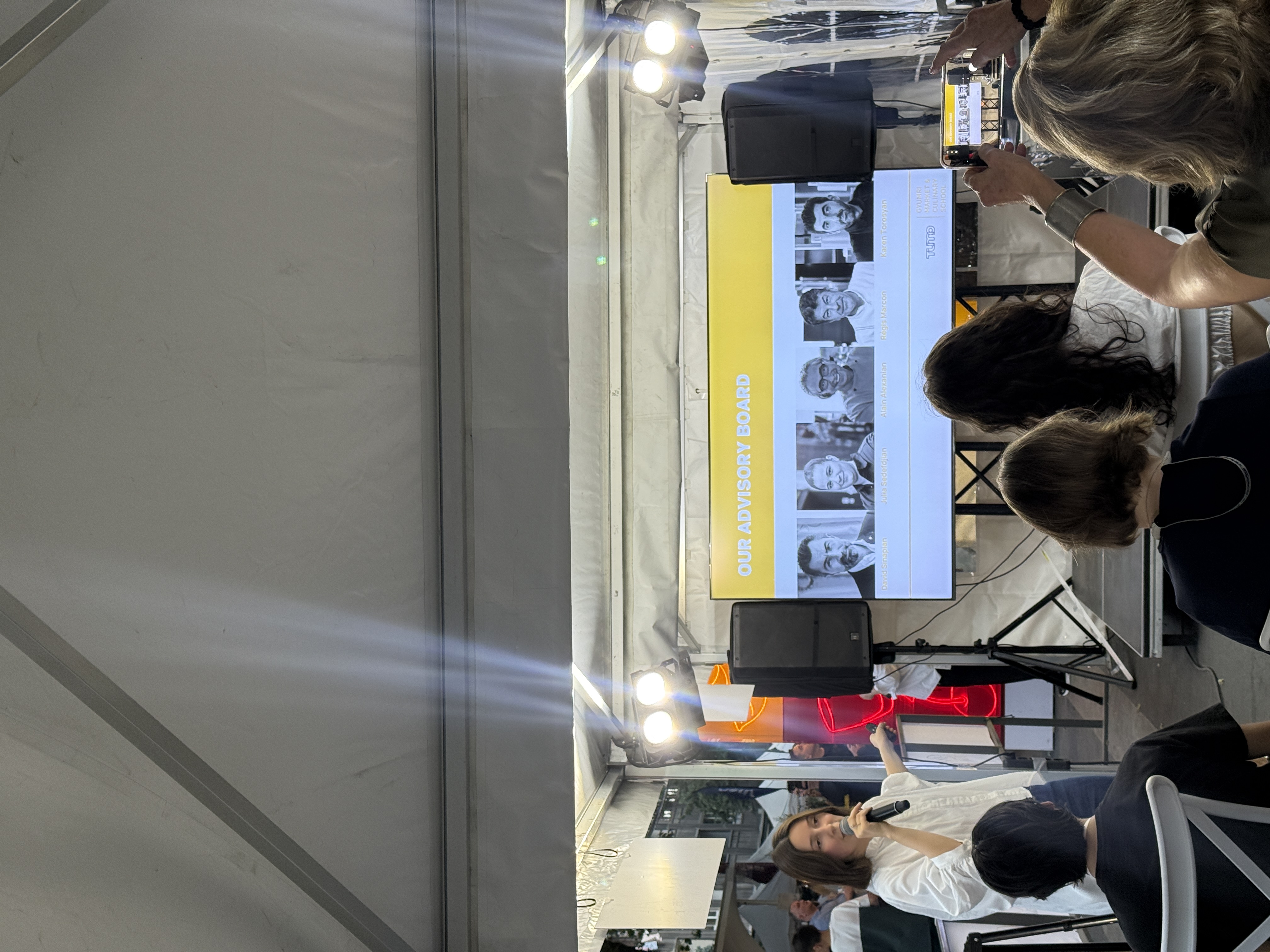
The €2.5 million grant comes from the European Union, signed in March 2024. The architectural competition drew more than 150 submissions from six continents; the winner was Aram Mooradian Studio, which proposed an ecosystem of small buildings around a public garden, built from local tufa, basalt, and upcycled Soviet steel. The advisory board includes David Sinapian (Groupe Pic), Julia Sedefdjian (youngest Michelin star at 18), Alain Alexanian (Lyon‑born, now working with Armenian herbs), Régis Marcon (three Michelin stars), and Karen Torosyan (two Michelin stars, born in Tbilisi).
This is not a wine project. It is a project about how gastronomy can reverse urban decline, break predatory debt cycles, and offer free vocational education – all without relying on donations.
Between the bricks
The TUMO presentation was the most unexpected session of the Talks. It had no wine, no food, no tasting. It had a land dispute, a smart kitchen, and a Michelin‑starred advisory board. Its presence in the programme proved that the Wine and Gastronomic Business Talks were not narrowly focused on drinking. They were about the entire ecosystem that supports wine and food – from soil to infrastructure.
In the macro article, TUMO supplies the third pillar: tech‑driven infrastructure as a form of private‑public collaboration (EU grant, TUMO’s self‑sustaining lease model). It shows that gastronomic development is not just about restaurants and wineries – it is about markets, schools, and the courage to reclaim a demolished site.
(Full article follows – collapsible)
Full Article: The Marriage between Wine and Gastronomy | A New Gastronomic Bet on Gyumri
The Marriage between Wine and Gastronomy | A New Gastronomic Bet on Gyumri
How TUMO’s €2.5 Million Culinary School and Covered Market Aims to Reverse a Half‑Century of Urban Shrinkage
By Mikael Yamiosei | IRCNA
YEREVAN — The rain arrived halfway through the presentation. It came down hard on Saryan Street, drumming against the temporary canopy, and the audience of winemakers, chefs, and journalists realized they were not going anywhere for a while. Hulé Kechichian, Head of Special Projects at TUMO, looked out at the soaked crowd and smiled. Near the end of her talk, she would say: “Now that we’ve all gathered and you cannot leave, do you have any questions?”
The joke landed because it was true. A sudden June downpour had turned the Wine and Gastronomic Business Talks into a captive audience. And for the next hour, Kechichian delivered the most ambitious proposal of the entire 10th anniversary of Yerevan Wine Days — not about wine, but about a derelict market in Gyumri, a mountain of reclaimed Soviet steel, and a free culinary school that runs on artificial intelligence.
The project is called the TUMO Gyumri Culinary School and Covered Market. It sits on more than 7,500 square meters of prime land two minutes from Gyumri’s City Hall. That land was once home to a century‑old covered market, one of the busiest in the Soviet Union, where merchants came from Georgia, Turkey, and Russia. In 2010, the public land was sold to a private developer who demolished the market, displaced the vendors, and promised a mall that was never built. The vendors moved to the sidewalks, where they still sell produce today — except in winter, when Gyumri drops to -10°C and their products freeze solid on the street.
Kechichian’s proposal is to rebuild the covered market, add a tuition‑free culinary academy, and surround both with restaurants and shops whose lease payments will fund the school indefinitely. The total budget includes a €2.5 million grant from the European Union, signed in March 2024. The architect is Aram Mooradian Studio, selected from more than 150 international submissions. The culinary partner is Institut Lyfe (formerly Institut Paul Bocuse) in Lyon. And the technology — a smart kitchen station with cameras, sensors, and artificial intelligence — is being built by TUMO Labs.
This is not a street festival. This is a bet on reversing a shrinking city.
I. The Shrinking City
Gyumri before the 1988 Spitak earthquake was a powerhouse. Kechichian called it “a very strong, active economic hub in Armenia and in the Soviet Union.” After the earthquake, the city began to shrink. It has never stopped.
TUMO opened its Gyumri center years ago — the second TUMO after Yerevan — and began noticing the demographic bleeding. They surveyed local teenagers. The results were stark: most wanted to stay in Gyumri, but felt they could not. No access to high‑quality education. No good‑paying jobs.
To understand the problem, TUMO invited a research team from MIT that specialized in shrinking cities. The team, led by Professor Brent Ryan, stayed in Gyumri for several weeks. Their conclusion, Kechichian said, was that investment in Gyumri was overwhelmingly “top‑down” — a shiny pedestrian street here, a renovated building there — but none of it created grassroots economic energy. What the city needed, the MIT team argued, was a single “bottom‑to‑top” model project: a flagship that would generate its own gravity, attracting community‑led initiatives around it.
TUMO decided to build that flagship. And they already knew where.
II. The Land: 7,500 Square Meters of Contested History
The Gyumri covered market was more than a century old. During the Soviet era, it was one of the most active agricultural markets in the region. Kechichian noted that Soviet officials once tried to close the market two days a week to benefit other markets — and failed. “Even if it was only functional five days,” she said, “people were waiting for the days that the market was open to buy their products.”
In 2010, that public land was sold to a private developer. The developer demolished the market, sparing only a few peripheral stone arches. The vendors were displaced. The planned mall was never built. Satellite imagery tracked by TUMO over two years confirmed the land remained a cleared, hollow lot.
The vendors did not leave. They settled on the surrounding sidewalks, blocking main streets, creating an ad‑hoc market with no drainage, no waste management, no protection from the elements. Kechichian described the winter reality:
“In Gyumri it can get to -10 Celsius. Even if I was strong enough to stand up here with a temperature of -10, my products freeze. I cannot. Most of them stop working in the winter. They have at least three to four months where they cannot work. They take loans that they repay working during the summer.”
That is the economic trap the project is designed to break.
III. The Three‑Fold Structure: Market, School, Revenue
Kechichian laid out the project in three interlocking parts.
First, the covered farmers market. Two buildings: one for vegetables, one for meat. The market will be strictly food‑only — no fake Gucci, no phone stalls. When TUMO held its first community meeting with the sidewalk vendors, Kechichian said the reaction was unexpected relief. “They said, ‘Oh, that’s fine. I will start selling food.’” The vendors, it turned out, wanted to return to their original trade.
Second, culinary school. A tuition‑free vocational academy for regional youth. The goal is to change the cultural perception of kitchen work in Armenia — from a low‑prestige default job for school dropouts to a respected, high‑tech craft. Kechichian contrasted this with France, where “you can be a singer or a chef and it’s basically the same thing. People want to be chefs.”
Third, restaurants and shops. Commercial spaces that will pay lease rent to TUMO. That revenue will cross‑finance the free education. Kechichian compared it to TUMO’s international franchise model, where licensing fees from abroad fund Armenian students. The project will also offer paid amateur cooking workshops for tourists, turning Gyumri from a day‑trip into a multi‑night destination.
IV. The Smart Kitchen: AI as a Teaching Assistant
The culinary school is not traditional. TUMO Labs is developing a “smart kitchen station” — a countertop equipped with cameras, sensors, and artificial intelligence.
The idea comes from TUMO’s core educational method: self‑learning. Students prepare for class by teaching themselves using digital tools, then work with instructors. When Kechichian first proposed this to chefs, she said, “their first reaction was, ‘Thank you, it’s impossible. They will burn themselves.’”
So TUMO designed a system that watches. A camera tracks knife cuts and alerts the student if a piece is too large or too small. Sensors detect smells and warn if something is burning. Another camera reads color and says, “Be careful, your meat is getting too brown.”
Kechichian was explicit: this is not a robot that cooks for you. “We want to create robots that help you learn how to cook yourself.” The station is still in development, but it is the technological core of the school’s scalability.
V. The Advisory Board: Twelve Michelin Stars in One Room
Kechichian listed the advisory board with visible pride. Five members, each with deep culinary and business credentials.
- David Sinapian: CEO of Groupe Pic, husband of Anne‑Sophie Pic (12 Michelin stars across her restaurants). He provides business and scaling expertise.
- Julia Sedefdjian: The youngest chef ever to receive a Michelin star (at age 18). French‑Armenian, dynamic, willing to help.
- Alain Alexanian: Lyon‑born Michelin star chef who closed his restaurant to focus on Armenian wild herbs. He now runs an artisanal tea company in Armenia. (He presented at Yerevan Wine Days the previous year.)
- Régis Marcon: A three‑Michelin‑star chef who helped develop the culinary curriculum for France’s Ministry of Education. Kechichian noted that his son is married to Alain Alexanian’s daughter — “basically we fished him” during a family vacation in Armenia.
- Karen Torosyan: Two‑Michelin‑star chef based in Brussels, born in Tbilisi, attached to his Armenian heritage.
This board advises on curriculum, market operations, and product sourcing.
VI. The Architecture: Upcycled Soviet Steel and an Open Garden
TUMO launched an international architectural competition. More than 150 firms submitted proposals from six continents. The jury included TUMO CEO Marie Lou Papazian, Spanish architect Iñaki Ábalos, Michelin chef Davy Tissot, art center figure Samia Yaba Christina Oshodi, and MIT’s Brent Ryan.
The winner was Aram Mooradian Studio, a London‑based firm that opened a dedicated Yerevan office for the project. Kechichian said the winning design was chosen because it rejected the idea of a monolithic mall. Instead, Mooradian proposed an ecosystem of smaller buildings around a public garden that will remain open to locals and tourists at all hours.
The construction materials are deliberately local and recycled:
- Upcycled steel from abandoned Soviet factories.
- Local tufa and basalt for the masonry.
Kechichian acknowledged the difficulty: “We’re realizing this is actually a difficult thing to do, but we want to stick to the concept.” The construction will be phased to minimize disruption to the current sidewalk vendors, who will be allowed to continue working during the build.
VII. The Funding: EU Grant and Self‑Sustaining Lease Model
In March 2024, the European Union signed a €2.5 million grant agreement with TUMO. The signatories were EU Ambassador Vassilis Maragos and TUMO CEO Marie Lou Papazian. The funds cover the capital costs of the market and school.
But the long‑term operational budget comes from lease revenue. Restaurants and shops will pay rent. Amateur cooking workshops will generate income. Kechichian noted that real estate values around the site have already begun rising simply because people know something is coming.
The school itself will remain free for students. That is non‑negotiable.
VIII. What TUMO Would Not Answer
Following the presentation, IRCNA submitted ten follow‑up questions to Hulé Kechichian, covering materials sourcing, economic impact projections, urban planning involvement, AI environmental effects, verification of the MIT and Institut Lyfe partnerships, and community engagement beyond the initial town hall. As of June 13, 2026, no response has been received.
This silence does not invalidate the project. But it does mean that certain details — particularly how TUMO plans to mitigate the environmental impact of its AI infrastructure, and the exact structure of community governance — remain unverified by independent journalism. Those gaps will be noted in any future reporting.
IX. The Rain and the Road Ahead
Kechichian ended her presentation with a practical joke. The downpour had not stopped. The audience was soaked, and the streets outside Saryan Street were flooding. She looked out at the captive crowd and said: “So now that we’ve all gathered and you cannot leave, do you have any questions?”
There were questions. About timelines (the school is expected to open in phases starting in 2027). About the vendors (they will have first priority for stalls in the new market). About the AI station (still in development, no release date). About the name of the French culinary partner (Institut Lyfe, confirmed via separate verification).
But the deepest question was unspoken: can a single building project reverse a half‑century of population decline?
The MIT study said yes — if it is the right kind of project. Bottom‑up, community‑anchored, economically self‑sustaining. TUMO’s bet is that a covered market, a free culinary school, and a smart kitchen station can generate the gravity that Gyumri has lacked since 1988.
The rain stopped eventually. The audience left Saryan Street. The vendors on Gyumri’s sidewalks will endure another winter of frozen produce and predatory loans. The construction has not yet begun. But the bet has been placed.
Sources
- Live presentation by Hulé Kechichian (Head of Special Projects, TUMO), Wine and Gastronomic Business Talks, Saryan Street, Yerevan Wine Days 2026 (June 6). Full transcript provided by IRCNA.
- Project description and architect announcement:
market.tumo.org(accessed June 13, 2026). Meta description confirms “catalyze economic, cultural and sustainable development… education, empowerment, a cooperative model, market space and tourism.” - EU grant: €2.5 million agreement signed March 2024 between EU Ambassador Vassilis Maragos and TUMO CEO Marie Lou Papazian, cited in EU Neighbours announcement (March 2024).
- Architectural competition: Aram Mooradian Studio selected from >150 submissions; jury included Brent Ryan (MIT), Iñaki Ábalos, Davy Tissot, Samia Yaba Christina Oshodi, and Marie Lou Papazian. Verified via market.tumo.org.
- Follow‑up inquiries: Ten questions submitted to Hulé Kechichian on June 7th, with a follow up on June 9th, 2026. No response as of June 13, 2026. This is noted transparently.
Why the Wine and Gastronomic Business Talks Matter
 (1).jpg)
TLDR
The Talks were not an accident. They were the result of Marianna Vardanyan, Project Manager and International Partnerships Manager at EventToura, believing that wine and gastronomy belong together. The first gastronomic show was in 2023. In 2024, USAID backed an expansion to two stages, bringing chefs from sixteen countries. In 2025, after USAID closed, EventToura cut back, merging the gastronomic show into Wine Days. In 2026, Marianna planned the Talks in one month, with limited financial aid, because she thought Armenia’s talented chefs and good ingredients deserved a stage.
I first saw Marianna on June 5, 6, and 7, working behind the scenes – setting up, coordinating speakers, solving problems. I knew her only through email until the end of the festival, when her coworker Gohar introduced us. We were both surprised to realise we had crossed paths repeatedly without knowing it.
The Talks were free. That was non‑negotiable. People come to Wine Days for different reasons – some to drink, some to eat, some to learn. The Talks were for the ones who wanted depth. Marianna described the 2026 edition as a miracle. She hopes next year to move the Talks to Republic Square, where larger capacity can accommodate growing interest. And she noted something remarkable: the festival ran alongside national elections. A celebration centred on alcohol took place peacefully in a democratic process. She called it a “miracle and democratic”.
“The wine and gastronomy industry go hand in hand,” she said.
That sentence became the thesis of everything I witnessed in the tent on Saryan Street.
Between the tent poles
The Marianna article is not a profile. It is the connective tissue that holds the three pillars together. Without the Talks, Jeff Ritchey would have answered my questions in thirty seconds at a crowded stall. Chef Antonio would have poured wine without explaining the history of tapas. Hulé Kechichian would have had no audience for her Gyumri market presentation.
The Talks turned a drinking festival into a learning festival. They gave vendors a way to connect deeply with customers. They gave the audience a place to sit, ask questions, and taste with context. And they were built by a private organisation that refused to give up after a major funder withdrew.
(Full article follows – collapsible)
Full Article: The Marriage between Wine and Gastronomy | Why the Talks Matter
The Marriage between Wine and Gastronomy | Why the Talks Matter
Wine and gastronomy go hand in hand: three days of deep dives, one‑month planning, and the private platform that made Yerevan Wine Days 2026 more than a street party
By Mikael Yamiosei | IRCNA
YEREVAN — I met Jeff Ritchey at his stall on Saryan Street. He was pouring Alexandrea Winery’s Riesling and Pinot Noir. I asked the same questions I had been asking all morning: what wines do you offer, what is your story, where are you from. He answered patiently, but after a few minutes, he said something unexpected: “You should come to my presentation. It starts in twenty minutes. That’s the best way to answer your questions.”
I went. The presentation was the opening session of the Wine and Gastronomic Business Talks, held in a shaded tent with folding chairs and a small stage. Jeff Ritchey and Karen Gabrielyan stood at the front. An audience of maybe forty people listened as they described soil composition, the 70‑centimetre gravel layer in Proshyan, the Pinot Noir triad of Plots 11, 12, and 13. They passed around glasses. People took notes.
I stayed for the next session. And the next. By the end of the first day, I had found the part of Yerevan Wine Days that mattered most to me.
The main festival is a river of people, corks popping, music thrumming. It is easy to get tired moving from stall to stall, tasting without context. The Wine and Gastronomic Business Talks offered something different: seats, shade, hour‑long deep dives, and the chance to hear winemakers, chefs, and builders tell their full stories. All of it was free.
Across three days, I watched Jeff Ritchey break down his Pinot Noir plots. I listened to Chef Antonio explain tapas history, wine pairings, and why sangria is for tourists. I sat through Hulé Kechichian’s presentation on the TUMO Gyumri Culinary School and Covered Market – a €2.5 million project to reverse decades of urban decline. Each session was a reminder that wine and gastronomy are not separate tracks. They are one conversation.
Marianna Vardanyan, Project Manager and International Partnerships Manager at EventToura, was the person who made those conversations happen. She planned the 2026 edition in one month, after the closure of USAID had gutted the previous year’s budget. She did not receive state funding. EventToura is a private organisation that relies on brands and sponsors. But she believed the Talks were important.
“We have talented chefs and good ingredients here in Armenia,” she told me in an interview on June 7, in the same tent where the sessions were held. “It’s important we give them a stage.”
I. What Are the Wine and Gastronomic Business Talks?
The Talks began in 2023, before they even had that official title. That year, the first gastronomic show proved that Yerevan Wine Days was not just about wine – it could also serve the gastronomic industry, giving restaurants, chefs, and food producers exposure using the festival as a platform.
In 2024, USAID backed the expansion into two stages. Chefs from more than sixteen countries participated, including Alain Alexanian, Davy Tissot, Mary Sue Milliken, Leila Fattalah, and Marco Leone. The focus was collaboration and skill exchange between international and local chefs. That year’s topic was food waste – UN specialists and local experts discussed the issue in the hospitality sector.
In 2025, USAID closed. EventToura had to cut back, merging the gastronomic show into Wine Days. The gastronomic event had outgrown the festival’s physical capacity, but the will remained.
In 2026, even having a Wine and Gastronomic Show at all was a miracle. Financial aid was limited. Marianna Vardanyan planned the entire thing in one month.
“We have talented chefs and good ingredients here in Armenia,” she said. “It’s important we give them a stage.”
She is hopeful next year will be bigger. She hopes to move the Talks to Republic Square, where larger capacity can accommodate growing interest. But for 2026, what mattered was that the platform existed at all.
II. Pillar One: Alexandrea Winery – The Technical Deep Dive
Jeff Ritchey’s presentation was the gateway. He stood in the tent twenty minutes after I left his stall and delivered the most technically detailed winemaker’s briefing I heard all festival.
He described the Proshyan vineyard at 1,315 metres, its volcanic soil extending more than 70 centimetres deep – so dense that workers needed Japanese rock‑cutting machinery to plant by hand. He explained the five‑year elevation study that pinpointed the mid‑slope sweet spot for Chardonnay. Then he walked the audience through the Pinot Noir triad: Plot 13 as the “skeleton” (dark, dense, structural), Plot 12 as the “flesh” (sun‑exposed, ripe, fruit‑forward), Plot 11 as the “humidness” (forest floor earthiness).
The audience tasted the Riesling and the Pinot Noir while he talked. People asked questions about harvest timing, barrel aging, and the challenges of building a winery in a country without a mature wine supply chain.
That session would have been impossible in a crowded street stall. The Talks gave Ritchey space to go deep – and gave the audience permission to listen.
III. Pillar Two: Olé Yerevan – Gastronomy as Equal Partner
Two days later, Chef Antonio took the same tent. Elizabeth B. stood immediately to his right, translating his Spanish into English in real time.
He traced tapas to King Alfonso X in the 11th century – wine glasses accompanied by small portions of cheese, ham, cured meat. He explained regional differences (Andalucía calls them tapas; the Basque Country calls them pinchos). He corrected the timing of paella – “el arroz no lo comiendo por la noche” – and the myth of sangria as a Spanish staple.
Then he gave a pairing framework:
- White wine with fish, seafood, fruit‑forward dishes.
- Red wine with stewed meat and jamón ibérico.
- Rosé with gazpacho, salmorejo, and seafood.
- Sweet wine with desserts and cheeses.
When I asked him, in Spanish, about fusing Armenian and Spanish cuisines, his answer was immediate: la hoja de la parra – the grape leaf. He explained that Armenian grape leaves are higher in acid than Spanish ones, and that acidity can balance the rich fats of Iberian pork and the oiliness of seafood. Wrap, grill, serve as a tapa.
Gastronomy was not an add‑on to wine. It was the conversation.
IV. Pillar Three: TUMO Gyumri – Infrastructure as Culinary Strategy
The most unexpected presentation came from Hulé Kechichian, Head of Special Projects at TUMO. She did not pour wine. She did not cook. She described a €2.5 million European Union‑funded project to rebuild Gyumri’s historic covered market, add a free culinary school, and surround both with restaurants whose lease payments would fund the education.
She detailed the land: more than 7,500 square metres in the centre of Gyumri, two minutes from City Hall. In 2010, it was sold to a private developer who demolished the market and never built the promised mall. Vendors moved to the sidewalks, where they still sell produce today – except in winter, when Gyumri drops to -10°C and their products freeze solid. They take loans in winter and repay them in summer. That is the debt loop the project is designed to break.
She described the smart kitchen station – cameras, sensors, and AI that watch a student’s knife cuts, detect burning smells, and read the colour of browning meat. Not a robot that cooks for you, but a robot that teaches you.
And she listed the advisory board: David Sinapian (Groupe Pic), Julia Sedefdjian (youngest Michelin star at 18), Alain Alexanian (Lyon‑born, now working with Armenian herbs), Régis Marcon (three Michelin stars), Karen Torosyan (two Michelin stars, based in Brussels, born in Tbilisi).
This was not a wine presentation. It was gastronomic infrastructure – and the Talks gave it a stage.
V. Marianna Vardanyan’s Perspective
Marianna Vardanyan was not the subject of the Talks. She was the person who made them run.
I first saw her on June 5, 6, and 7, moving between the tent and the backstage area, coordinating speakers, solving problems, ensuring that each session started on time. I knew her only through email until the end of the festival, when her coworker Gohar introduced us. We were both surprised to realise we had crossed paths repeatedly without knowing it.
When we sat down for an interview on June 7, in the same tent, she explained why the Talks mattered to her.
“You get to know Wine Days as a festival,” she said. “You don’t see the industry or behind the scenes.”
Behind the scenes, a team of people worked to keep the Talks free. That was non‑negotiable. People come to Wine Days for different reasons – some to drink, some to eat, some to learn. The Talks were for the ones who wanted depth.
She described the 2026 edition as a miracle. One month of planning. Limited financial aid. No state funding – EventToura is private, relying on brands and sponsors. But she believed that Armenia has talented chefs and good ingredients, and that they deserved a stage.
She hopes next year the Talks will move to Republic Square, with larger capacity to accommodate growing interest. The government is proud of the festival’s tourism impact, she said, and EventToura has a good relationship with the state. But the funding is private.
And she noted something remarkable: Armenia held national elections during the festival. A celebration centred on alcohol ran peacefully alongside a democratic vote. She called it a “miracle and democratic” – the atmosphere of the people made it possible.
“The wine and gastronomy industry go hand in hand,” she said.
That sentence became the thesis of everything I witnessed in the tent on Saryan Street.
VI. Editorial block quote on IRCNA Independence
IRCNA is not affiliated nor sponsored by EventToura. All reporting, opinions, and articles are solely mine and IRCNA’s.
VII. Why the Talks Matter
The main festival is extraordinary. One hundred wineries, fifty restaurants, 180,000 people over three days. But it is also overwhelming. Walking from stall to stall, tasting without context, you risk missing the stories behind the bottles.
The Wine and Gastronomic Business Talks solved that. They gave winemakers space to explain their soil. They gave chefs room to teach. They gave infrastructure builders a chance to describe a future that does not yet exist. And they gave the audience – for free – a place to sit, listen, taste, and ask questions.
Jeff Ritchey invited me to his presentation because a stall conversation could not hold everything he wanted to say. That invitation changed how I experienced the festival. I stopped walking. I started listening.
Marianna Vardanyan planned the Talks in one month, with limited money, after a major funder had withdrawn. She did not have to. But she believed that wine and gastronomy belong together – not as separate attractions, but as one conversation.
She was right.
Sources
- In‑person interview with Marianna Vardanyan (Project Manager & International Partnerships Manager, EventToura), Wine and Gastronomic Business Talks tent, Saryan Street, Yerevan Wine Days 2026 (June 7). Transcript provided by IRCNA.
- Presentation by Jeff Ritchey and Karen Gabrielyan (Alexandrea Winery), Wine and Gastronomic Business Talks, Saryan Street, June 5.
- Presentation by Chef Antonio (Olé Yerevan), with live English translation by Elizabeth B., Wine and Gastronomic Business Talks, Saryan Street, June 7.
- Presentation by Hulé Kechichian (Head of Special Projects, TUMO), Wine and Gastronomic Business Talks, Saryan Street, June 6.
- Personal observation and stall interaction with Jeff Ritchey, Saryan Street, June 5.
- Email correspondence with Marianna Vardanyan (pre‑festival and post‑festival).
IRCNA is not affiliated with or sponsored by EventToura. All reporting, opinions, and articles are solely the work of Mikael Yamiosei and IRCNA.
Conclusion: The Bridge
The 10th anniversary of Yerevan Wine Days was not remarkable because of the number of visitors or bottles poured. It was remarkable because a private organisation, against financial headwinds, built a free platform where winemakers, chefs, and infrastructure builders could speak at length.
Alexandrea Winery proved that high‑altitude viticulture can produce world‑class wine without state support. Olé Yerevan showed that authentic international hospitality can absorb local ingredients and create something new. TUMO Gyumri demonstrated that gastronomic infrastructure can reverse urban decline and offer free education. And the Wine and Gastronomic Business Talks – planned in one month, funded by private will – connected all three.
Marianna Vardanyan believed that wine and gastronomy go hand in hand. She was right. The three pillars stand on their own, but together they tell a larger story: that festivals can become economic infrastructure, that private organisations can outlast funding cuts, and that a shaded tent on Saryan Street can matter more than the crowded pavement outside.
Mary Badalyan, President and Co‑founder of EventToura, offered this closing statement:
“Yerevan Wine Days’ 10th anniversary was dedicated to the people who have built this festival with us – locals, visitors, and partners who return year after year and turn it into a living tradition. Wine is the anchor, but the true meaning is wider: visitors enter the country through culture, people, and place. We’re proud that the Wine & Gastronomic Business Talks continued to create a real bridge between the community and the industry, and we’ll keep expanding that platform in the years ahead.”
</strong>
That bridge is why I stopped walking from stall to stall. That bridge is why I wrote these articles. And that bridge – free, shaded, and open to anyone – is the future of Yerevan Wine Days.
Editorial Independence & IRCNA Values: IRCNA is an independent, nonpartisan, nonprofit news platform. We do not receive state funding, nor are we affiliated with or sponsored by EventToura, Yerevan Wine Days, or any of the entities featured in this report. All reporting, opinions, and editorial decisions are solely those of IRCNA’s founder and journalist, Mikael Yamiosei. The views expressed by individuals quoted in this article are their own and do not reflect the position of IRCNA. IRCNA does not engage in political reporting, endorsements, or partisan commentary; our commitment is to community‑first journalism, accuracy, transparency, and the principle that our platform belongs to the people of Armenia — not to any political party, commercial interest, or external agenda. If you believe any content falls short of these standards, please contact us for correction or review.
Sources
Interviews and personal correspondence
- Marianna Vardanyan (Project Manager & International Partnerships Manager, EventToura) – in‑person interview, June 7, 2026; pre‑festival and post‑festival email correspondence.
- Mary Badalyan (President & Co‑founder, EventToura) – closing statement provided via email.
- Jeff Ritchey (Chief Winemaker, Alexandrea Winery) – floor briefing and presentation, June 5, 2026.
- Karen Gabrielyan (Presenter, Alexandrea Winery) – presentation, June 5, 2026.
- Nvard (Communications Representative, Alexandrea Winery) – email correspondence, June 13, 2026.
- Ara SH (Owines) – floor interview, June 6, 2026.
- Chef Antonio (Head Chef, Olé Yerevan) – masterclass presentation, June 7, 2026.
- Elizabeth B. (Translator) – live translation during Olé Yerevan presentation.
- Hulé Kechichian (Head of Special Projects, TUMO) – presentation, June 6, 2026.
- Tamar Burjanadze – audience question, documented on‑site, June 5, 2026.
- Sargsyan Wines by Ararat Wine Factory – written correspondence, June 2026.
Presentations and transcripts
- Alexandrea Winery presentation transcript (Karen Gabrielyan and Jeff Ritchey), Wine and Gastronomic Business Talks, Saryan Street, June 5, 2026.
- Olé Yerevan masterclass transcript (Chef Antonio, translation by Elizabeth B.), Wine and Gastronomic Business Talks, Saryan Street, June 7, 2026.
- TUMO Gyumri Culinary School and Covered Market presentation transcript (Hulé Kechichian), Wine and Gastronomic Business Talks, Saryan Street, June 6, 2026.
External verification
market.tumo.org– project description, architect competition results, advisory board.- EU Neighbours announcement – €2.5 million grant signed March 2024 between EU Ambassador Vassilis Maragos and TUMO CEO Marie Lou Papazian.
- Personal observation and on‑site notes (Mikael Yamiosei), June 5–7, 2026.
Additional notes
- Eight restaurants and gastronomic businesses contacted for comment – no responses as of June 13, 2026. (Referenced in Pillar Two.)
- Seventeen wineries contacted for comment – only Owines (partial, pending clarifications) and Sargsyan responded. (Referenced in Pillar One.)
- Follow‑up inquiries to Hulé Kechichian (TUMO) submitted June 13, 2026 – no response as of that date. (Referenced in Pillar Three.)
Directory of People, Wineries, Organizations, and Businesses
People
- Alain Alexanian – Lyon‑born Michelin star chef, now working with Armenian wild herbs; member of TUMO advisory board.
- Antonio (Chef) – Head Chef, Olé Yerevan.
- Aram Mooradian – Architect, Aram Mooradian Studio; winner of TUMO Gyumri architectural competition.
- Brent Ryan – Professor of Urban Design and Public Policy, MIT; member of architectural competition jury.
- David Sinapian – CEO of Groupe Pic; member of TUMO advisory board.
- Davy Tissot – Michelin star chef, Bocuse d’Or winner; member of architectural competition jury.
- Elizabeth B. – Translator for Chef Antonio’s masterclass.
- Gohar – EventToura staff; introduced Mikael Yamiosei to Marianna Vardanyan.
- Hulé Kechichian – Head of Special Projects, TUMO.
- Iñaki Ábalos – Founder of Abalos+Sentkiewicz architecture firm; member of architectural competition jury.
- Jeff Ritchey – Chief Winemaker, Alexandrea Winery.
- Julia Sedefdjian – Youngest chef to receive a Michelin star (age 18); member of TUMO advisory board.
- Karen Gabrielyan – Presenter, Alexandrea Winery.
- Karen Torosyan – Two‑Michelin star chef based in Brussels; member of TUMO advisory board.
- Marie Lou Papazian – CEO, TUMO.
- Marianna Vardanyan – Project Manager & International Partnerships Manager, EventToura.
- Mary Badalyan – President & Co‑founder, EventToura.
- Mikael Yamiosei – Founder and sole journalist, IRCNA.
- Nvard – Communications Representative, Alexandrea Winery.
- Régis Marcon – Three‑Michelin star chef; member of TUMO advisory board.
- Samia Yaba Christina Oshodi – Art centre figure; member of architectural competition jury.
- Tamar Burjanadze – Audience member who asked a question at the Alexandrea Winery presentation.
- Vassilis Maragos – European Union Ambassador to Armenia.
Wineries and wine brands
- Alexandrea Winery – High‑altitude estate winery (Proshyan, Nor Yedesia, Vayots Dzor).
- Owines – Sustainable Red Areni producer, Aghvanadzor, Vayots Dzor.
- Sargsyan Wines by Ararat Wine Factory – Founded 1906, largest cognac/wine/vodka factory in Armenia.
Restaurants and gastronomy
- Olé Yerevan – Spanish restaurant, 52/2 Mashtots Avenue, Yerevan.
Organizations and institutions
- EventToura – Private event tourism developing agency; organiser of Yerevan Wine Days and the Wine & Gastronomic Business Talks.
- European Union – Provided €2.5 million grant for TUMO Gyumri project.
- Institut Lyfe (formerly Institut Paul Bocuse) – Culinary school partner for TUMO Gyumri.
- IRCNA (Independent Reporting and Community Networking in Armenia) – Non‑profit, English‑language news platform.
- MIT (Massachusetts Institute of Technology) – Provided shrinking cities research for Gyumri.
- TUMO – Creative technology education centre; developer of Gyumri Culinary School and Covered Market.
- TUMO Labs – Research and development arm of TUMO; developing the smart kitchen station.
- TUMO Studios – Design and crafts branch of TUMO.
- USAID – Past funder of the gastronomic component (2024); ceased support in 2025.
Businesses and other entities
- Abalos+Sentkiewicz – Architecture firm.
- Aram Mooradian Studio – Architecture firm selected for TUMO Gyumri project.
- Groupe Pic – Restaurant group managed by David Sinapian.
Comments