Full Article: The Marriage between Wine and Gastronomy | A New Gastronomic Bet on Gyumri</summary>
The Marriage between Wine and Gastronomy | A New Gastronomic Bet on Gyumri
How TUMO’s €2.5 Million Culinary School and Covered Market Aims to Reverse a Half‑Century of Urban Shrinkage
By Mikael Yamiosei | IRCNA
YEREVAN — The rain arrived halfway through the presentation. It came down hard on Saryan Street, drumming against the temporary canopy, and the audience of winemakers, chefs, and journalists realized they were not going anywhere for a while. Hulé Kechichian, Head of Special Projects at TUMO, looked out at the soaked crowd and smiled. Near the end of her talk, she would say: “Now that we’ve all gathered and you cannot leave, do you have any questions?”
The joke landed because it was true. A sudden June downpour had turned the Wine and Gastronomic Business Talks into a captive audience. And for the next hour, Kechichian delivered the most ambitious proposal of the entire 10th anniversary of Yerevan Wine Days — not about wine, but about a derelict market in Gyumri, a mountain of reclaimed Soviet steel, and a free culinary school that runs on artificial intelligence.
The project is called the TUMO Gyumri Culinary School and Covered Market. It sits on more than 7,500 square meters of prime land two minutes from Gyumri’s City Hall. That land was once home to a century‑old covered market, one of the busiest in the Soviet Union, where merchants came from Georgia, Turkey, and Russia. In 2010, the public land was sold to a private developer who demolished the market, displaced the vendors, and promised a mall that was never built. The vendors moved to the sidewalks, where they still sell produce today — except in winter, when Gyumri drops to -10°C and their products freeze solid on the street.
Kechichian’s proposal is to rebuild the covered market, add a tuition‑free culinary academy, and surround both with restaurants and shops whose lease payments will fund the school indefinitely. The total budget includes a €2.5 million grant from the European Union, signed in March 2024. The architect is Aram Mooradian Studio, selected from more than 150 international submissions. The culinary partner is Institut Lyfe (formerly Institut Paul Bocuse) in Lyon. And the technology — a smart kitchen station with cameras, sensors, and artificial intelligence — is being built by TUMO Labs.
This is not a street festival. This is a bet on reversing a shrinking city.
I. The Shrinking City
Gyumri before the 1988 Spitak earthquake was a powerhouse. Kechichian called it “a very strong, active economic hub in Armenia and in the Soviet Union.” After the earthquake, the city began to shrink. It has never stopped.
TUMO opened its Gyumri center years ago — the second TUMO after Yerevan — and began noticing the demographic bleeding. They surveyed local teenagers. The results were stark: most wanted to stay in Gyumri, but felt they could not. No access to high‑quality education. No good‑paying jobs.
To understand the problem, TUMO invited a research team from MIT that specialized in shrinking cities. The team, led by Professor Brent Ryan, stayed in Gyumri for several weeks. Their conclusion, Kechichian said, was that investment in Gyumri was overwhelmingly “top‑down” — a shiny pedestrian street here, a renovated building there — but none of it created grassroots economic energy. What the city needed, the MIT team argued, was a single “bottom‑to‑top” model project: a flagship that would generate its own gravity, attracting community‑led initiatives around it.
TUMO decided to build that flagship. And they already knew where.
II. The Land: 7,500 Square Meters of Contested History
The Gyumri covered market was more than a century old. During the Soviet era, it was one of the most active agricultural markets in the region. Kechichian noted that Soviet officials once tried to close the market two days a week to benefit other markets — and failed. “Even if it was only functional five days,” she said, “people were waiting for the days that the market was open to buy their products.”
In 2010, that public land was sold to a private developer. The developer demolished the market, sparing only a few peripheral stone arches. The vendors were displaced. The planned mall was never built. Satellite imagery tracked by TUMO over two years confirmed the land remained a cleared, hollow lot.
The vendors did not leave. They settled on the surrounding sidewalks, blocking main streets, creating an ad‑hoc market with no drainage, no waste management, no protection from the elements. Kechichian described the winter reality:
“In Gyumri it can get to -10 Celsius. Even if I was strong enough to stand up here with a temperature of -10, my products freeze. I cannot. Most of them stop working in the winter. They have at least three to four months where they cannot work. They take loans that they repay working during the summer.”
That is the economic trap the project is designed to break.
III. The Three‑Fold Structure: Market, School, Revenue
Kechichian laid out the project in three interlocking parts.
First, the covered farmers market. Two buildings: one for vegetables, one for meat. The market will be strictly food‑only — no fake Gucci, no phone stalls. When TUMO held its first community meeting with the sidewalk vendors, Kechichian said the reaction was unexpected relief. “They said, ‘Oh, that’s fine. I will start selling food.’” The vendors, it turned out, wanted to return to their original trade.
Second, culinary school. A tuition‑free vocational academy for regional youth. The goal is to change the cultural perception of kitchen work in Armenia — from a low‑prestige default job for school dropouts to a respected, high‑tech craft. Kechichian contrasted this with France, where “you can be a singer or a chef and it’s basically the same thing. People want to be chefs.”
Third, restaurants and shops. Commercial spaces that will pay lease rent to TUMO. That revenue will cross‑finance the free education. Kechichian compared it to TUMO’s international franchise model, where licensing fees from abroad fund Armenian students. The project will also offer paid amateur cooking workshops for tourists, turning Gyumri from a day‑trip into a multi‑night destination.
IV. The Smart Kitchen: AI as a Teaching Assistant
The culinary school is not traditional. TUMO Labs is developing a “smart kitchen station” — a countertop equipped with cameras, sensors, and artificial intelligence.
The idea comes from TUMO’s core educational method: self‑learning. Students prepare for class by teaching themselves using digital tools, then work with instructors. When Kechichian first proposed this to chefs, she said, “their first reaction was, ‘Thank you, it’s impossible. They will burn themselves.’”
So TUMO designed a system that watches. A camera tracks knife cuts and alerts the student if a piece is too large or too small. Sensors detect smells and warn if something is burning. Another camera reads color and says, “Be careful, your meat is getting too brown.”
Kechichian was explicit: this is not a robot that cooks for you. “We want to create robots that help you learn how to cook yourself.” The station is still in development, but it is the technological core of the school’s scalability.
V. The Advisory Board: Twelve Michelin Stars in One Room
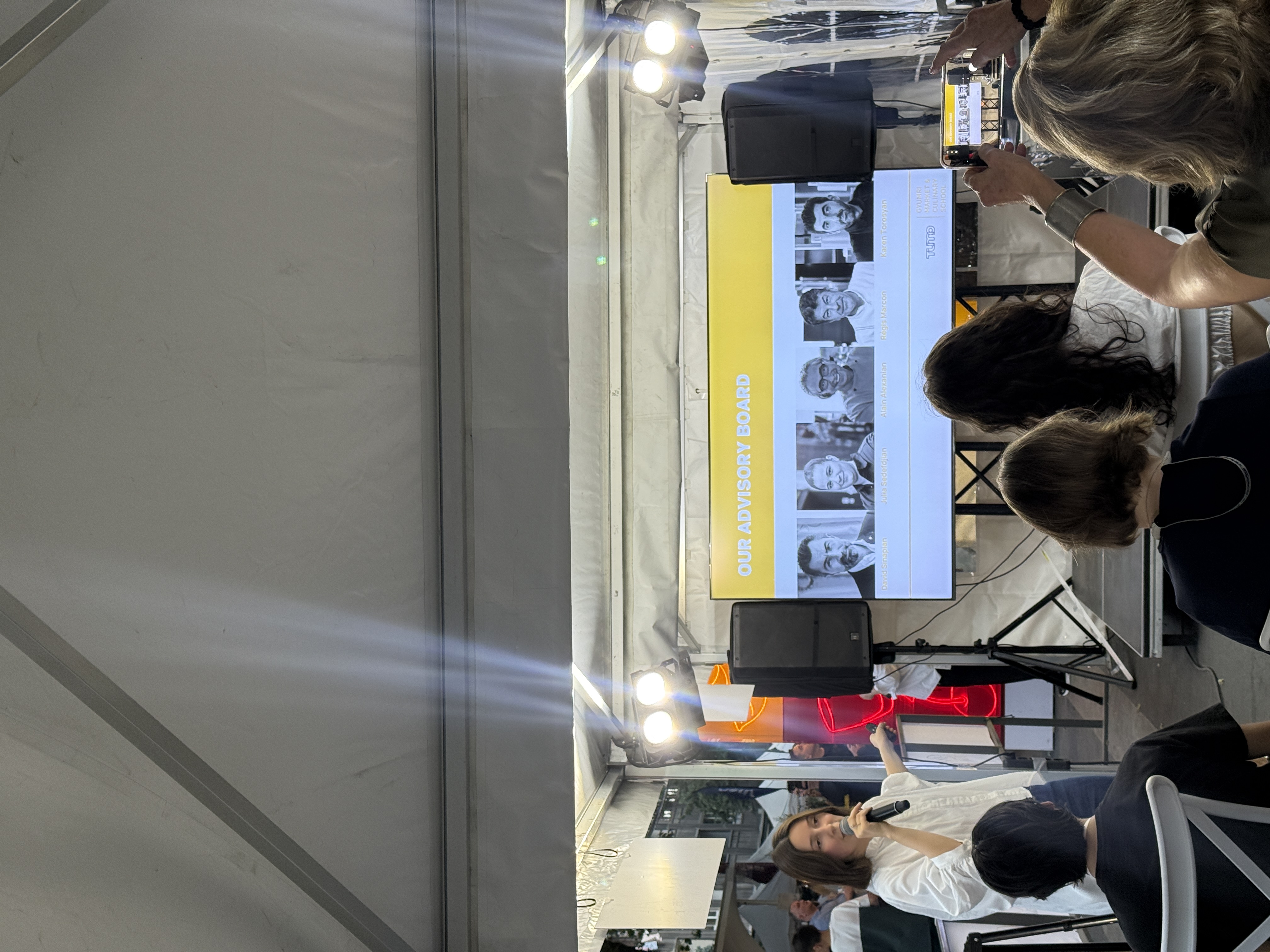
Kechichian listed the advisory board with visible pride. Five members, each with deep culinary and business credentials.
- David Sinapian: CEO of Groupe Pic, husband of Anne‑Sophie Pic (12 Michelin stars across her restaurants). He provides business and scaling expertise.
- Julia Sedefdjian: The youngest chef ever to receive a Michelin star (at age 18). French‑Armenian, dynamic, willing to help.
- Alain Alexanian: Lyon‑born Michelin star chef who closed his restaurant to focus on Armenian wild herbs. He now runs an artisanal tea company in Armenia. (He presented at Yerevan Wine Days the previous year.)
- Régis Marcon: A three‑Michelin‑star chef who helped develop the culinary curriculum for France’s Ministry of Education. Kechichian noted that his son is married to Alain Alexanian’s daughter — “basically we fished him” during a family vacation in Armenia.
- Karen Torosyan: Two‑Michelin‑star chef based in Brussels, born in Tbilisi, attached to his Armenian heritage.
This board advises on curriculum, market operations, and product sourcing.
VI. The Architecture: Upcycled Soviet Steel and an Open Garden
TUMO launched an international architectural competition. More than 150 firms submitted proposals from six continents. The jury included TUMO CEO Marie Lou Papazian, Spanish architect Iñaki Ábalos, Michelin chef Davy Tissot, art center figure Samia Yaba Christina Oshodi, and MIT’s Brent Ryan.
The winner was Aram Mooradian Studio, a London‑based firm that opened a dedicated Yerevan office for the project. Kechichian said the winning design was chosen because it rejected the idea of a monolithic mall. Instead, Mooradian proposed an ecosystem of smaller buildings around a public garden that will remain open to locals and tourists at all hours.
The construction materials are deliberately local and recycled:
- Upcycled steel from abandoned Soviet factories.
- Local tufa and basalt for the masonry.
Kechichian acknowledged the difficulty: “We’re realizing this is actually a difficult thing to do, but we want to stick to the concept.” The construction will be phased to minimize disruption to the current sidewalk vendors, who will be allowed to continue working during the build.
VII. The Funding: EU Grant and Self‑Sustaining Lease Model
In March 2024, the European Union signed a €2.5 million grant agreement with TUMO. The signatories were EU Ambassador Vassilis Maragos and TUMO CEO Marie Lou Papazian. The funds cover the capital costs of the market and school.
But the long‑term operational budget comes from lease revenue. Restaurants and shops will pay rent. Amateur cooking workshops will generate income. Kechichian noted that real estate values around the site have already begun rising simply because people know something is coming.
The school itself will remain free for students. That is non‑negotiable.
VIII. What TUMO Would Not Answer
Following the presentation, IRCNA submitted ten follow‑up questions to Hulé Kechichian, covering materials sourcing, economic impact projections, urban planning involvement, AI environmental effects, verification of the MIT and Institut Lyfe partnerships, and community engagement beyond the initial town hall. As of June 13, 2026, no response has been received.
This silence does not invalidate the project. But it does mean that certain details — particularly how TUMO plans to mitigate the environmental impact of its AI infrastructure, and the exact structure of community governance — remain unverified by independent journalism. Those gaps will be noted in any future reporting.
IX. The Rain and the Road Ahead
Kechichian ended her presentation with a practical joke. The downpour had not stopped. The audience was soaked, and the streets outside Saryan Street were flooding. She looked out at the captive crowd and said: “So now that we’ve all gathered and you cannot leave, do you have any questions?”
There were questions. About timelines (the school is expected to open in phases starting in 2027). About the vendors (they will have first priority for stalls in the new market). About the AI station (still in development, no release date). About the name of the French culinary partner (Institut Lyfe, confirmed via separate verification).
But the deepest question was unspoken: can a single building project reverse a half‑century of population decline?
The MIT study said yes — if it is the right kind of project. Bottom‑up, community‑anchored, economically self‑sustaining. TUMO’s bet is that a covered market, a free culinary school, and a smart kitchen station can generate the gravity that Gyumri has lacked since 1988.
The rain stopped eventually. The audience left Saryan Street. The vendors on Gyumri’s sidewalks will endure another winter of frozen produce and predatory loans. The construction has not yet begun. But the bet has been placed.
Sources
- Live presentation by Hulé Kechichian (Head of Special Projects, TUMO), Wine and Gastronomic Business Talks, Saryan Street, Yerevan Wine Days 2026 (June 6). Full transcript provided by IRCNA.
- Project description and architect announcement:
market.tumo.org(accessed June 13, 2026). Meta description confirms “catalyze economic, cultural and sustainable development… education, empowerment, a cooperative model, market space and tourism.” - EU grant: €2.5 million agreement signed March 2024 between EU Ambassador Vassilis Maragos and TUMO CEO Marie Lou Papazian, cited in EU Neighbours announcement (March 2024).
- Architectural competition: Aram Mooradian Studio selected from >150 submissions; jury included Brent Ryan (MIT), Iñaki Ábalos, Davy Tissot, Samia Yaba Christina Oshodi, and Marie Lou Papazian. Verified via market.tumo.org.
- Follow‑up inquiries: Ten questions submitted to Hulé Kechichian on June 7th, with a follow up on June 9th, 2026. No response as of June 13, 2026. This is noted transparently.
Comments