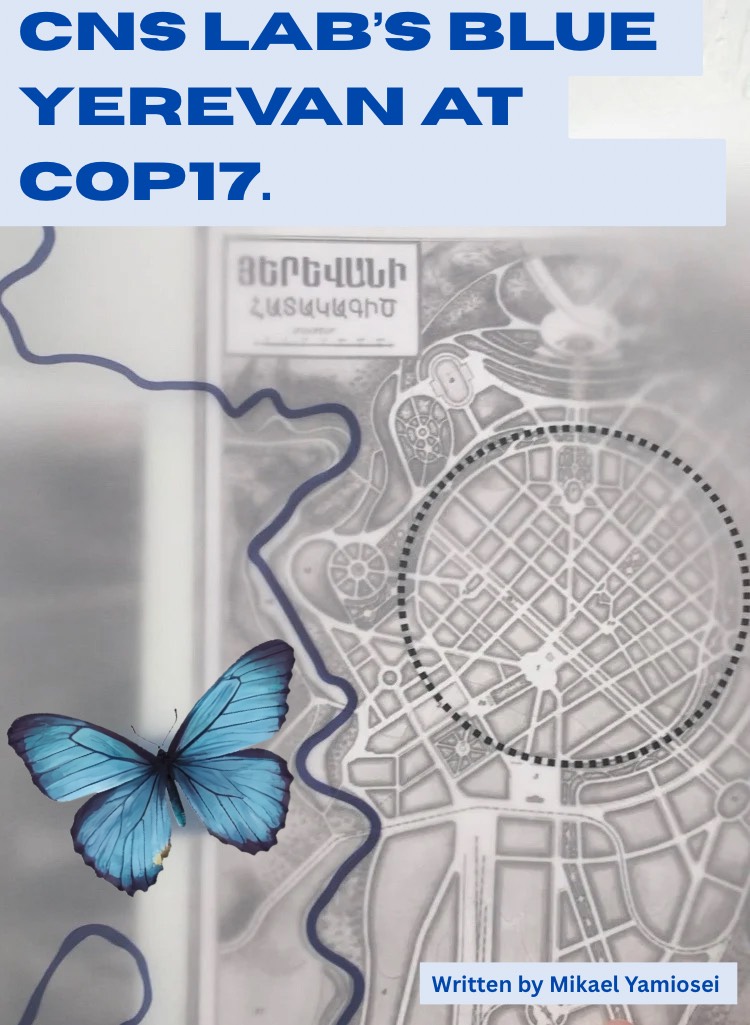
In the Green Zone – As international delegates, researchers, and civil society advocates gathered in Yerevan, Armenia, for the United Nations Convention on Biological Diversity COP17, global discussions frequently centered on macro-level conservation metrics, overarching biodiversity targets, and international environmental policy. Yet within the exhibition spaces of the Green Zone, the Cultural & Social Narratives Laboratory (CSN Lab) presented a deeply localized, human-scaled intervention titled “BLUE YEREVAN: Art-doc exhibition”.
Curated by Tigran Amiryan and Arsen Abrahamyan with art direction by Harutyun Tumaghyan, the exhibition directly interrogates the ecological and cultural transformation of Yerevan’s urban waters. By weaving together historical archival documents, Soviet-era architectural plans, oral histories, and contemporary visual art, Blue Yerevan demonstrates how rapid modernization, Soviet industrial planning, and post-Soviet privatization have systematically altered, buried, and erased the city’s natural and engineered aquatic heritage.
The Hydro-Poetics of a Vanishing Urban Landscape
The structural backbone of the exhibition unfolds through extensive wall panels and archival mappings that trace Yerevan’s historical relationship with water across distinct eras. The curatorial text established within the installation positions water not merely as a physical commodity, but as a dynamic medium of social memory, spatial ideology, and ecological coexistence:
“In an endlessly fragmented geography, water crosses barriers. It flows beyond state borders, political divides, urban fabrics, and architectural forms—connecting us, our pasts and futures, our communities, ecosystems, and landscapes.”
The narrative journey of the exhibition opens with an examination of Paradise Square, centering on Yerevan’s largest and most representative fountain complex located on Republic Square, formerly known as Lenin Square. Within the framework of Soviet urban planning, monumental fountains functioned as vital elements of urban iconography and spatial imagination, projecting concepts of abundance, public order, and communal harmony. Their immediate proximity to central state institutions underscored how water architecture was deployed as an active instrument of spatial ideology. Over subsequent decades, however, many of these monumental fountain complexes were dismantled, privatized, or entirely disconnected from the living urban fabric.
Expanding on monumental designs, the exhibition transitions into Small Architectural Forms of Spatial Imagination, exploring how Soviet modernist architects in Yerevan developed diverse formal solutions—such as basins shaped like flower petals, organic biomorphic volumes, elevated platforms, and cascading compositions. These structures operated as active agents of scenography and spatial design, providing essential microclimatic cooling within a city characterized by a sharply continental climate featuring hot, dry summers.
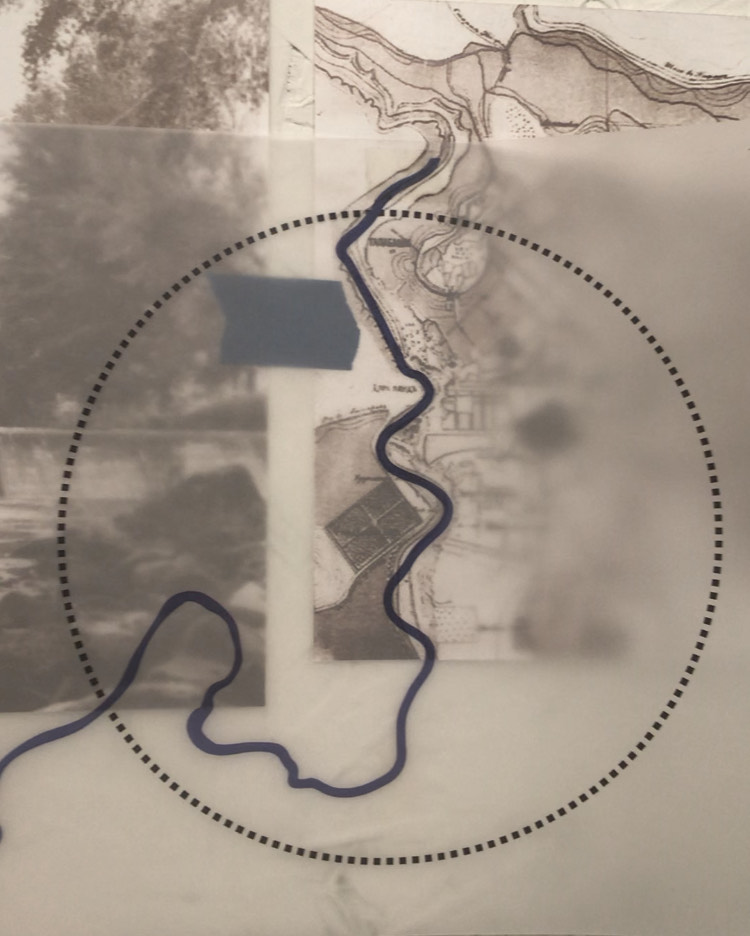
The spatial history of Yerevan is further unraveled through the panel Following the Water, which examines master plans proposing a continuous “green-blue axis” along Main Avenue. Intended to link the Circular Park to the Hrazdan Gorge through tunnels and landscaped water zones, this vision was partially implemented through the efforts of architect Armen Zaryan before being progressively disrupted by late-Soviet and post-Soviet urban fragmentation.
Parallel to this spatial planning is the history of the Getar River, detailed under River – Network in the Network and River – History. Archival research and oral testimonies trace how the Getar’s natural flow through the city was altered by canalization, covering, and structuring into a simplified drainage system. Historical documents record catastrophic events, such as the large-scale flood of May 1946, which served as a catalyst for systematic structural control. Alongside structural engineering records, the exhibition preserves personal neighborhood memories of wooden bridges, private gardens, and local legends.
The narrative extends deeply into the socio-ecological life of public water spaces under Water Bodies, Yerevan’s Blue Utopia, The Constructed Sea, and The Archive of Energy. Built between 1965 and 1967 on the Hrazdan River, Yerevan Lake was engineered to regulate water flow and establish a recreational maritime identity for the landlocked city. Despite initial features like boating stations, swimming zones, and active public life, the lake ultimately suffered from severe pollution and ecological decline. Similarly, Soviet swimming pools and public baths once served as vital infrastructure for hygiene, leisure, and state-sanctioned physical culture, but post-Soviet economic shifts led to their privatization, abandonment, or commercial enclosure. In the Hrazdan Gorge, the Yerevan Children’s Railway, built in the 1930s, symbolized the triumph of industrialization as a utopian childhood dream before slipping into a zone of uncertainty after the collapse of the Soviet system.
Bridging Memory and Form: Contemporary Artistic Interventions
IMG_0004 By Mikael Yamiose/IRCNA
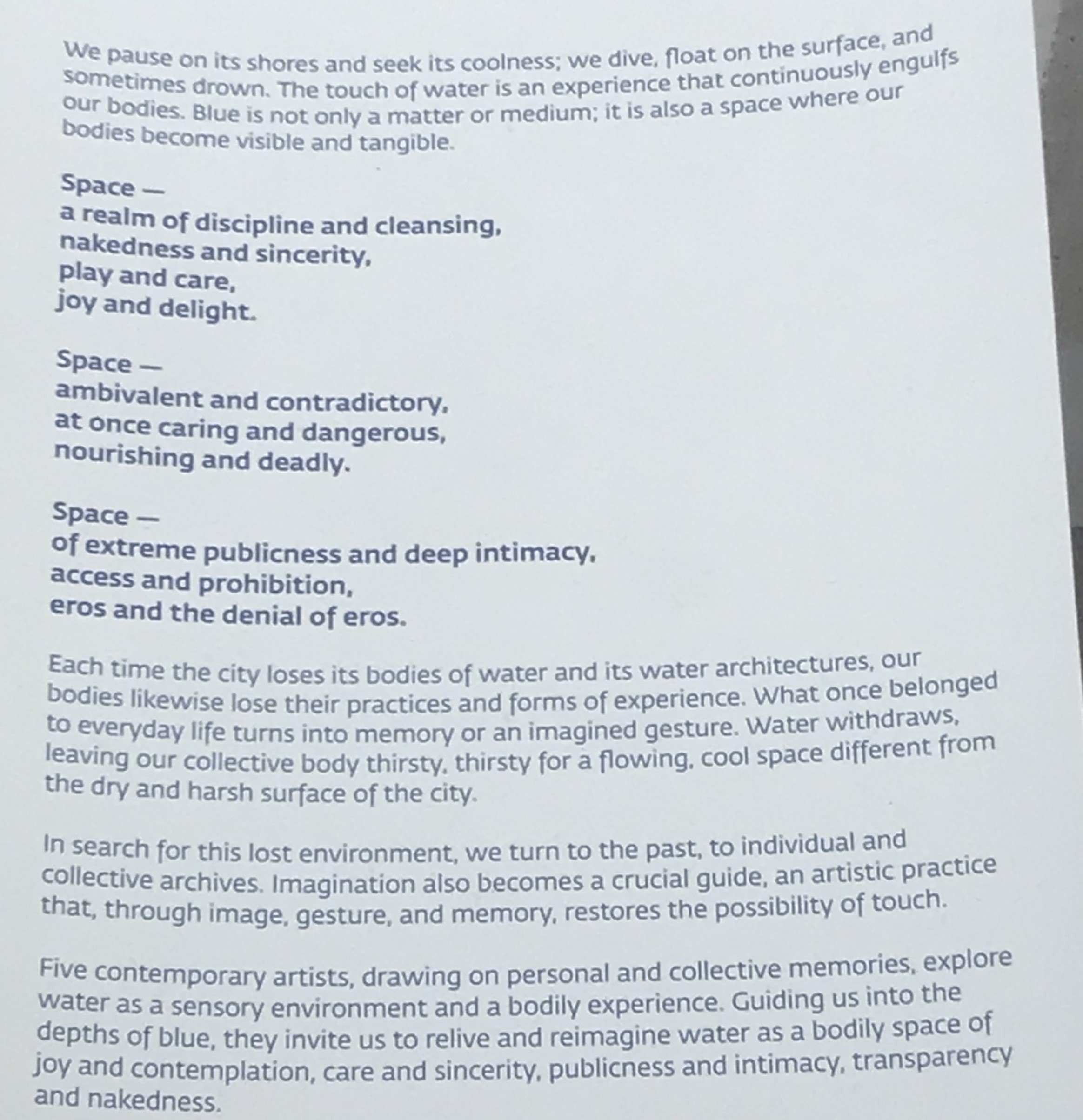
To bridge the gap between archival fact and subjective experience, the exhibition incorporates dedicated showcases of contemporary artwork positioned alongside the central curatorial statement titled Immersed. The text notes that “each time the city loses its bodies of water and its water architectures, our bodies likewise lose their practices and forms of experience,” emphasizing that artistic practice restores the possibility of touch and memory.
IMG_0011 By Mikael Yamiose/IRCNA
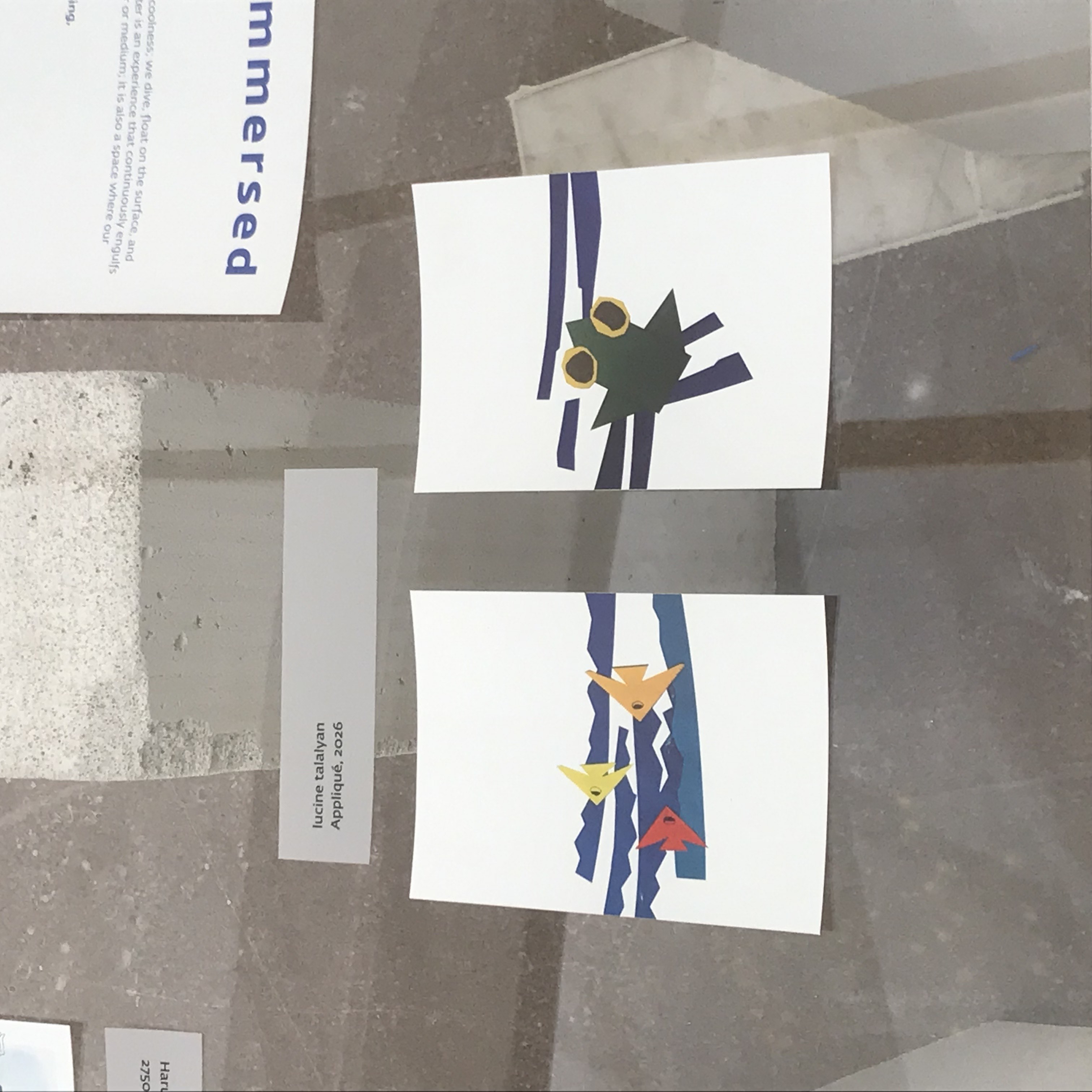
Working within this conceptual space, Lucine Talalyan’s Appliqué (2026) utilizes minimalist paper cut-out collage works to evoke lost aquatic ecosystems. One composition displays three vibrant fish—colored red, yellow, and orange—swimming across layered blue water bands, while another features a stylized green frog with prominent yellow-rimmed eyes submerged in deep blue geometric channels. Talalyan’s work invokes the tactile presence of aquatic fauna that once inhabited Yerevan’s open streams and gorges, offering a playful yet poignant reminder of lost biodiversity.
IMG_0005 By Mikael Yamiose/IRCNA
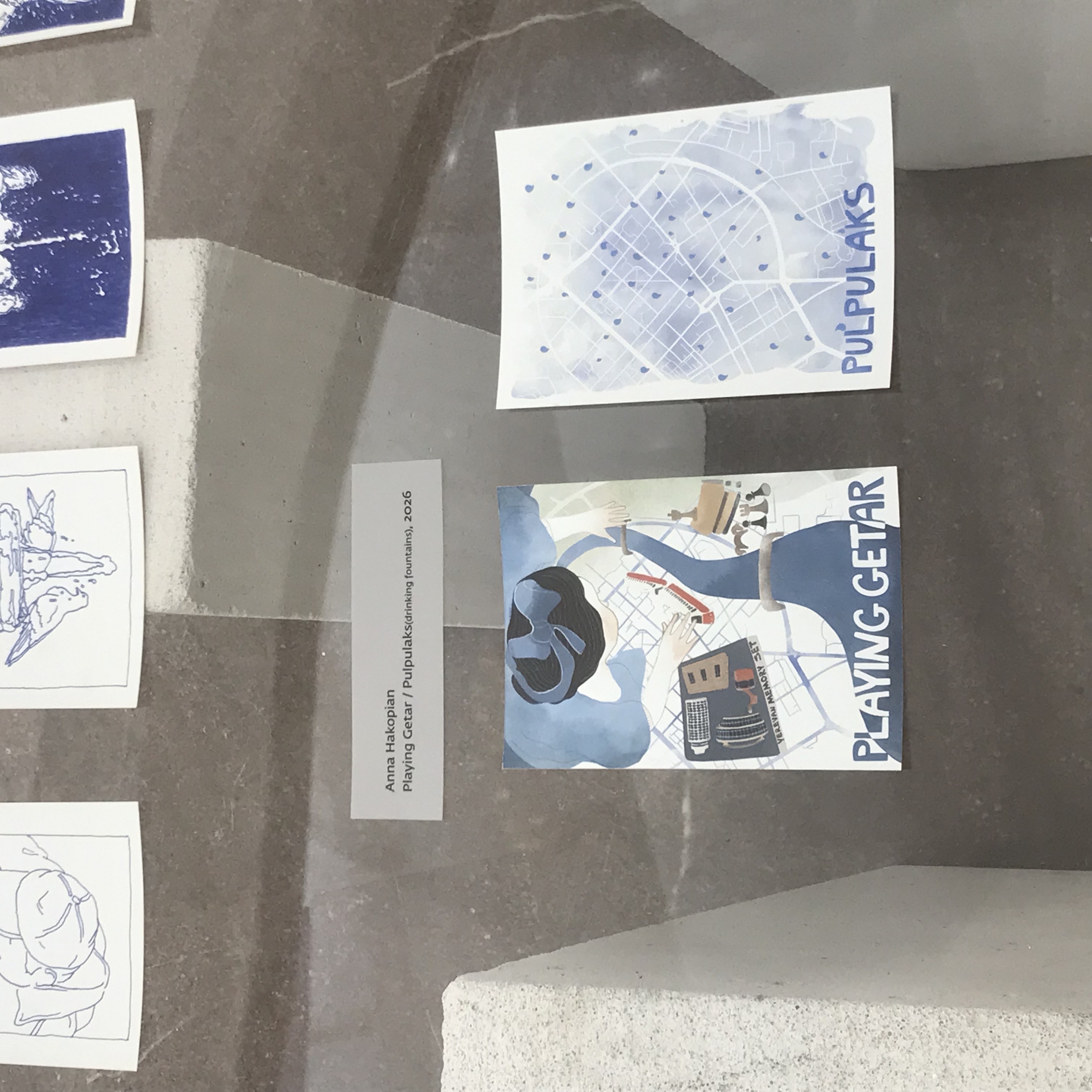
Anna Hakopian’s Playing Getar / Pulpulaks (drinking fountains) (2026) explores the intersection of civic infrastructure and collective memory through mixed media and graphic print works. Playing Getar superimposes a winding blue river across urban maps alongside cultural objects including chess pieces and a cassette tape labeled “Yerevan Memory Set,” while Pulpulaks maps the city’s extensive network of public drinking fountains as blue water drop nodes distributed across a street grid. Through these works, Hakopian demonstrates how public drinking fountains and hidden river networks structure everyday urban life.
IMG_0006 & IMG_0007 By Mikael Yamiose/IRCNA
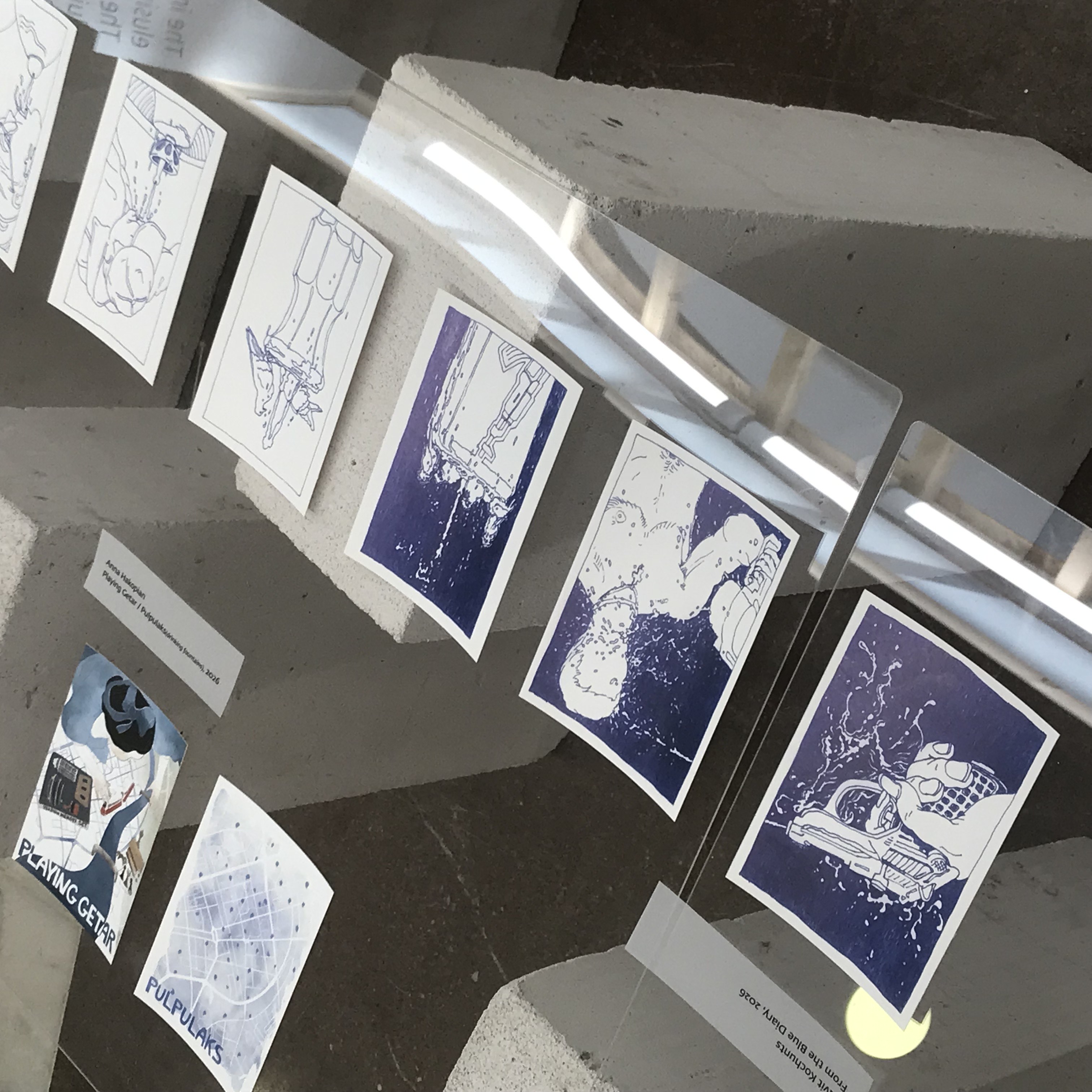
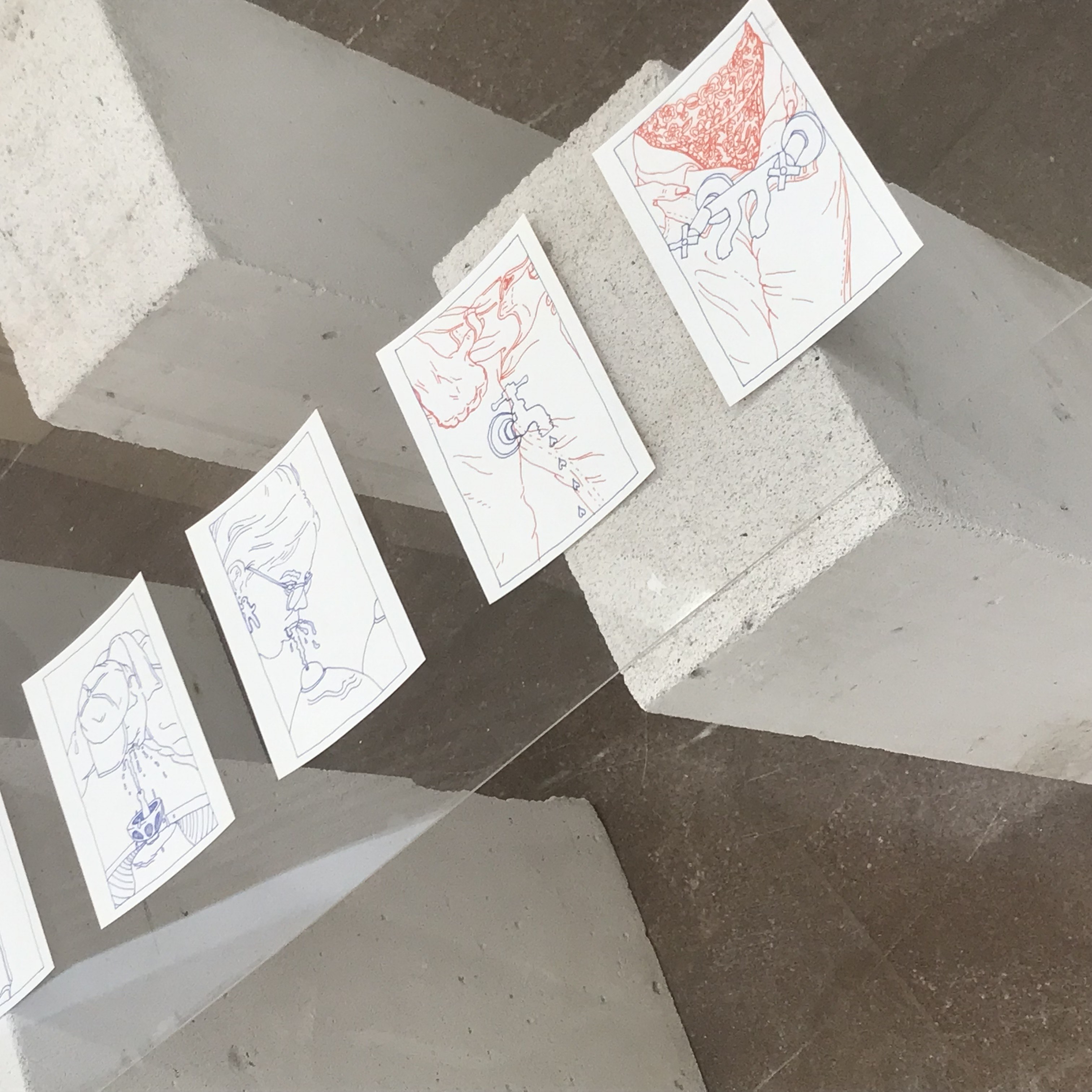
Davit Kochunts’ From the Blue Diary (2026) investigates the intimate, tactile dimension of daily water engagement through a series of blue-toned prints and monochromatic line illustrations. The series depicts personal moments of cleansing and touch, including a hand operating a spray nozzle generating water splashes, structural studies of fountains surmounted by birds, and line drawings capturing individuals engaged with public water outlets.
IMG_0010 By Mikael Yamiose/IRCNA
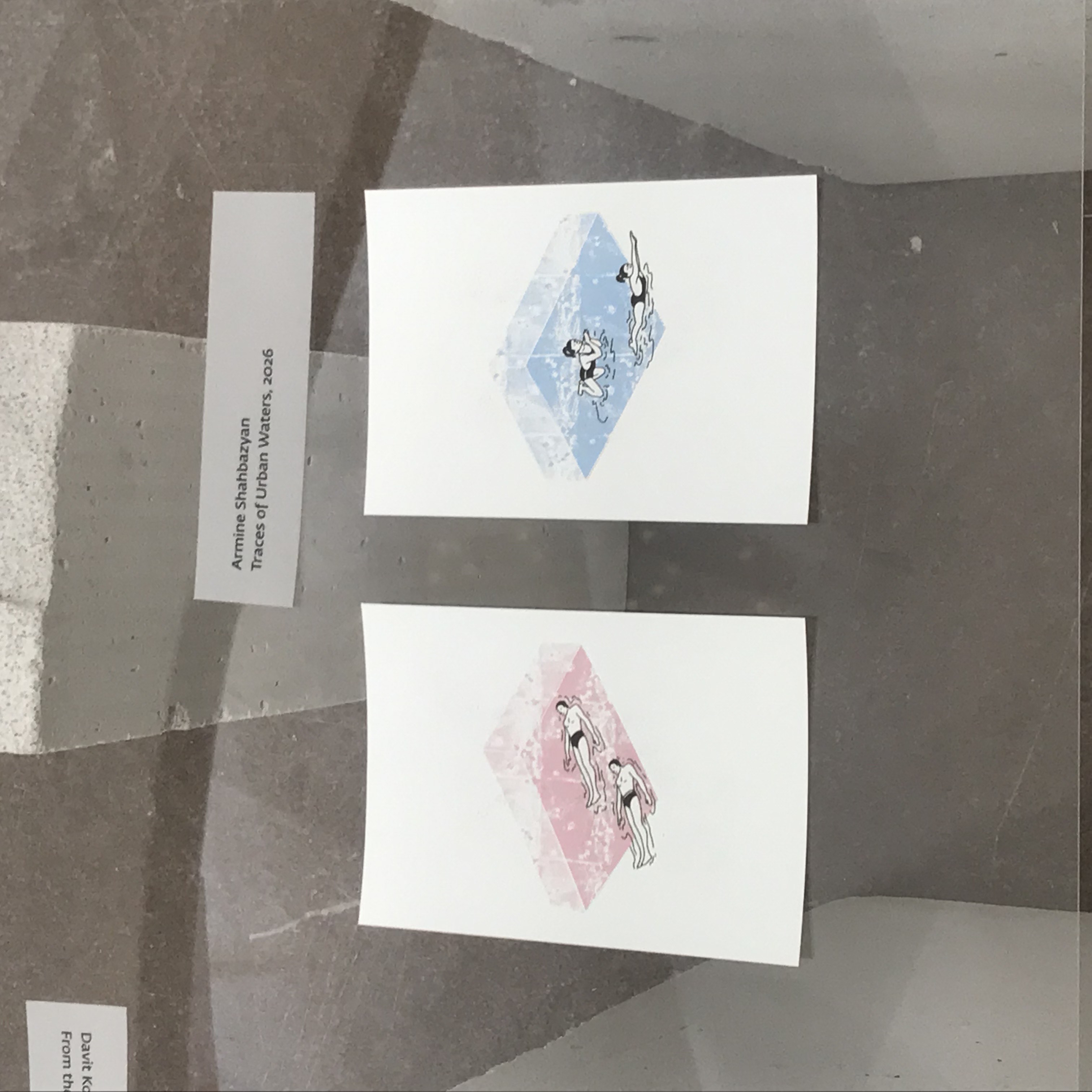
Armine Shahbazyan’s Traces of Urban Waters (2026) captures the sensory memory of public swimming spaces through dual print works illustrating figures floating and swimming within isometric, diamond-shaped volumetric pools of water. One print portrays figures resting on a pink-tinted water plane, while the second displays swimmers moving through a light blue aquatic basin, framing water as a geometric sanctuary of weightlessness, leisure, and bodily freedom.
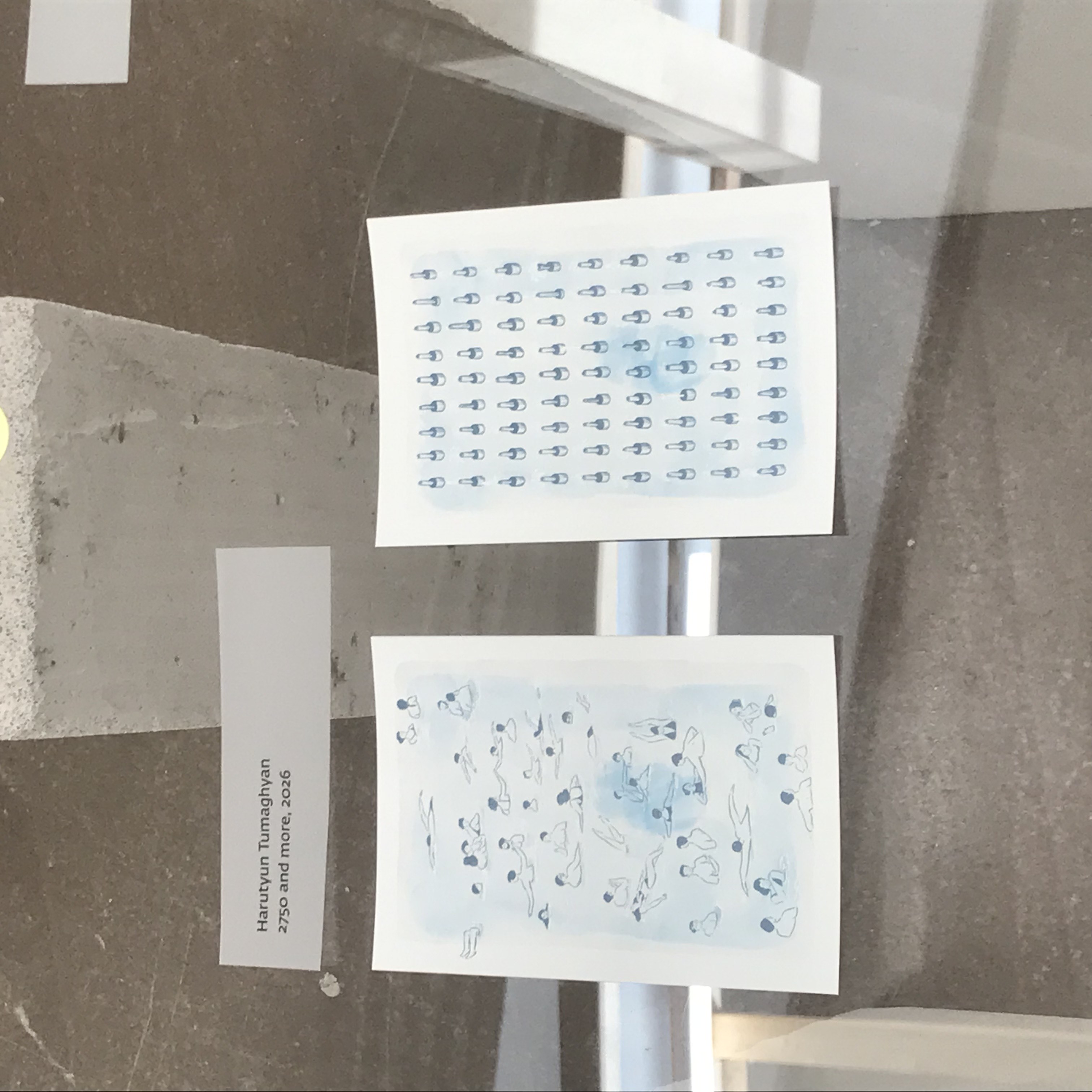
IMG_0012 By Mikael Yamiose/IRCNA
Finally, Harutyun Tumaghyan’s 2750 and more (2026) contrasts the monumental scale of public water celebrations—such as fountains built for Yerevan’s historical anniversaries—with the modest, egalitarian act of communal drinking fountains distributed across the urban landscape. The project comprises two complementary works on paper: the first presents a fluid blue line illustration of a crowd swimming and wading together in a shared pool, while the second features a structured grid array of individual drinking fountain (pulpulak) spouts emitting tiny blue water drops.
Connecting Blue Yerevan to the COP17 Biodiversity Agenda
Presenting Blue Yerevan within the Green Zone of COP17 establishes a vital dialogue between international environmental governance and localized cultural practice. While global biodiversity frameworks frequently concentrate on remote ecosystems and protected reserves, data from the exhibition underscores that urban environments are also vital ecological niches where piping rivers, sealing wetlands, and destroying water basins disrupts microclimates and fragments urban biodiversity.
Furthermore, while ecological engineering focuses on physical daylighting—the act of exposing buried streams—CSN Lab’s exhibition asserts that cultural daylighting—reviving forgotten waterways within community memory, oral history, and artistic practice—is a necessary precondition for successful ecological restoration. Environmental policy often reduces urban water to a mechanical metric of utility or sanitation, but by pairing historical archives of community swimming and fishing with contemporary art, Blue Yerevan advocates for treating urban water as an integrated social, ecological, and cultural commons.
Exhibition Credits
- Exhibition Title: BLUE YEREVAN: Art-doc exhibition
- Organizer: Cultural & Social Narratives Laboratory (CSN Lab)
- Venue & Context: UN CBD COP17 Green Zone, Yerevan, Armenia
- Curators & Authors: Tigran Amiryan, Arsen Abrahamyan
- Art Director: Harutyun Tumaghyan
- Research Team: Hourig Attarian, Davit Yeremyan, Inessa Sahakyan, OHM Team
- Participating Artists: Anna Hakopian, Armine Shahbazyan, Davit Kochunts, Lucine Talalyan, Harutyun Tumaghyan
- Graphic Design: Klim Gretchnka
Sources
- Video Documentation File: Primary on-site video walkthrough (which can be found here: https://youtube.com/shorts/HzCZ1OcowSM?feature=share ) capturing exhibition wall texts, curatorial statements, archival photographs, architectural maps, and spatial layouts of the Blue Yerevan exhibition. Taken by Mikael Yamiosei for IRCNA
- Visual Documentation & Exhibition Photography: Primary still photography files taken by Mikael Yamiosei; documenting individual artwork installations, artist credit labels, and vitrine displays:
- IMG_0004.jpg – Curatorial statement panel detailing the Immersed thematic framework.
- IMG_0005.jpg – Artwork display and credit label for Anna Hakopian’s Playing Getar / Pulpulaks (drinking fountains) (2026).
- IMG_0006.jpg /IMG_0007.jpg – Vitrine layout displaying Davit Kochunts’ From the Blue Diary series (2026) alongside neighboring artist works.
- IMG_0010.jpg – Artwork display and credit label for Armine Shahbazyan’s Traces of Urban Waters (2026).
- IMG_0011.jpg – Artwork display and credit label for Lucine Talalyan’s Appliqué (2026).
- IMG_0012.jpg – Artwork display and credit label for Harutyun Tumaghyan’s 2750 and more (2026).
Comments